
Agentic AI could turn patents from static documents into active assets that monitor markets, update their value, and find licensing partners on their own.
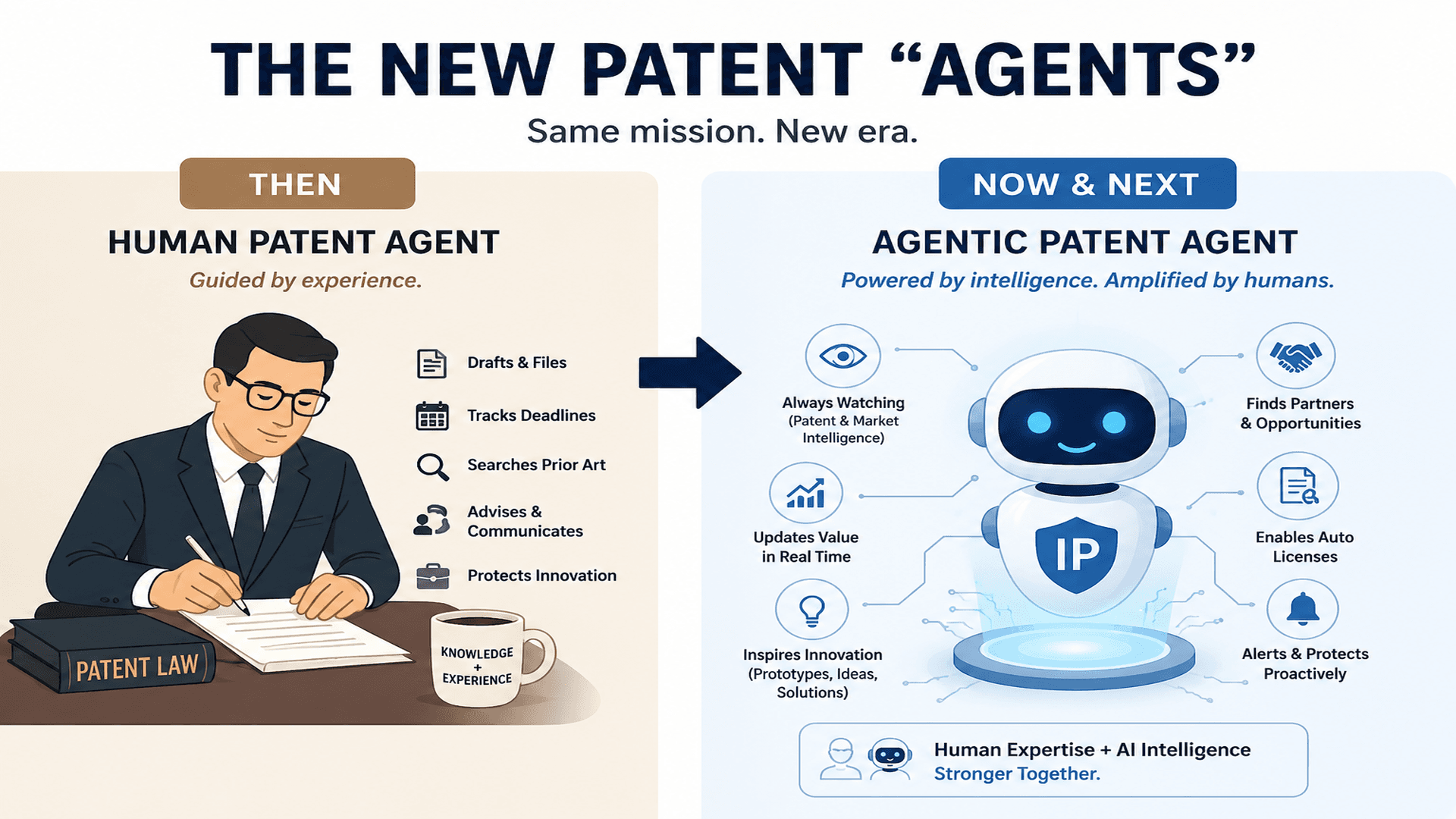
For decades, the term “patent agent” referred to a highly skilled professional helping inventors navigate the intellectual property system. Patent agents and attorneys have long served as the connective tissue between innovation, legal protection, commercialization, and strategy. They help ideas move from imagination into protected economic assets. Patent agents could do most of the things a patent attorney could do (except writing licensing contracts) and where much lower costs, but maybe, in the world of Agentic AI, A patent “agent” (and AI robot) could do so much more, and a much lower cost. Tongue and cheek here, an idea for the new Patent “Agent” has come!
As agentic AI systems emerge, the meaning of the word “agent” may itself begin to evolve.
We may be entering the era of the new Patent “Agents.”
Not human replacements, but intelligent AI-driven systems designed to work alongside inventors, patent agents (the old ones), attorneys, licensing teams, and corporations to help patents become more active participants in commerce. Historically, patents have behaved like static legal documents. They were drafted, filed, prosecuted, issued, and then often stored in databases where they remained largely dormant unless litigation, licensing, or enforcement activity occurred. The patent itself was passive, while humans performed the active work around it.
Agentic AI changes that model entirely. In the near future, patents may become connected to intelligent systems capable of continuously monitoring technological, legal, and commercial environments in real time. Instead of quarterly portfolio reviews or periodic competitive analysis, AI-driven patent agents may autonomously watch newly published applications, technical papers, startup funding announcements, standards bodies, product launches, GitHub repositories, and manufacturing trends.
The patent becomes continuously aware of its surrounding ecosystem. This creates an entirely new layer of intellectual property infrastructure. A patent may soon have the ability to continuously update its estimated economic value based on market adoption, licensing demand, industry movement, litigation trends, and adjacent patent activity. Rather than static valuation reports prepared every few years, portfolios may eventually carry dynamic AI-generated valuation models operating in real time. Just like you might put “calls” or “options” on real time stock assets, the same could be true for intellectual property assets!
What would a live read on your patent’s value show? Run a quick value screen with our patent valuation calculator, then explore monetization support when you are ready to act.
Even more fascinating is the possibility that patents themselves become executable inputs into innovation systems. A future AI platform may ingest a patent specification and generate prototype architectures, CAD designs, software frameworks, manufacturing pathways, technical simulations, and commercialization strategies. The patent stops being merely a historical record of an invention and becomes an operational starting point for future product development.
Commercialization may also evolve dramatically. AI-driven patent agents could continuously search for strategic partners, manufacturers, investors, distributors, and licensing candidates whose business activities align with specific patent assets. Instead of waiting for introductions or conferences, patents may proactively surface opportunities for collaboration and monetization. Maybe your patent could read the technical literature and write a new patent including itself as an enhancements – did I just say that, weird, huh, patents wanting to get credit.
Licensing itself could become far more fluid. Agentic systems may someday create automated “microlicenses,” enabling temporary or limited-use IP rights negotiated autonomously between AI systems. Intellectual property may eventually move with the speed and flexibility of cloud infrastructure or APIs rather than traditional multi-month licensing negotiations. One particularly interesting future category may involve what I call “EOU Chasers,” referring to AI systems that continuously search for Evidence of Use across products, software, APIs, technical manuals, videos, source code repositories, and manufacturing systems. These systems could help patent professionals identify commercialization opportunities, partnership targets, or potential infringement indicators at scales never before possible.
Another possibility is the emergence of semi-autonomous patent ecosystems. Future AI-driven patent agents may recommend continuation filings, generate related defensive publications, identify adjacent trade secret opportunities, cluster complementary patent groups, and even help build commercialization roadmaps around entire innovation families.
At that point, patents begin acting less like static documents and more like living economic assets. Importantly, this future does not reduce the importance of patent professionals. In many ways, it increases it. Human judgment, legal expertise, negotiation strategy, ethics, creativity, and client trust become even more valuable when paired with intelligent systems operating at machine scale. The role evolves from manually managing information to strategically orchestrating highly capable AI-driven patent ecosystems.
The original patent agents helped inventions move through legal systems.
The new Patent “Agents” may help inventions move through economies. That shift may fundamentally redefine how intellectual property is created, valued, protected, commercialized, and ultimately brought into the world. The future of patents may not simply be smarter documents.
They may become active participants in innovation itself.
Work with ipCapital Group
From invention to monetization, our team has guided 2,000+ engagements across the full IP lifecycle. Start with a free 30-minute discovery call.

Written by
John Cronin