
EDI exception handling is the real agentic AI opening in B2B software. The patent white space around autonomous document intelligence is still open.
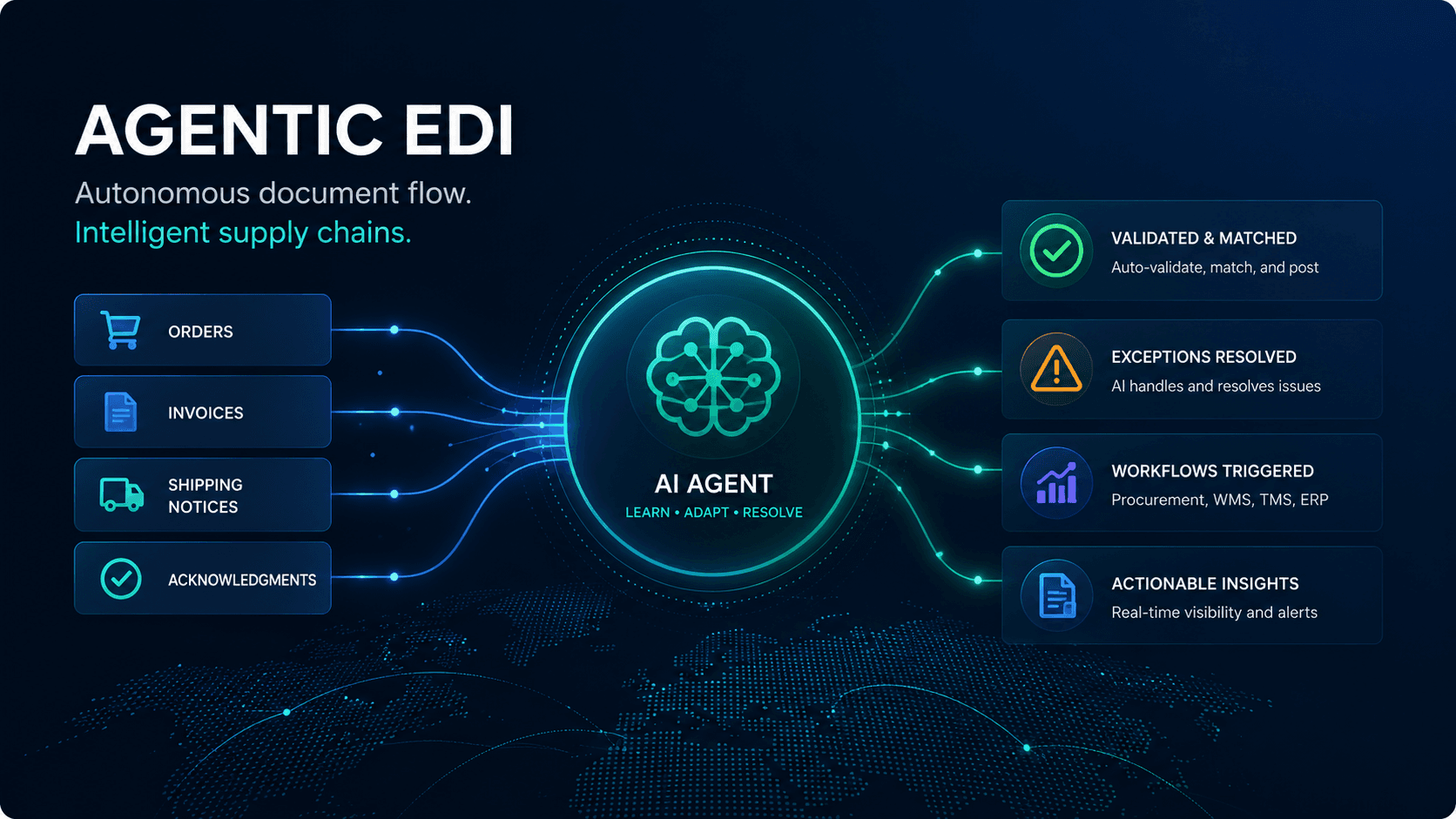
EDI is not glamorous software. That is why it is interesting right now.
For decades, electronic data interchange has quietly moved the global economy.
Purchase orders, invoices, shipping notices, acknowledgments, and payment-related documents still pass through systems most executives only notice when a shipment, invoice, or chargeback goes sideways.
The opening is no longer just cleaner document movement. It is the judgment layer around the messy cases: which partner rule applies, which field broke the transaction, which system needs to be updated, and whether the platform can fix it without waiting for a human queue.
This is where agentic AI becomes useful in supply-chain software: not as a demo assistant, but as exception-handling infrastructure.
Traditional EDI solved connectivity. It allowed companies, suppliers, retailers, logistics partners, and financial systems to exchange structured documents at scale.
But connectivity alone does not eliminate friction. Trading partner requirements differ. Exceptions pile up. Chargebacks occur. Onboarding takes too long. Human operators still interpret failures, correct mappings, chase partners, and coordinate across ERP, WMS, TMS, and procurement systems.
The better platforms will not simply transmit documents. They will interpret document flow, detect exceptions, learn partner-specific rules, select corrective actions, and orchestrate responses across enterprise systems.
Large enterprise software companies have built meaningful patent positions in procurement automation, invoice processing, and adjacent AI workflows. But the specific intersection of autonomous AI agents and EDI document flow remains comparatively underdeveloped.
That gap creates an important strategic window. In mature software markets, the white space often appears not in the main category but at the boundary between categories: EDI plus AI agents, procurement plus autonomous exception handling, B2B integration plus self-learning partner onboarding.

EDI exceptions are not just technical defects. They become operational delays, chargebacks, missed shipments, inventory errors, partner disputes, and manual labor.
An agentic EDI system changes the operating model. Instead of waiting for people to diagnose failures, the system can identify the issue, infer the trading partner requirement, recommend or execute a correction, and learn from the outcome.
That creates a new category: autonomous B2B document intelligence.
Building in the agentic EDI window? A facilitated ipScan invention session can surface the exception-handling inventions already inside your platform, and ipCG can help you claim them before the window closes.
Procurement, invoice automation, and enterprise workflow players are already building patent portfolios. That means the agentic EDI window will not remain open indefinitely.

The strongest opportunities sit where EDI infrastructure becomes self-learning, partner-aware, and connected to downstream enterprise systems.
For many years, the moat in supply-chain software was connectivity: how many systems, partners, document types, and workflows a platform could support.
The moat will be learning. Which platform knows the partner’s rule? Which platform predicts the exception? Which platform resolves the defect before the chargeback? Which platform can coordinate across multiple enterprise systems without waiting for a human operator?
That shift turns EDI from a document rail into an intelligent transaction layer.
The same transition is happening across enterprise software. Static workflows are becoming adaptive. Automation scripts are becoming agents. Integration platforms are becoming orchestration engines.
Procurement, logistics, finance, healthcare claims, insurance, manufacturing, and retail operations all face the same problem: structured documents move through brittle workflows, and exceptions require human intervention.
The companies that learn those exceptions fastest may become the enterprise automation leaders customers actually depend on.
The most valuable supply-chain platforms of the coming decade may not simply move documents faster. They may make document networks self-correcting.
That creates opportunities for new products, new licensing models, new platform positions, and new intellectual property around the agentic layer of enterprise transaction flow.
As enterprise automation matures, the visible workflow becomes less defensible. The strategic layer becomes the system that interprets exceptions, selects actions, learns partner behavior, and coordinates across the enterprise.
The companies that recognize this shift early can build IP positions around the infrastructure competitors will later need to copy, license, or work around.
If your organization is building AI agents, EDI tools, procurement workflows, B2B integration systems, or transaction automation platforms, there may be hidden innovation assets already inside the business. The most valuable opportunities are often not the integrations customers see, they are the intelligence layers quietly turning broken transactions into resolved outcomes.
Work with ipCapital Group
From invention to monetization, our team has guided 2,000+ engagements across the full IP lifecycle. Start with a free 30-minute discovery call.

Written by
John Cronin