
AI-driven materials discovery is shifting energy-storage IP from university labs to fast-moving startups. The patent data already shows startups leading.
AI-driven materials discovery may shift energy storage IP from university labs to small companies faster than most people expect.
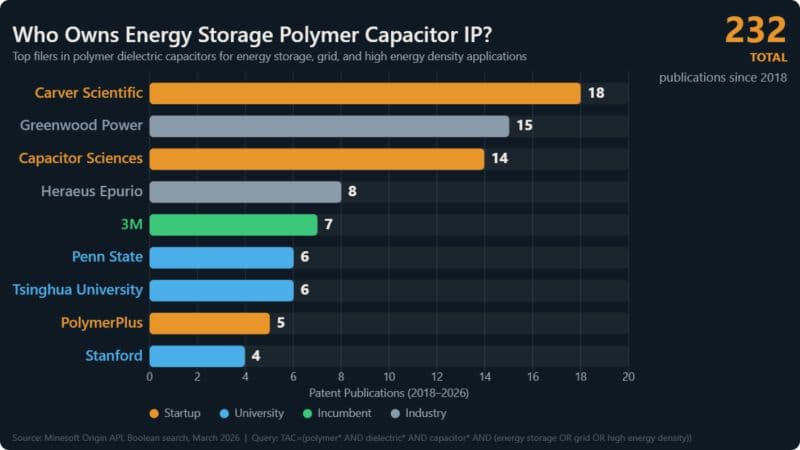
Penn State just published a polymer blend capacitor in Nature that stores four times the energy of conventional devices and operates at 250°C. It is a genuine breakthrough, and it took a full university research program to get there. The patent filings tell a different story about who owns this space: only 232 publications mention polymer dielectric capacitors for energy storage since 2018, and startups like Carver Scientific and Capacitor Sciences hold the top positions, not universities.
Agentic AI platforms can screen thousands of candidate material compositions and predict performance before a single sample is fabricated. A small company with an AI-driven research pipeline and minimal lab access can cover ground that used to require years of university bench work. We have seen this firsthand: using AI models combined with a fraction of the typical university involvement, we helped a client develop a set of materials that were remarkably unique.
The patent data already shows startups leading universities in this niche. As AI research tools mature, and especially as quantum computing accelerates molecular simulation, that gap will widen.

The IP in advanced materials is shifting toward smaller, faster-moving companies that invest in AI-driven discovery rather than traditional lab programs.
Could an AI-driven discovery program put your company ahead of the university labs in your field? Talk to ipCapital Group about building and protecting IP from AI-driven research.
Work with ipCapital Group
From invention to monetization, our team has guided 2,000+ engagements across the full IP lifecycle. Start with a free 30-minute discovery call.

Written by
John Cronin