AI Runs on Electrons: The Patent Race Reshaping On-Site Power
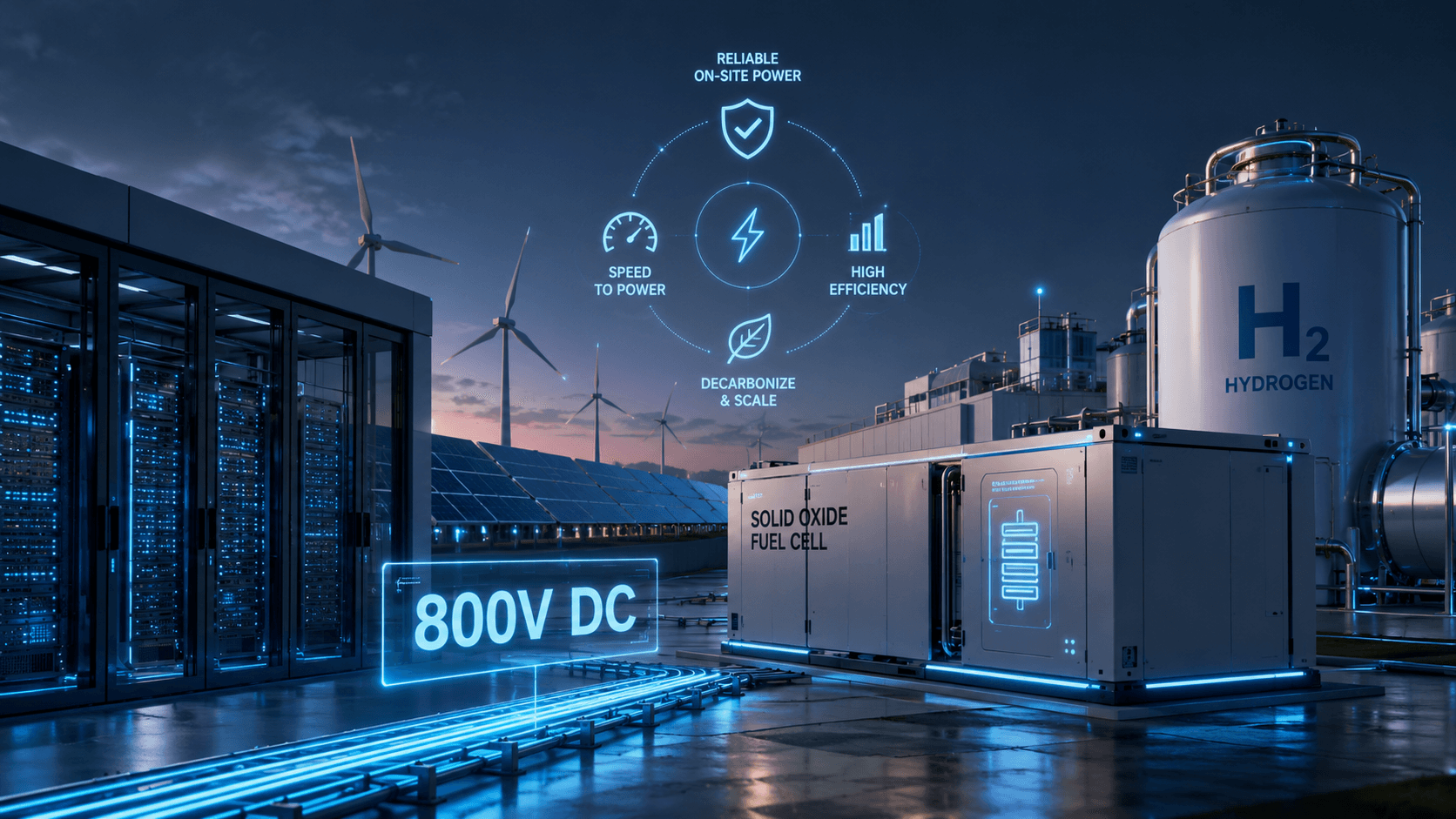
A 45% surge in solid oxide filings is closing the window on 800V DC data center power, speed-to-power deployment, and high-efficiency electrolyzers.
A 45% surge in solid oxide innovation is closing the window for 800V DC data center power, speed-to-power deployment, and high-efficiency electrolyzers. Here is where the white space sits, and how to turn it into product and IP advantage.
Market Shift: AI Infrastructure Stops Waiting for the Grid
Power-hungry data centers and industrial loads are moving to on-site generation that delivers 800V DC directly to compute racks, cuts 10% to 15% of AC-to-DC conversion losses, and can be commissioned in weeks rather than years.
At the same time, solid oxide electrolyzers are turning waste heat into an efficiency weapon, reaching around 80% electrical-to-hydrogen conversion when integrated with high-temperature processes. The competitive edge is shifting from megawatts procured to electrons architected.
45% acceleration: SOFC patent publications rose from 904 in 2021 to 1,310 in 2025.
6,934 patents since 2020: a large but highly fragmented field.
13.1% top-three share: roughly 87% of the space remains unclaimed.
800V DC delivery: eliminates 10% to 15% of AC-to-DC conversion losses.
About 80% efficiency: SOEC electrical-to-hydrogen conversion using waste heat.
55 days to deploy: against grid interconnection queues of 5 to 7 years.
Evidence: Filing Activity Is Accelerating
After a dip that bottomed out in 2021, solid oxide fuel cell publications have climbed every year but one, reaching a nine-year high in 2025. The acceleration lines up with data center and hydrogen build-out cycles.
SOFC publications fell to 904 in 2021 and recovered to 1,310 by 2025, a 45% rise.
Evidence: Fragmented Control Means White Space
The economics of on-site power are consolidating faster than the patent landscape is. The three largest holders control only 13.1% of recent filings, and power systems integration remains thin at 292 filings against 4,884 for core electrochemistry. That gap between where the market is heading and where the claims sit is the opportunity.
Nobody has consolidated this field. The top three holders account for just 909 of 6,934 patents.
Opportunity: Value Concentrates in Interfaces and Methods
When a market sprints from AC grid dependence to on-premise DC architectures, value concentrates in interfaces, methods, and integration know-how. Three areas now offer outsized return for both product leadership and protectable IP.
1. 800V DC Data Center Architecture
What: direct DC power delivery to GPU racks and power-dense compute, eliminating 10% to 15% AC-to-DC losses and large swaths of legacy conversion hardware.
Why it matters: lower capex and opex per teraflop, higher uptime, simplified fault domains, and faster capacity adds.
What to build: rack-level DC busbars, fault-tolerant DC protection, hot-swap DC PDU designs, SOFC and UPS co-control for ride-through, and DC-native safety monitoring.
Strategic IP: system-level coupling of SOFC stack output to 800V rack rails, methods for dynamic DC voltage shaping, and conversion-free GPU farm interconnects (CPC H02J and H01M8).
2. Speed-to-Power Deployment Methods
What: repeatable, pre-engineered deployment enabling on-site generation to go live in about 55 days, against grid interconnection queues of 5 to 7 years.
Why it matters: time is the new IRR. Shaving years from power availability wins AI workloads, site leases, and customer contracts.
What to build: site templates, factory-tested modules, standardized commissioning and QA telemetry, and containerized thermal and balance-of-plant systems.
Strategic IP: method claims for site configuration, commissioning sequences, and digital twin sign-off gates that achieve days-to-power at scale (CPC H01M8 and E04H).
3. SOEC Green Hydrogen With Waste-Heat Integration
What: high-temperature electrolysis integrated with industrial heat to reach roughly 80% electrical-to-hydrogen efficiency.
Why it matters: lower levelized cost of hydrogen and better asset utilization for refineries, chemicals, steel, and seasonal energy storage.
What to build: heat-sharing manifolds, stack-safe thermal transients, and hybrid power-to-hydrogen modes with optimal dispatch.
Strategic IP: heat-assisted electrolysis control loops, dynamic switch-over regimes, and degradation-aware setpoints (CPC C25B1 and C25B9).
One caution: electrolysis is already a crowded arena, with 1,027 recent C25B patents. Timing matters here more than in the other two areas.
Product and IP Implications
In fragmented, fast-moving landscapes, the most defensible positions are often not the core cell chemistry. They are the system architectures and methods competitors need to copy in order to match outcomes.
Codify the architecture: treat the DC interface, protection scheme, and rack coupling as a product with its own roadmap and claims, not a wiring detail.
File the playbook: if a 55-day deployment is repeatable, it is patentable as a method family. Document the steps, test criteria, pre-fabrication boundaries, and digital sign-offs.
Own the efficiency knobs: waste-heat integration is a control problem as much as a hardware problem. Protect algorithms that minimize degradation while maximizing net conversion.
Guard the manufacturing moment: high-volume SOFC and SOEC production invents process IP by necessity, including sintering profiles, seal integrity, and yield analytics. Capture it before it becomes tribal knowledge.
Signals From the Patent Tape
The lead filer holds 390 recent SOFC patents, No. 2 has 301, and No. 3 has 218, yet the top three own only 13.1% of the space.
Publications climbed from 904 in 2021 to 1,310 in 2025, a 45% rise and an unmistakable land grab.
One UK stack developer filed 88 patents in 2023, indicating a coordinated file-around-the-core strategy.
Chinese research institutions already exceed 300 combined filings, concentrated in materials and manufacturing, which points to future supply-chain friction if ignored.
Power systems integration (H02J) remains thin at 292 filings relative to core electrochemistry (H01M at 4,884), a clear white-space corridor.
Meaningful Technology White Space
Three strategically important gaps stand out where engineering reality and IP scarcity intersect.
DC-Native Safety and Fault Isolation
Opportunity: fast, selective DC fault clearing for multi-rack AI clusters tied to SOFC output without intermediate AC conversion.
Why now: 800V DC buses at multi-megawatt scale push beyond legacy DC UPS practice.
Build: solid-state breakers, arc-flash detection, and zone-selective tripping for DC.
IP angle: protection topologies, sensing methods, and coordinated control with generation inverters.
Orchestration Between Compute Loads and Generation
Opportunity: dispatch algorithms that co-optimize SOFC output, battery buffers, and AI job scheduling to hit latency and PUE targets.
Why now: training and inference cycles create predictable but spiky profiles, which is ideal for co-control.
Build: APIs between cluster schedulers and power controllers, plus workload-aware ramp strategies.
IP angle: control policies, prediction models, and fallback states that bound risk.
Thermal Integration Kits for SOEC
Opportunity: drop-in heat exchanger and manifold modules that standardize 80%-class electricity-to-hydrogen performance across industrial hosts.
Why now: most hosts have heat but not compatibility. Standardization wins scale.
Build: modular skids, anti-thermal-shock routines, and degradation-aware controls.
IP angle: transient-safe control envelopes, heat-sharing geometries, and lifecycle management methods.
The Bigger Trend: Hidden Innovation Hides in the Interfaces
The pattern visible in solid oxide systems repeats across technologies. When a category crosses from pilots to scale, the moat moves into interfaces, orchestration, and deployment methods. That is where competitors file, and they file fast.
Industries: grid-edge storage, EV charging depots, microgrids, maritime propulsion, chemicals, steel, cement, and advanced manufacturing lines.
Layers: power conversion stages, safety envelopes, installation playbooks, telemetry and commissioning, and hybrid operating modes.
Data architectures: workload-aware dispatch, predictive maintenance fused with warranty triggers, and digital twins that compress time-to-power.
Automation and AI: closed-loop controllers that translate business objectives such as SLAs, LCOH, and LCOE into setpoints and hardware states.
Executives often discover their most valuable inventions sitting inside implementation details: the way a site is brought online in 55 days, the way 800V DC rails ride through faults, or the way heat is harvested without accelerating degradation. Those details are product, and they can be protectable positions.
CEO-Level Takeaway
Market momentum is now mirrored by IP momentum. With 6,934 recent filings and a 45% surge since 2021, the leaders who convert deployment know-how into filings, and who align product strategy with IP, will set the terms others must license.
The window is open but narrowing. The next 6 to 12 months are decisive for staking claims around 800V DC data center power, speed-to-power deployment, and heat-assisted electrolysis.
Let’s Pressure-Test Your Advantage
Useful conversations to have now:
Where is the hidden white space in our architecture, especially in DC interfaces, deployment methods, and hybrid power modes?
Which roadmap concepts quietly contain invention-grade ideas we should formalize?
What strategic positions could fast-moving rivals occupy first if we do not act?
Which innovations should we capture before this market becomes crowded, and what should be patented rather than defensively published?
How do we make product strategy and IP strategy reinforce one another quarter by quarter?
If you run AI infrastructure, industrial decarbonization, or hydrogen initiatives, the window is open but narrowing.Talk to ipCapital Group about mapping the white space in your architecture and turning deployment know-how into a defensible IP position.
Share
Work with ipCapital Group
Turn insight into IP strategy
From invention to monetization, our team has guided 2,000+ engagements across the full IP lifecycle. Start with a free 30-minute discovery call.