
A lot of invention is a search problem, and AI is making every step of the search cheaper, from code and math to biology labs and now simulated physical worlds.
This is the main story from This Week in IP for November 3, 2026, written out from what I said on the episode. Lightly edited, so it reads like I talk.
What if you could try your invention a hundred times before you built it once? This week, Google DeepMind showed Genie 4. You type a sentence and you get a world. Not a video. A place you can walk through, steer, and change while it’s running. My first thought wasn’t video games. It was, could I test an invention in there? A lot of invention is a search problem, and the search keeps getting faster.
Here’s the question I’ve been stuck on all week. Where, when, how, and why can I use AI simulation as a tool for invention? It may sound like we’re entering the matrix, but stick with me here.
To answer it, I want to start with how I think about invention. A lot of it is really a search problem. There’s a huge space of possible ideas, and most of them don’t work, or certainly don’t work well. The job is to get through that space as fast and as cheaply as you can, and find the new candidates most likely to work.
Now, for most of history, every step of that search costs you something physical, some resources, a prototype, a machine part, a lab run, a few months. So you didn’t search much. You guessed well, and then you got attached to your guess. What’s changing is the cost of a step. And it’s changing at every level of the AI stack.
Start at the bottom. Training an AI model is already a search. A process called gradient descent takes billions of settings, basically neurons, the model has and nudges each one in whatever direction lowers the error, downhill, over and over, millions of times.
Then there’s the scaling laws. In 2020, researchers at OpenAI found that a model’s error falls along a smooth, predictable curve as you add compute, data, and model size. The catch is that each step down costs more than the last one. But it’s predictable, and predictable is what lets labs bet billions on the next training run.
But it doesn’t stop at pre-training, the process where you get the whole internet and turn it into the base model. In 2024, OpenAI reported its first reasoning model kept improving with more reinforcement learning and training. Basically, setting the model to do a bunch of tasks, seeing how it performs, and training the model to perform better at those tasks. It gives the model more time to think, and so you add this same shape of scaling to a whole new layer.
The whole stack runs on one recipe: a clear score, a cheap way to check it, and a lot of attempts.
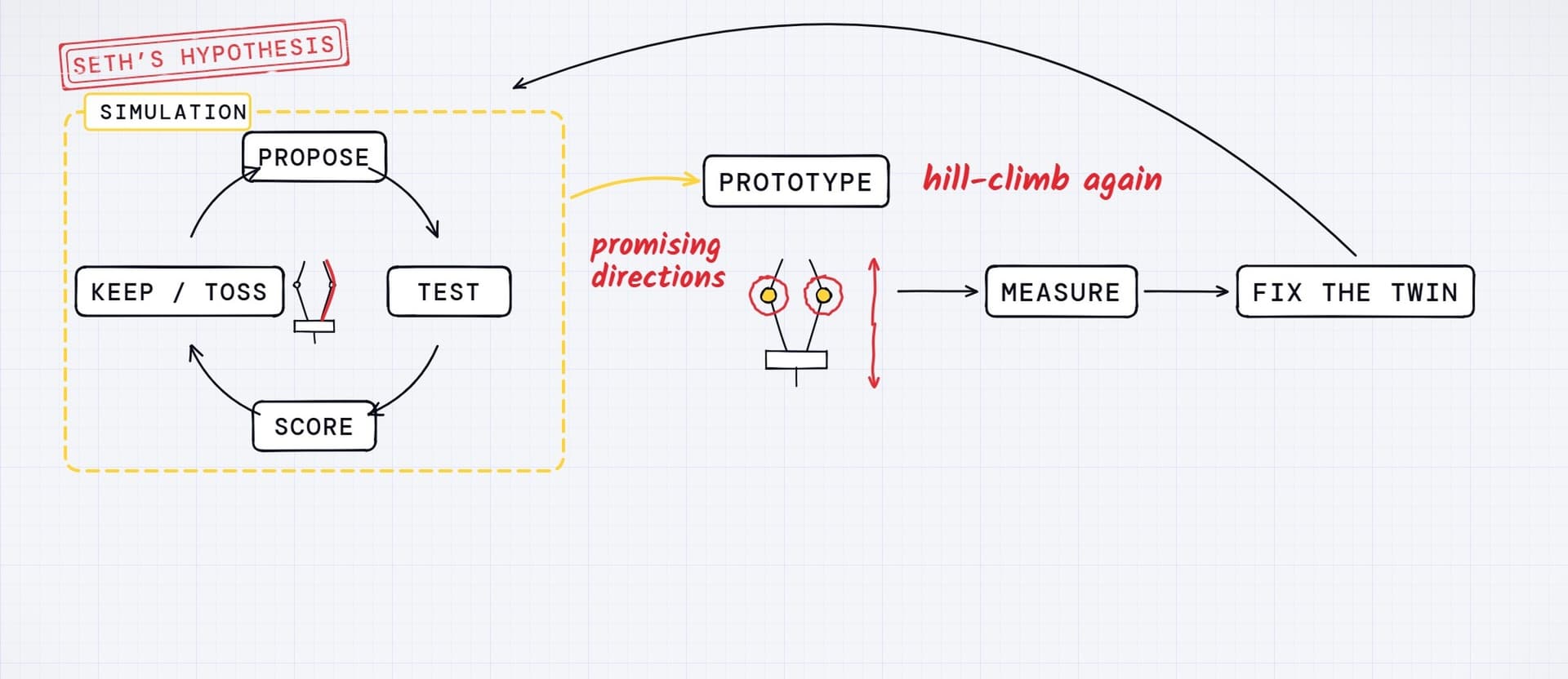
Now, if we go up a level, once you have models and agents that can write code, you can put them in a loop. Developers call it hill climbing these days. You give an agent a target like, make my app run faster. The agent proposes a change, runs the test, keeps what helps and throws out what doesn’t, and goes around and around again. All night. All week, if it takes that long.
One of the cleanest examples of this I’ve seen is Andrej Karpathy’s autoresearch project from March. Karpathy was a founding member of OpenAI and ran AI at Tesla. He’s now at Anthropic. His setup is almost boring. The agent edits the training code, trains a small model for exactly five minutes, checks whether the result got better, keeps it, or tosses it and repeats. It’s really simple, but it’s really effective.
He left it running for about two days. It worked through roughly 700 changes on its own and found about 20 that actually helped. Stacked together, they cut his benchmark training time by about 11%. On a project he’d already tuned by hand for a long time.
Then he wrote the line that I keep coming back to. Any metric you care about that is reasonably efficient to evaluate, he said, can be handed to a swarm of agents. And he told people to think about whether their problem falls into that bucket. That’s basically my thesis in one tweet. If you can measure it, you can search it. Especially if you can measure it cheaply, you can search it.
A few days after autoresearch went public, Shopify CEO Tobi Lütke pointed it at Liquid, the open source templating engine behind Shopify stores. He reported 53% faster parsing and rendering, with 61% fewer memory allocations. And to his credit, he said up front it was probably somewhat overfit. If you’ve ever tuned anything, that’s the most honest sentence in software. You can solve one problem but create a whole host of other ones.
Google has already showed where this goes next. Last year, its AlphaEvolve system had language models propose programs while automated tests scored them. One circuit rewrite it found passed Google’s correctness checks and went into an upcoming version of its TPU, Google’s AI chip. Software search landing in hardware.
See where I’m going with this? This week, the loop hit math. On October 26th, a company called Axiom said it had formalized the classification of finite simple groups. Mathematicians call it the enormous theorem. It’s about the basic building blocks of symmetry, and the original proof runs about 15,000 pages across more than 500 papers by about 100 mathematicians over decades. A massive search problem.
Axiom says its team directed swarms of AI agents for 24 days and turned the whole thing into code a computer can check every step. About 43 million lines of it. Along the way, they found 34 noteworthy deviations from the published record that had to be resolved. Let’s step back and think about that. Generations of the best people in the field wrote about it. AI did the proofreading.
Of course, OpenAI is in on this too. The same post where it claimed to refute the Exponential Time Hypothesis also claimed new proofs in harmonic analysis and in mathematical physics. Those are huge claims, and nobody outside has checked them yet. The physicists involved are writing up their own paper.
But OpenAI already has physics milestones on the books. In February, a group of physicists, including Andrew Strominger at Harvard, published a result on how gluons scatter in a case most people assumed came out to zero. The physicists worked out small cases by hand and OpenAI says GPT-5.2 Pro, a model, by the way, far behind the frontier now, spotted the pattern and proposed the general formula, and then it was proved. Mathematicians have always guessed first and proved second. The guessing just got a lot cheaper, and maybe the proving did too.
Biology, of course, is like a harder space because the test has to happen in a real lab. Or does it? On October 20th, Anthropic published a project it ran with Citrini Research. Citrini isn’t a biotech. It’s an investment research firm. Their question was whether a group of motivated non-experts with AI could take a real shot at a real health problem.
They picked scorpion stings, which kill thousands of people a year, mostly kids in places without good medical care. They put Claude to this question, and Claude designed proteins meant to latch on to scorpion toxins. Two outside labs tested over 200 of them, and 17 met the bar for binding. To be clear, binding is not an antivenom, not yet. But a team of investment researchers asked a real question and got a real answer back from a real lab. For me, I think this is more evidence that it is the golden age of the idea guy.
The same week, Anthropic said drug developers are running in the same loop. At one partner, BigHat, Claude proposed changes to each molecule. The lab made and tested about 1,000 variants over 10 weeks, and the best one bound more than 10 times more tightly than where it started. This is still preclinical evidence, not tested in humans, but that’s the loop. It gets better each time it goes around as long as you can verify the result.
Anthropic has its own lab that works this way too, with Claude proposing and scientists doing the bench work. Earlier this year, OpenAI and Ginkgo Bioworks closed the loop with robots. GPT-5 proposed experiments, a robotic cloud lab ran them, and the results shaped the next round.
Which brings me back to Genie 4, and why I am this excited. Everything so far has one thing in common. The test is cheap. The code runs. A proof checks. A lab can run a couple hundred samples.
But many inventions are physical. A gripper, a circuit board, a hinge. For physical stuff, the test has always been the expensive part. You’ve got to build it on the workbench. You’ve got to test it with an actual multimeter.
But Genie 4 went out October 27th as a research preview for some trusted testers. You describe a world, and it builds it in real time. With sound. And you can steer it as you go. You can change the weather. You can drop in a new object. You can move the camera.
The part that got me is under the hood. DeepMind pairs Genie with Gemini as an agent in the loop. Gemini watches the world as it’s generated, breaks a goal into steps, and checks the incoming frames to see whether each step actually worked. That’s the hill climbing loop, running inside a simulated world. In the release video, they even showed a robotics demo. A simulated Apptronik humanoid playing checkers that way.
DeepMind says its testers include engineering teams, and enterprise partners are trying it for quick scenario generation. Game developers are of course using it to go from an idea to something you can walk around in before writing a line of engine code. DeepMind, to their credit, is upfront that it’s early. Physical interactions, spatial accuracy, and long runs still drift. So no, you’re not testing a jet engine in Genie this week.
But I don’t see a philosophical wall here. If world models keep getting more faithful, there’s no reason this stops at pretty video or game demos. Mechanical, electrical, maybe biological at small scales and big ones. That’s my bet.
Robotics shows the other half of the problem, which is carrying what you learn into the real world. In September, Figure pre-trained its Helix robot model on a huge data set of human behavior, then tested it on three chores, tidying up, folding towels and making beds, in 30 Bay Area homes it had never seen before. No data was collected in those homes. Figure says the pre-training took whole task success from 9% to 56%. That’s about a coin toss of whether a humanoid robot can tidy up or fold the laundry, but it’s still a massive improvement.
Here’s the catch, and to me it’s the whole ballgame. More attempts only help if the score tracks something real. A simulator that’s beautiful and wrong just lets you fail faster.
So let’s think of it as a ladder. If you’re exploring what a product could look and feel like, a loose world model is plenty. If you’re rehearsing a task, like a robot learning a sequence, it’s pretty useful to have that simulation be as accurate as possible. If you need to predict what a physical thing will actually do, you need a simulator somebody has checked against real measurements.
From my research, that’s doable. In fact, researchers on a project called REALM carefully lined up a simulator with a real robot and simulated scores tracked the real ones on the tasks they tested. That’s the bar we’re trying to get over.
So here’s the pattern I think autonomous, or at least directed invention at first, is going to follow. You won’t build a prototype until you’ve already run the idea dozens or hundreds of times in a world model, a digital twin, some type of simulated environment. That simulation will point you at the promising directions. Then you build a rough prototype and reality shows you the constraints you actually care about. You could then take those measurements back and fix the twin and hill climb again.
Each joint, each circuit, each handoff between the hardware, the software, and the learning loop keeps getting better. The prototype keeps the twin honest and the twin makes every prototype count.
I’m happy to admit some bias here. We’re quietly working on a version of this at ipCapital Group for some specific projects where we’ve created a digital twin of the circuit in a hardware prototype covering the printed circuit board and the software we use to control it. It’s speeding up development of the actual hardware and maybe soon I’ll have my dad John on to talk about it.
So let’s step back. Gradient descent, scaling laws, agents hill climbing on code, AI checking 15,000 pages of math, labs running the loop in biology, and now worlds you can steer. As each of these tools come online, we get closer to giving inventors superpowers. That’s why I think this is the golden age of the idea guy.
If you can name a goal worth hitting and a way to score it, you can orchestrate these tools to iterate toward it. You can be three turns in before a competitor has finished writing down the problem. You still pick the problem, you still pick the score, and you still decide when the model is lying to you. That part’s yours. You end up owning the result.
But I hope you can appreciate how exciting a time this is for motivated innovators. You have all these tools available to you, and if you’re not using them to develop your inventions, you are falling way behind people who are.
Watch the full episode on YouTube, or listen on Spotify. The episode also covers this week’s headlines and our Patent of the Week, LG Energy Solution’s battery-line simulation patent.
The Axiom, OpenAI, Anthropic, Figure and DeepMind results are the companies’ own claims unless stated. Strategy education from ipCapital Group, an IP strategy consulting firm (not a law firm). Nothing here is legal advice.
Work with ipCapital Group
From invention to monetization, our team has guided 2,000+ engagements across the full IP lifecycle. Start with a free 30-minute discovery call.

Written by
Seth Cronin