
The most valuable invention of this decade is about to be owned by the public, and almost none of what protects it is at the patent office.
This is the main story from This Week in IP for November 17, 2026, written out from what I said on the episode. Lightly edited, so it reads like I talk.
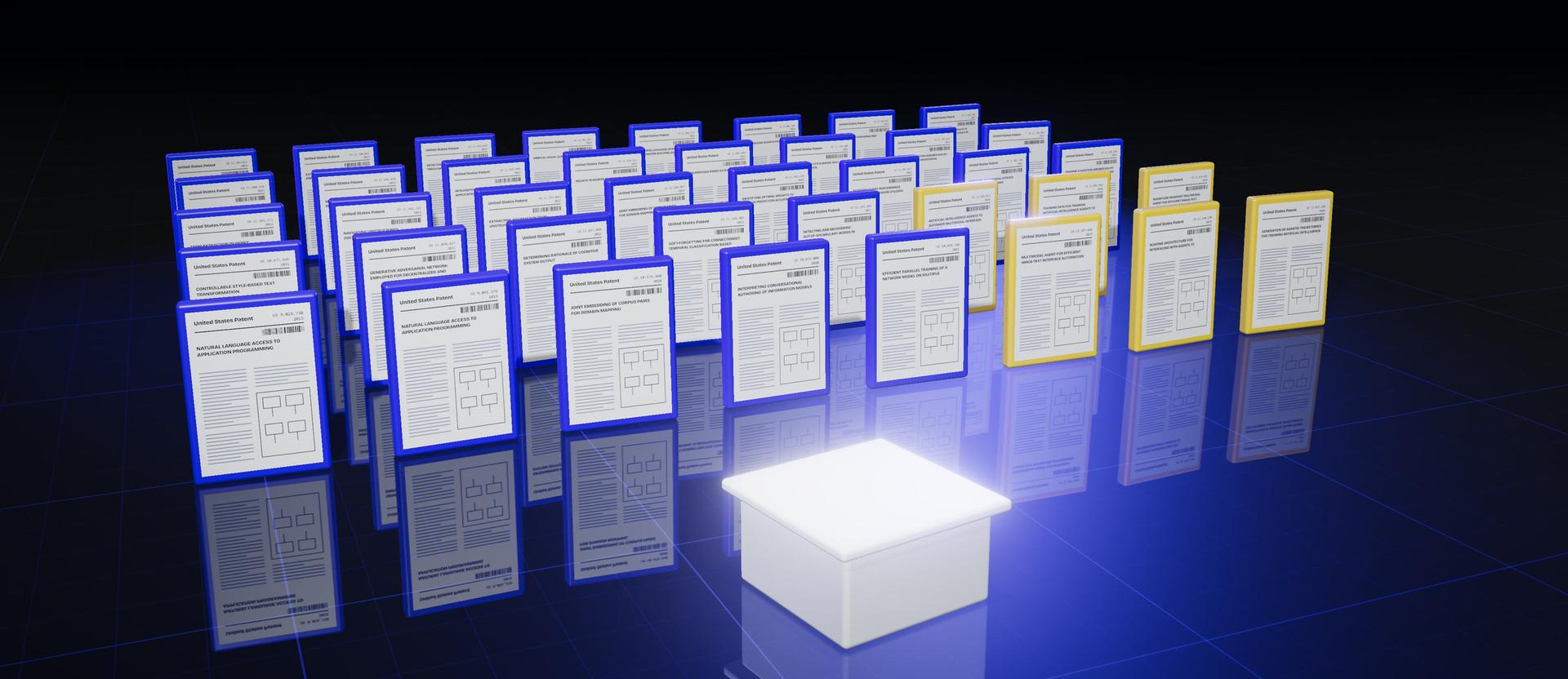
Anthropic, the company behind Claude, is expected to start trading this week. At the top of its price range, the company would be valued at around $1.4 trillion. Its filing says it holds 40 U.S. patents. So I went and found all 40. Here’s what I find so interesting. Not one of them started at Anthropic. 34 came from IBM. The other six came from a startup called Adept. So if the patents weren’t where Claude came from, what is actually protecting a trillion dollar company? And if you’re inventing something right now, maybe with Claude open in another window, what should you take from that?
Let me show you one of the 40. It’s from IBM, and it was filed December 2013. Interestingly, this was the year I joined ipCapital Group. Say I get on my computer and type, “Get me tomorrow’s weather in Burlington.” You might know what I mean, but the weather service doesn’t. It wants a specific request. Which Burlington? What date? IBM’s inventors describe software that takes the pieces of my sentence, matches them to what the service expects, and builds the call to the API, the application programming interface that is going to provide the weather data. The patent was granted in 2015. Anthropic was founded in 2021. And today, asking software in plain English to go do something for you is one of the most useful things that Claude does. So Anthropic didn’t invent that one. It acquired it this September with about seven years left before it expires.
We know this because every time a patent changes hands, there’s a public record of it. It’s called an assignment and we pulled them. There are three transfers. In April of last year, Adept signed over a set of applications about AI agents that operate software. Six of those have since been granted. A month later, IBM transferred 22 patents, and this September, six weeks before the IPO filing went public, IBM transferred 12 more.
One caveat I should point out here is Anthropic’s filing gives a count, not a list. We read the whole thing. It never says the patents were bought, and the names IBM and Adept don’t appear in it once. The match is our reconstruction from the public record, but the numbers line up exactly.
I’ll be honest, I was genuinely surprised by this, taken aback actually. Buying your patents from IBM is a pretty wild way to end up with a portfolio when you’re the company everyone says is inventing the future.
So next, I went looking for the ones that Anthropic filed themselves. The filing says there are 67 applications pending. We checked the patent office’s own records and then a worldwide patent database. Every application on record in Anthropic’s name traces back to IBM or Adept. Applications stay confidential for about 18 months, so there may be newer ones we can’t see yet. As of today, though, there isn’t a single public patent filing anywhere in the world that started with an Anthropic inventor.
So, if you’re Anthropic, why would you do that? I looked for an answer from Anthropic or from IBM. There isn’t one. There’s no announcement. There’s no price. No stated reason. But we have seen this exact move before. Way back in 2012, a year before that IBM patent was filed, Facebook filed to go public with 56 patents. A few weeks later, Yahoo sued it for patent infringement. Before the month was out, Facebook just bought about 750 patents from, you guessed it, IBM. In 2013, Twitter was about to go public with nine patents. Right after the IPO, it bought more than 900. Guess who? That’s right, from IBM. When a young company is about to become a very rich public company, IBM is who you call.
And I’m proud to say there’s some family history here. My dad, John Cronin, spent years at IBM helping run what they called the patent factory. That machine never stopped running. These patents are some of what it makes.
Here’s how I think the logic works. At ipCapital, one thing we tell every funded company is that the day your funding hits the press, you become a target. People with patents can see that you have cash. And it’s already happening to Anthropic. In July, the University of Tennessee’s Research Foundation sued it over two neural network patents. And Anthropic says the quiet part in its own risk factors. I’ll read it exactly: “Certain of our competitors hold substantially larger patent portfolios than we do, which they could assert against us.”
That’s the whole game. A patent you bought doesn’t make you an inventor. What it gives you is something to answer with. And in April, Anthropic helped start a group with IBM, Meta, Microsoft, and Genentech, where the members license each other’s AI patents for free. That’s kind of like a peace treaty. You sign one of those when what you want from patents is to not get sued. There’s a number of these patent pools out there, like AST, that have exactly this mechanism. Everyone just put their patents together, pay some membership fees, and we’ll all agree not to sue each other.
One detail in the paperwork is worth mentioning. When IBM sold the first batch, it kept rights for itself. So Anthropic owns those patents. It’s not the only one allowed to use them. My view is that buying gets you a shield quickly, which is good. But it doesn’t tell anyone what you invented. And maybe that’s the whole point?
Which brings me to the question I keep coming back to. Does this company believe in patents at all? You may have heard a rumor. In August, an investor said on the All In podcast that he’d been told Anthropic CEO Dario Amodei thinks it might end up the only private company in the world. An Anthropic employee called that completely false. So here’s what’s on the record. Back in 2023, an investor pitch that TechCrunch got a hold of said the companies that train the best models in the next couple of years would be too far ahead for anyone to catch up. Now, think about a patent from that point of view. It takes two or three years to get one. It lasts 20. If you believe the race gets decided in the next few years, a patent shows up after the finish line.
To be clear, I’m just guessing. Anthropic never said any of this. In the short term, patents may just be obstacles to them, and if you move an obstacle out of the way by buying your way past it, then great. In the long term, they don’t seem to think that patents are where the value is. The filing even lists what it relies on in this order. Trade secret, copyright, patents last.
In fairness, there is some evidence going the other way. Anthropic has a head of IP. One of its IP lawyers used to be a patent judge. A former director of the patent office is advising the company. And three weeks ago, it posted a job for a patent lawyer in life sciences. Hold on to that last one. I’ll come back to it.
So what actually protects Claude? Well, Anthropic tells you in its filing. It calls the model weights the primary intellectual asset of a company like this. The weights, in a large language model like Claude, the weights are the numbers, literally just a long list of numbers that the model learned in training. Anthropic says it recently held off training a new model for more than a month so it could tighten the security around them. That’s a trade secret. And it passes the test we talked about last week with Lumentum. If a competitor can figure it out from the product, patent it. If they can’t see it, keep it a secret.
You can talk to Claude all day and you’ll never see the weights. Or can you? There might be a couple of holes to look at in that statement. The first one Anthropic found itself. In February, it said three AI labs in China used about 24,000 fraudulent accounts to pull more than 16 million answers out of Claude and train their own models on that. That’s called distillation, or a distillation attack. That’s Anthropic’s account, and those labs haven’t been found liable for anything, and they have publicly denied any wrongdoing. Think about what that is. Nobody broke into the vault. They sort of reverse-engineered the secret through the front door by asking the product a lot of questions. And what did Anthropic reach for? Not a patent, a contract. Its terms say you can’t use Claude to train a competing model.
The second hole is people. A trade secret lives in somebody’s head and heads go home at night. Last month, Thariq, one of the most public voices of the Claude Code team, said he’d left Anthropic. And the filing says former employees can join or found competing companies immediately following their departure. Now, I’ve got to be careful here. Nobody has accused anyone of taking anything. But a patent stays with the company when the inventor walks out. Know-how walks out with them. If your whole plan is secrecy, your most important IP document is the employment agreement.
Now, the major Claude models, like Sonnet, Opus, and Fable, have trillions of parameters. There’s no way anyone has the weights memorized, and it’s even less likely that they’ve copied these weights outside of Anthropic confidential systems. That would seriously expose them to trade secret theft. What they do know is a lot of how the models are trained, how the harnesses are built around the models so that the models can actually do things, and a lot of that secret sauce that happens inside the company to figure out how to make the models themselves and the products really performant for their customers.
There’s one more layer I want to look at, and it’s copyright. Anthropic has been on both sides of it. It trained Claude on books, lots and lots of books. Last year, a federal judge said the training itself was fair use, but keeping a library of pirated copies to do so was not. That part ended in a $1.5 billion settlement. But now, look at how Claude handles its own work. Since August, the text from new Claude models carries a hidden watermark so someone with the detector can show that Claude wrote it. Google and OpenAI watermark too. And when Claude Code writes code for you, by default, it adds a line to the record naming Claude as a co-author in your code base, which is pretty crazy if you think about it. You can turn that off, but most people never will.
So I think there’s something a little two-faced here. When it was other people’s books, credit and payment weren’t part of the plan until a court got involved. When it’s Claude’s output, the credit is built in. To be fair, the court did say the training was fair use. It’s just still a strange position to hold. On the one hand, you think the works of authors can be turned into a model that you’re going to sell to other people without necessarily paying any of those original authors for copyright. On the other hand, you don’t want a Chinese lab distilling your model, copying you and turning it into a new model the way you copied human authors and turned it into another model. And then once again, you know, you want to go and watermark all the outputs from your models, list Claude as a contributor in your GitHub repo. It’s just interesting to me how you kind of want to be having your cake and eating it too when you’re a company like Anthropic. You want to own the model and you don’t want to pay for what goes into making it. You don’t want anyone else to use your model to make the next model. And you want the human’s prompt that turns into work products to be marked to show that it was actually Claude that produced the thing. Very interesting.
Now put yourself on the other side. Say you’re designing a circuit. You give Claude the schematic through your company’s account, and it suggests a change that saves you two components. Who owns that? Under Anthropic’s commercial terms, you do. You keep your inputs. You own the outputs. And Anthropic is living this itself. Its filing says more than 90% of the contributions to its own codebase in September were written by Claude. So put that contract next to what I just showed you. The contract says the work is yours. The commit log says Claude co-wrote it. The watermark says Claude wrote the text. In the US, only a person can be inventor on a patent. So if you invent with Claude, there is now a record of how much the machine did. Sort of. Keep your own record of what you did, what the problem was, what you asked for, what you changed, what you decided. That’s the part that makes you the inventor.
Then there’s the last question I’d want answered before I ordered 10,000 printed circuit boards. What if somebody else already holds a patent on the way the circuit works? Anthropic promises to defend business customers against certain IP claims, but there’s a specific exception and I’ll read it: “the practice of the patented invention contained in an output.” If the answer Claude gives you happens to be somebody’s patented invention and you go build it, that’s on you. And I think that’s fair. You know, a patent is a negative right. It lets its owner stop other people. It doesn’t matter that you came up with the idea honestly or that a machine did. Checking that is called freedom to operate and nobody’s terms of service will do it for you.
Last, I want to talk about what this IPO says about invention, and here’s what I take from all this. The most valuable invention of this decade is about to be owned by the public, and almost none of what protects it is at the patent office. It’s in a vault. It’s in a contract. The patents are a shield somebody else built. Now, you could look at that and say patents are over. I think it says the opposite for almost everyone watching this closely. Anthropic can do this because its invention never leaves the building. Claude runs on Anthropic’s computers or the computers of its partners like Azure and AWS. You just rent the access. If you make a sensor or a battery or a medical device, your invention leaves the building every time you ship one. Your competitor can buy one, and now your competitor has the same tireless reverse engineer that you do. See also our episode on reverse engineering everything.
And Anthropic knows it. Remember that job posting? Anthropic is moving into science. Its filing says it’s building a molecular biology lab, and the patent lawyer it’s hiring is for life sciences. You see, a drug is a molecule. It leaves the building in every bottle. The moment Anthropic’s own work starts leaving the building, it goes looking for a patent lawyer. So for the part of your invention the world can see, the patent matters more than it used to. For the part they can’t, keep it secret and be honest with yourself about how long that lasts.
And I wanted to also float this idea that what you can say about Anthropic, even though they’re not filing patents, they’re buying them. They care. And if you have a patent portfolio that they think is valuable to their business, there’s no reason to believe that your patent has no value. In fact, if they see the same value that they saw in the portfolios of IBM and Adept, it might be that your patent portfolio is an acquisition target. If not for Anthropic, then for one of their competitors or one of the many startups in the AI world.
I think one of the things I take out of this is just because a company like Anthropic isn’t filing a world-class patent portfolio, it doesn’t mean they don’t understand the risks and tradeoffs of patents. It’s just that they’re playing with a unique and potentially risky strategy. That could be something you as an inventor, as an IP owner, could take advantage of. And at ipCapital Group, we work with inventors and IP owners all the time to figure out how to use the patents that they own or that they want to create in order to take advantage of this moment and capture a lot of value because, as we can see, Anthropic has one of the best AI models and could be writing hundreds of patents a week. They’re deciding not to, which might be reasonable from their perspective, but it opens a whole bunch of opportunities for people who are willing to believe in the value of patents, write and file their own inventions, and get them to the patent office.
Watch the full episode on YouTube, or listen on Spotify. The episode also covers our Patent of the Week, Adept’s computer-use agent patent, now Anthropic’s: US 12,566,913.
Strategy education from ipCapital Group, an IP strategy consulting firm (not a law firm). Nothing here is legal advice.
Work with ipCapital Group
From invention to monetization, our team has guided 2,000+ engagements across the full IP lifecycle. Start with a free 30-minute discovery call.

Written by
Seth Cronin