
Tesla, Waymo, and Cruise reveal the same lesson from different angles: autonomous-vehicle IP is shifting from capability claims to safety, validation, and human-interface strategy.
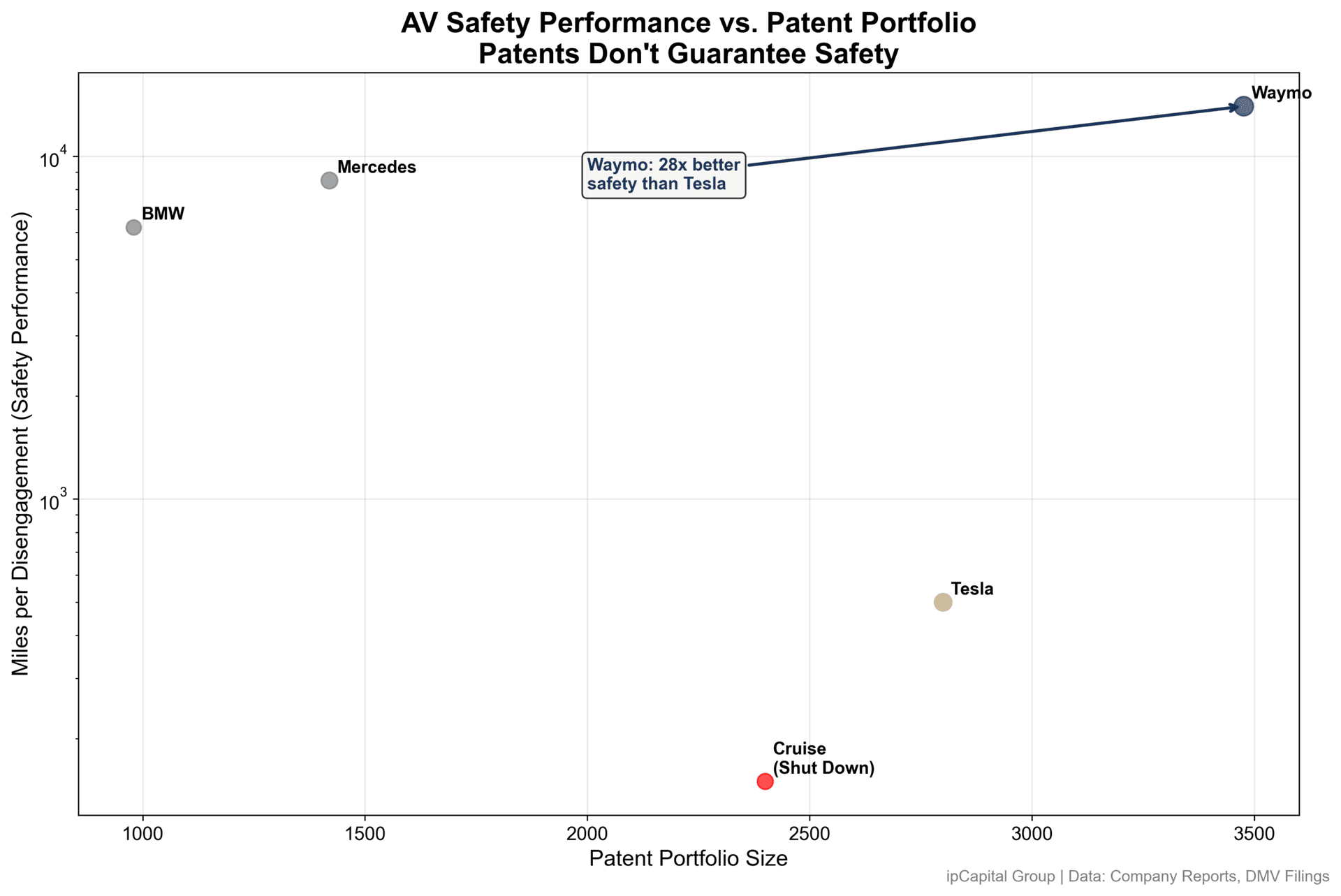
Tesla kills $8,000 FSD purchase. Waymo logs 14 million paid rides. Cruise burns $9 billion, exits the market. The autonomous vehicle patent race isn’t about technology anymore. It’s about safety.
On February 14, Tesla will stop selling Full Self-Driving as a one-time purchase. $8,000 upfront becomes $99 monthly subscription only.
This isn’t just a pricing change. It’s Tesla admitting FSD is a service, not an asset attached to your car. The “appreciating asset” narrative Musk promoted for years? Quietly unwound.
The business implications are massive. Tesla needs 10 million active FSD subscriptions for Musk’s 2025 CEO Performance Award. Current reality? Tesla has zero fully driverless rides while Waymo operates commercially in 14 cities.
Patent data reveals the real battleground: safety systems and reliability.
Waymo averages 14,000 miles per disengagement. Tesla? Roughly 500 miles. That 28x difference isn’t just performance. It’s the difference between commercial viability and expensive beta testing.
Cruise learned this lesson expensively. After spending $9 billion, one safety incident killed the entire business. October 2023: A Cruise vehicle dragged a pedestrian 20 feet after a collision. The company covered up details for weeks.
Result? License suspended. NHTSA fined them $1.5 million. GM shut down Cruise entirely in December 2024.

Our analysis reveals three distinct IP strategies emerging:
PERCEPTION FIRST (Waymo): 3,476 patents, 92% active. Heavy investment in LiDAR, radar, and computer vision fusion. They’re building redundancy into every sensor decision.
VISION ONLY (Tesla): 2,800+ patents focused on camera-based perception and neural networks. Betting that vision-only systems will eventually match multi-sensor approaches.
HUMAN INTERFACE (GM + Others): GM’s active U.S. Patent No. 12,539,879 focuses on vehicle HMI alerts tied to both the environment and driver attention. It uses vehicle sensors plus gaze or head-orientation monitoring to direct visual, audio, or haptic alerts toward occluded hazards.
That is the safety role of HMI: not replacing the driver’s view, but restoring situational awareness where it is weakest. As automation expands, valuable interface IP will increasingly address what the vehicle communicates, when it escalates an alert, and whether the human is ready to respond.

Filing patterns reveal regional priorities:
US: 45% of AV patents, focused on software and perception
China: 30%, emphasizing manufacturing and cost optimization
Germany: 15%, concentrating on safety standards and validation
Japan: 10%, developing sensor hardware and precision systems
Breaking down technology focus:
Safety Systems: 34% of recent filings
Perception: 28%
Planning/Control: 22%
Human-Machine Interface: 16%
Safety isn’t just leading. It’s accelerating. Post-Cruise shutdown, investors and regulators demand proven safety records before commercial deployment.

Founders should move beyond the vision-only versus multi-sensor debate. Safety validation is the bottleneck. The stronger IP position is around proof, fallback, validation, and human handoff, not just raw driving capability.
Investors should distinguish technical progress from deployment credibility. Waymo’s paid rides are commercial evidence. Tesla’s subscription shift says something different: autonomy is still being sold as an evolving service.
Acquirers should look beyond perception patents. Safety validation, fallback logic, remote assistance, and human interface patents may determine commercial viability.
Tesla’s FSD pricing shift signals the end of autonomous vehicle hype and the beginning of autonomous vehicle reality.
Three patterns matter:
Cruise spent $9 billion learning what Waymo knew from the start: in autonomous vehicles, being second-safest means being last.
The companies building safety-first IP strategies today will own the robotaxi market tomorrow.
Need to understand what this means for your portfolio? ipCapital Group helps leadership teams turn patent landscapes into practical decisions about filing strategy, competitive diligence, M&A readiness, and monetization.
Start a conversation with ipCapital Group or download the IP Strategy Playbook.
Work with ipCapital Group
From invention to monetization, our team has guided 2,000+ engagements across the full IP lifecycle. Start with a free 30-minute discovery call.

Written by
Seth Cronin