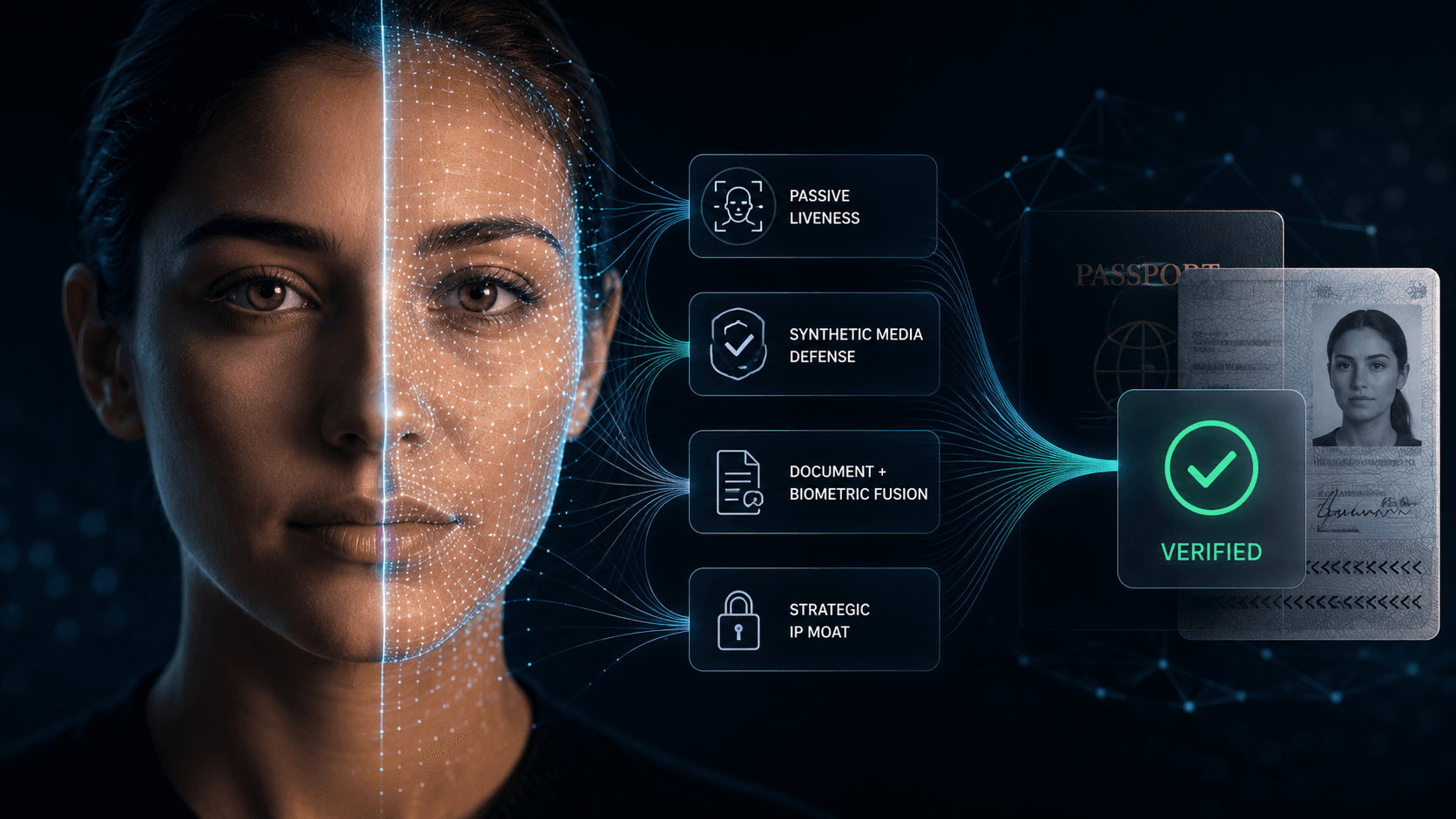
The Deepfake-Resilient IDV Moat: Where Product and Patents Will Be Won
Hardware owns the sensors. The next defensible layer in identity verification is software: passive liveness, biometric fusion, and deepfake defense.
Hardware leaders own the sensors. The next defensible layer is software: passive liveness that users do not notice, document and biometric fusion that adversaries cannot fool, and synthetic-media defense that evolves as fast as attacks.
Market shift: the adversary is now synthetic media
Identity verification is crossing a threshold. The primary adversary is no longer a printed photo or a silicone mask. It is synthetic media. Users reject active blink-and-turn challenges, while enterprises demand lower friction and higher assurance. The winning posture is passive liveness that feels invisible and resists AI-generated attacks.
Passive approaches are now table stakes. The next moat is the software stack that detects subtle spoof artifacts, cross-validates documents and biometrics, and flags generative forgeries in real time, without adding steps.
Evidence
3,000%+ increase in AI-generated identity fraud attempts between 2023 and 2024.
20% of biometric fraud attempts are deepfakes.
More than 180 US patents from 2018 to 2026 cluster around passive liveness, selfie matching, and document fraud detection.
Hardware giants emphasize sensor-level spoof detection, so software-only methods present distinct, open IP angles.
One selfie-matching leader holds 16 patents, and a handful of other players range from 4 to 11, yet few filings directly target deepfake defense in production IDV flows.
Selected US patent holdings in identity verification and liveness detection, 2018 to 2026.
Opportunity: where the next category leaders can differentiate
1. Deepfake-specific detection in IDV
Why it matters: AI-generated faces, videos, and voices are now a primary attack vector.
Build: Synthetic face and video classifiers, injection-attack prevention at SDK and API boundaries, and adversarial training pipelines.
Edge: Real-time risk scoring across both selfie and document streams.
IP hooks: Novel features for texture, blending, eye-region and specular anomalies, plus ensemble methods tied to IDV workflow states.
2. Passive liveness without 3D sensors
Why it matters: Pure software liveness scales across devices and channels without user friction.
Build: Single-frame and micro-motion analysis, lighting and texture residuals, and display-replay artifact detection.
Edge: Checks that stay invisible to the user, integrated into standard selfie capture flows.
IP hooks: Feature engineering that isolates camera-sensor noise patterns from screen-emission artifacts, and calibration-free methods.
3. Document and biometric fusion
Why it matters: Single-signal systems are brittle, and cross-verification raises the cost of attack.
Build: Selfie-to-document matching with tamper detection, and cross-modal consistency checks.
Edge: Confidence-weighted fusion that adapts by region, document type, and capture quality.
IP hooks: Algorithms that learn optimal fusion weights from risk outcomes, and document tamper cues propagated into biometric thresholds.
Product and IP implications
Win enterprise cycles: Regulated buyers look for technical ownership. Patents and defensible know-how de-risk vendor selection.
Strengthen fundraising: Clear, focused claims around passive liveness and deepfake defense signal a durable moat to investors.
Deter fast followers: As accuracy improves, larger players will copy, and filings create leverage to protect premium margins.
Enable licensing: Synthetic-media defenses apply to healthcare, gaming, and social platforms, well beyond core fintech flows.
Design freedom to operate: One selfie-matching leader holds 16 US patents, so understanding claim boundaries guides design-around and reveals protectable gaps.
Forward-looking invention captures where your architecture is heading, not just what is already built. That is how product strategy and IP strategy reinforce each other.
Concentration versus white space
A small set of players hold clusters of liveness and selfie-matching patents, while deepfake-specific defenses in production IDV flows remain underrepresented.
Holdings of 16, 11, 9, 7, 6, and 4 US patents anchor the visible clusters among selected leaders.
The surge in synthetic attacks, more than 3,000%, and their 20% share of biometric fraud both outpace filings aimed squarely at generative threats.
Generative attacks are rising faster than traditional liveness portfolios were designed to handle, opening space for purpose-built defenses.
The bigger trend
This pattern of hardware concentration, software white space, and rapid attacker evolution repeats across categories.
Voice and call-center fraud: Sensor and telephony controls exist, but synthetic speech detection and cross-channel risk scoring remain open ground.
Video presence and avatars: Camera pipelines are mature, while adversarially resilient authenticity heuristics and watermark triangulation invite invention.
Workflow layers: Risk-adaptive UX, policy engines tied to model confidence, and audit-grade telemetry often sit unclaimed.
Data architectures: Privacy-preserving training, federated feedback loops from fraud outcomes, and secure model-update channels are nascent.
Automation: Real-time decisioning that fuses document signals with biometric liveness and deepfake scores is still emerging.
The takeaway for leadership teams: valuable inventions often hide inside roadmap choices, in feature engineering, fusion logic, feedback loops, and deployment architecture, long before they are named or protected.
CEO-level next step
Now is the window to convert deepfake-resistant IDV into a defensible market position, in product and in patents. If you are building passive liveness, document tamper detection, or synthetic-media defense, you likely have protectable inventions already.
Where is the hidden white space in our identity verification stack?
Which roadmap concepts contain valuable, protectable inventions?
Which strategic positions could competitors occupy first if we wait?
What should we capture before the category becomes crowded?
How can product strategy and IP strategy reinforce one another in the next 12 months?
The sensors are commoditized. The discrimination is the moat.Talk with ipCapital Group about mapping the protectable seams in your identity verification stack.
Share
Work with ipCapital Group
Turn insight into IP strategy
From invention to monetization, our team has guided 2,000+ engagements across the full IP lifecycle. Start with a free 30-minute discovery call.