
If AI creates something you would not have written yourself, or writes something you haven’t read, don’t send it.
This is my talk from the 2026 AI Patent Symposium, re-recorded for Invent Anything and written out from what I said. Lightly edited, so it reads like I talk.
If you use AI and work with intellectual property, there’s one thing I’d ask you not to become. A meat proxy.
That’s someone who just forwards what the AI wrote, so the client, or your boss, feels like they’re talking with ChatGPT or Claude, not to you.
On November 12th, I was invited to give a talk at the 2026 AI Patent Symposium, presented by the National Council on Patent Practicum and the National Association of Patent Practitioners. It was part of a session called “The Rules of the Road for AI and Patent Practice,” in front of about 140 patent practitioners, and my slot was sponsored by Minesoft.
The talk was about what AI means for ethics, cybersecurity, and client trust. How to use these tools while still protecting the clients who trust you with their confidential information. I thought it was a useful talk, so I organized some of this content for the Invent Anything audience, and I hope you enjoy.
Today I’d like to talk to you about the duty to defend in intellectual property. The ethics, cybersecurity, and client trust concerns of using AI, artificial intelligence, in the practice of creating, defending, analyzing, or otherwise interacting with intellectual property.
First, a little about me, because it will help you interpret everything that follows. First of all, I’m not a lawyer. I work with ipCapital Group, an intellectual property consultancy. We do everything for IP that is not the practice of law. That means a lot of strategy and a lot of analytics. I do a lot of valuation. I do a lot of competitive strategy. I interview inventors and write disclosures that might someday get filed as patent applications by attorneys.
We deal with many of the same risks and the same data, and we work with a ton of attorneys. So this whole talk is an outside perspective looking in, and I think that can be valuable.
I’m also an inventor myself. Type in my name and you’ll see me listed on about 200 patents and applications.
And I think importantly, I’m also an AI builder. One of the things I do at ipCapital Group is build and maintain our internal stack of AI tools. A lot of them are custom. Some of them are off the shelf. Some of them are built on tools you know, like the Minesoft API, which is one of our default patent databases.
One of the important things I’d like to emphasize up front is that these tools are changing all the time. So when we talk about ethics or cybersecurity or trust, I don’t think it’s useful to spend our time on a specific tool set or specific actions that you should take. Instead, we should focus on the frameworks we use to assess these risks and these trade-offs. That will empower you no matter what tools come along.
I think everyone can appreciate that the most difficult thing about working with AI is how fast it moves. It’s hard to believe it was four years ago this month that the world was introduced to ChatGPT for the first time. In that time, I think more has changed about how we work in intellectual property than in the 30 or even 40 years before it. The compression of time is so significant that all we can really do is ask, what are our enduring guiding principles?
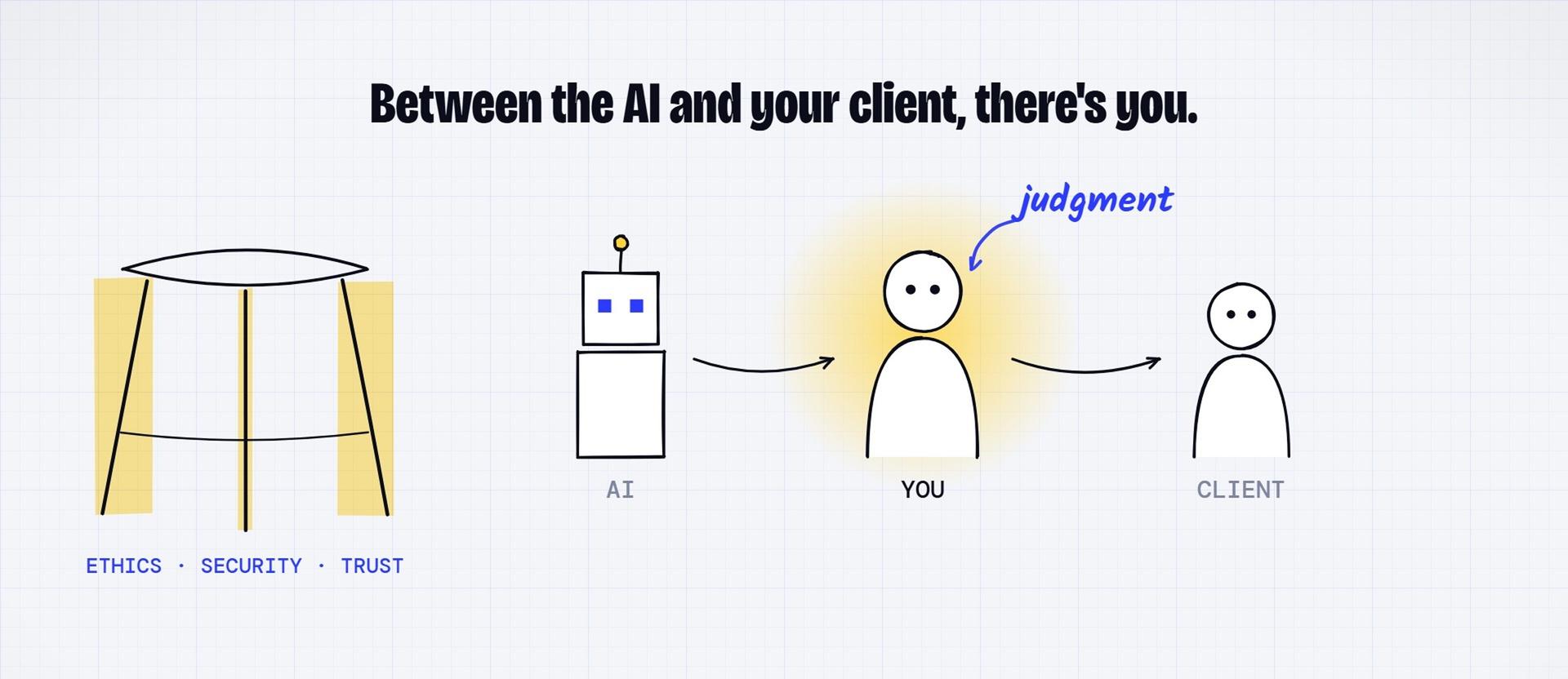
So with that in mind, let’s go through the three legs of the stool: ethics, security, and trust.
Here’s one way I like to think about every technology adoption.
Let’s picture it like a clock, and although this clock is moving faster than ever, I think the metaphor still holds.
At some point, let’s call it midnight, a new technology is introduced. At first, around three o’clock, it’s really only used by early adopters, and then it moves on to forward-thinking professionals.
And finally, it reaches broad adoption, when essentially everybody is using it all the time.
You could think about computers themselves. I’m old enough to remember the first time a computer entered my household, and then the internet after that. Those of us who remember dial-up remember what now seems like a very slow period of technology change. There was a time when you’d have been surprised to learn your attorney was using the internet. But at some point, it flipped. Today, it would be extremely surprising to learn that your counsel was not using the internet for basic research.
In fact, I think most of us could agree it would be a huge red flag if you were trying to get counsel on technology, intellectual property, and your attorney didn’t know how to use the internet.
With AI, I think we’re already at about seven o’clock. We’re past the point where it’s only forward-thinking professionals. It hasn’t reached complete saturation yet, but it’s on its way.
I put this here because it changes the ethics question. As technology moves around the clock, it moves from efficiency to opportunity. Efficiency asks, can it speed up what we’re doing already?
Opportunity asks, are there things we can now do that we could never do before?
There’s an idea that comes up a lot in these discussions called Jevons paradox.
It comes from the industrial era. As steam engines got more efficient at burning coal, people assumed we’d do the same amount of work with less coal. What actually happened is that there turned out to be millions more coal-shaped problems than anyone anticipated. As the cost of using coal went down, its use went way up. There were opportunities for automation that nobody could see until the new technology got cheap enough. We’re entering that era with AI.
This filters into the ethics of using AI, and I think it is an important lens for how we look at this technology. There was an era early on when AI was used in unexpected and, dare I say, unethical ways. We’ve all seen the examples. It hallucinated case law and citations that simply were not true. But as the technology advances, it becomes more of an optional thing. There are good times to use it and bad times to use it. Maybe that’s where we are now, in some kind of messy middle, where you really need to use your judgment about when to use it and when not to.
At some point on this curve, just like with the internet, it becomes expected. It’s expected that you’re going to use the technology and pass on those efficiencies and those opportunities to your client. In the same way, it would be really unexpected today to find out your IP professional simply refused to use the internet because it wasn’t secure.
So as we move along this spectrum, I think it’s important to think about the ethics of what you’re leaving on the table if the pendulum swings too far toward restriction. There’s a ton to be said about how we safeguard this technology and use it ethically, and I don’t want to be glib about that. But I also want to recognize the other side. If you aren’t using AI responsibly, you’re giving up efficiency and opportunities you would otherwise be able to pass on that would benefit your clients.
Any technology conveys its benefits to the people who use it. You’re going to go farther and faster flying a plane than driving a car, and farther driving than walking. The people who use AI really well are going to be flying jets over your head if you’re using it naively. That’s my controversial take on the ethics.
Let me move on to one real example where these principles collide: AI claim drafting.
Again, I’m not an attorney. I don’t draft claims. I work with the attorneys who do, and we do a lot of the specification and disclosure drafting for our clients. But the setup is a classic one. You have an unpublished disclosure, you’re authorized to see it because your client gave it to you, and now you’re gonna work through a chain. The first link in that chain is, what is the approved provider and account for this authorized disclosure? That can sit at different levels depending on the task you’re asking for and the agreements you have in place. Just understanding that first layer, where the specific disclosure is approved for use with this specific provider, already puts you in a really good place to make reasoned decisions.
The second link is, inside that approved provider, what are its settings and access controls? Does this tool retain any data? Do its retention policies line up with what you’ve already established with the client? Does it train on my data? How much of my data does it have access to? And how do I limit that, so I stay compliant with IP I have a duty to protect?
And the final gate: it’s you, the human, who verifies and judges the outputs.
See, everything before that step can be completely sound and reasonable, or it can contain mistakes. None of it becomes truly problematic until that last step isn’t done to the full extent of your duty. That duty is to understand everything that went in and everything that came out, and to ask, is this something I would stake my reputation and my career on? Would I have produced it myself?
So that’s the chain. What am I authorized to use? Who is approved to receive it? Are they set up with the right access controls? And who’s the final person who verifies it and judges it before it goes out? If all four of those things are taken care of, then regardless of the task, you’re in a really good position to feel good about the ethics of doing it, with AI or, honestly, without it.
One of the ways I like to put this, albeit a bit provocatively, is policy is the best honesty.
At ipCapital Group, we have a very public AI policy. Anyone can go read how we use AI. My intuition and my experience is that the more transparent you are about how you use AI, the more confidence people have in it. That means your team knows the policy and your clients can go inspect it if they want to. By having a policy that is completely transparent, you are being honest, de facto, about how you use AI. And once that document exists, it can be debated. It can be updated as new tools come online. You’re no longer wading through the dark about what can and can’t be used. You have a North Star that you can judge any particular action against.
So that’s how I’d cap off this framework. Take all of it into consideration, the efficiencies, the opportunities, the move from unexpected use to optional to expected, and then ask how we, as people who work with intellectual property, can canonize that into one document everyone agrees on, so no one has to guess.
One thing I wanted to do in this talk is to end each section with a prompt you can take straight to your AI. I really like these meta prompts where you use AI to ask how you should use AI. Go to the chatbot of your choice, describe the task you’re trying to do, and then ask it:
Which parts can AI responsibly handle? What context would you need to handle them? And which ethical judgments ultimately remain mine?
Taking that proactive step, using these tools in order to use them well, makes you a really powerful AI user. And I think it’s part of what gives you the strength to make ethical decisions. You keep the conversation going with yourself, with the AI, with your policy, and with the senior people around you about what ethical use looks like.
That’s the key differentiator between people who have built an intuition to act ethically and people who wait until there’s a problem to correct the record.
Now, as we move into the world of cybersecurity with AI use, I want to kick this off with a classic line: there are no solutions, there are only trade-offs.
It would be great if there were a button you could press. Maybe it costs some money, but you press the button and you pay the money and all of your cybersecurity is taken care of. Unfortunately, I believe that is not the world we’re entering. Because of the power and opportunity of this technology, it’s more a case of with great power comes great responsibility.
Ultimately, there’s a trade-off between the amount of risk you take on and the amount of reward you get back. Think back to that clock. The earlier you are to a new technology, the more risk you take on. But you’d also expect to gain more, because you’re using it before your competitors are. There are rewards for moving early, and you take on additional risk to reach those rewards.
Now, obviously we want to minimize the risks, and obviously we want to maximize the rewards, but the more you try to minimize risk, the more you may be locking yourself out of some of those rewards. So I can’t make that choice for you. I can give you the framework I use to assess whether a risk is worth taking and what reward I expect in return. These two things are in constant, deliberate tension, and it’s our role as practitioners to decide where on that spectrum we want to land.
Caveat emptor: I’m not a cybersecurity professional. But there are two basic concepts that carry most of the weight here, and once you understand them, you’re ahead of most people. They are attack surface area and blast radius.
Attack surface is how big a field you’re exposed on. You already have plenty of surfaces. There’s your email, there’s your website, there’s your cloud service provider, and now there’s your AI provider, or maybe several AI providers. Each one is surface area. AI is a strange technology in this respect, especially once you get into agents, because an agent connects to a whole network of things. It can read your files, it can reach your applications, it can act through your accounts, and information can reach it from the web. Every one of those connections is useful, right? It conveys certain rewards. But every one of them changes what you’re exposed to, the risks.
So the first practical step is simply to be aware of each surface and what your position is toward it. The second is minimizing them. It almost goes without saying: the more products you sign up for that have access to some level of your data, the more risk you take on. With surface area, there’s always this idea of least permissions, right? What is the least amount of access you can give your AI in order to get the task done? That is always going to minimize the surface area for attacks.
So if you can determine that your agent can get everything it needs done without connecting to your email, great. Don’t let it connect to your email.
The next question is blast radius.
If something does go wrong, how far does it spread? A mistake that stays inside one task is a very different thing from one that reaches a whole account. And that is very different again from one that reaches everything. Before I give an agent more reach, I want to know where those boundaries are, and what it has permission to do, and whether I could recover if and when something goes wrong.
Here’s how we’ve made that trade-off in practice at ipCapital Group. We’ve moved almost all of our AI use onto local desktop applications.
We still use the frontier AI providers, but we don’t use them through a chat window in a browser, at least not for agents. We use what’s called a local desktop agent. The agent, its framework, its tools, your sessions, and the files you’re working with all live on your own machine.
Now, you’re still connecting through the internet to get the artificial intelligence itself, but you’re keeping the environment, the workspace the agent is working in, in your local machine.
If you compare that with a cloud chat or a cloud agent, there your device is just a window. The agent runs on someone else’s computer. Your data sits there with it, and it may reach out to third-party tools from there. Now, neither picture is right or wrong. They put the surface area in different places.
And I gotta be super careful here, because local AI isn’t automatically safer. What local gives you is control.
And that control comes with responsibility. Now you own the configuration, the updates, the access controls, and the backups. A hosted provider takes some of that work off your plate and hands you a different set of dependencies.
Again, no solutions, only trade-offs.
The other thing we get from a local setup is that we own the stack.
Not everyone wants to be an AI builder, totally get that, but owning how you work with AI can be as simple as owning the documents and the instructions you regularly feed it. I think there’s something to be said for not being totally reliant on a single provider. If your files and your ways of working live with you, you can switch between providers or move to a third one really quickly. The tool we built and use every day can run on any model. Once again, that has trade-offs too. Every provider you add is more surface area, and they don’t all behave the same way, but it means no one company is a single point of failure for how we work.
One more framework I’d like to introduce you to in this section is to run the fire drill before there’s a fire. If you suspect something has been exposed, what do you do? First, contain it. Stop the workflow and cut off further access.
Second, trace it. Work out what was actually exposed and to whom. Third, report it internally, always, every time, so the right people know and you learn from it. Fourth, ask who, if anyone, outside the organization needs to be told, and when. And fifth, most important: harden. Fix the cause, and then run the drill again.
You really want that map drawn while everyone is calm. Alerting all your clients there was a security breach, even though it didn’t touch any of their data, doesn’t do them any favors. It might make them just unnecessarily concerned.
Here’s the prompt for this section. If you’re running an agent on a machine you’re responsible for, ask it:
Audit this device and setup for critical security risks and update vulnerable software. Confirm changes with me before updating.
I think that last sentence really helps you stay in the loop on anything it changes, so you’re not caught off guard.
Now, the last leg of the stool is client trust, and the principles are actually pretty simple. If AI creates something you would not have written yourself, don’t send it. It’s not good enough yet. If AI writes something and you haven’t read it, don’t send it. You’re not done yet.
If you take nothing else from this talk, take this home. Read every word. Verify the sources. Own the reasoning.
There’s a line Andrej Karpathy quoted recently that I love. You can outsource your thinking, but you can’t outsource your understanding.
Let me unpack that. You can hand off working through the chain of logic that gets to a decision. You can’t hand off understanding that chain. There’s no other way to know whether a result is worthy of putting your name on it. Question for you: does that make the work perfect? No, of course not. Review can’t guarantee accuracy.
But if it’s something you would have written yourself, if you’ve read every word, and if you’ve checked every source, then a hallucination is no different from a human simply getting something wrong occasionally, or making a bad decision. That’s a standard we already know how to hold ourselves to. That’s priced in. And AI should get you to that end state better and faster and cheaper.
As we look towards the future, I also think all of these principles that we’ve discussed so far is how you avoid being wholly replaced by AI.
Increasingly, clients can tell when something came straight out of a flagship model they could have used themselves, with no original thinking added. Anyone can pay for the $20 subscription. What the AI providers can’t sell them is you. That means your expertise, your taste, your emphasis on what matters based on the tacit knowledge of a whole career. When your judgment and your way of communicating aren’t present in the final work product, that’s how you degrade trust.
So the skill worth building now is getting your context into the machine. At ipCapital Group, we do this with what are called skills.
A skill is basically a folder with a few files in it, including a plain text document that tells the AI how we like a certain thing done. We have a knowledge base that records our methodology. We have skills at the project level for how we run certain projects, and at the user level for how each person works. The more personalized your AI setup is to you and how you work, the more value you can create for other people with it. Only you can figure out how to get your tacit knowledge, your taste, and your workflows into the machine.
I think keeping a stable of context that you regularly use, whether it’s a formal agent skill or just a reusable prompt that you’re going to iterate on and refine over time, is just a really effective way of building your AI muscle and keeping AI outputs that you generate unique to you, closer to your voice, to your thinking on the first draft than you’d otherwise get going into the model straight away.
There’s this programming principle that I think really applies well here, called DRY: don’t repeat yourself.
If you write or dictate something into AI that you want to be a standing principle, see if you can add it to the custom settings. Keep it in a private file for your knowledge base that you can reuse over and over again.
Here’s the prompt for this section. Attach the work product and ask the AI to question you:
Ask me some questions that challenge my understanding of this work product and draw out my judgment on quality and trade-offs.
This time, you’re not asking it to tell you the work is good. You’re asking it to find out whether you understand it.
So I’ll leave you with this.
Don’t be a meat proxy. A meat proxy is a person who simply forwards what the AI wrote, putting their name on it. The client feels like they’re talking really to ChatGPT or Claude or Harvey, not to you.
Second, don’t just be a sin eater either. That’s the person who signs their name and absorbs the blame for the work they never understood.
Between the AI and your client, there’s you. Put your judgment there and you will create a lot of value.
Watch the full talk on YouTube, or listen on Spotify.
Strategy education from ipCapital Group, an IP strategy consulting firm (not a law firm). Nothing here is legal advice.
Work with ipCapital Group
From invention to monetization, our team has guided 2,000+ engagements across the full IP lifecycle. Start with a free 30-minute discovery call.

Written by
Seth Cronin