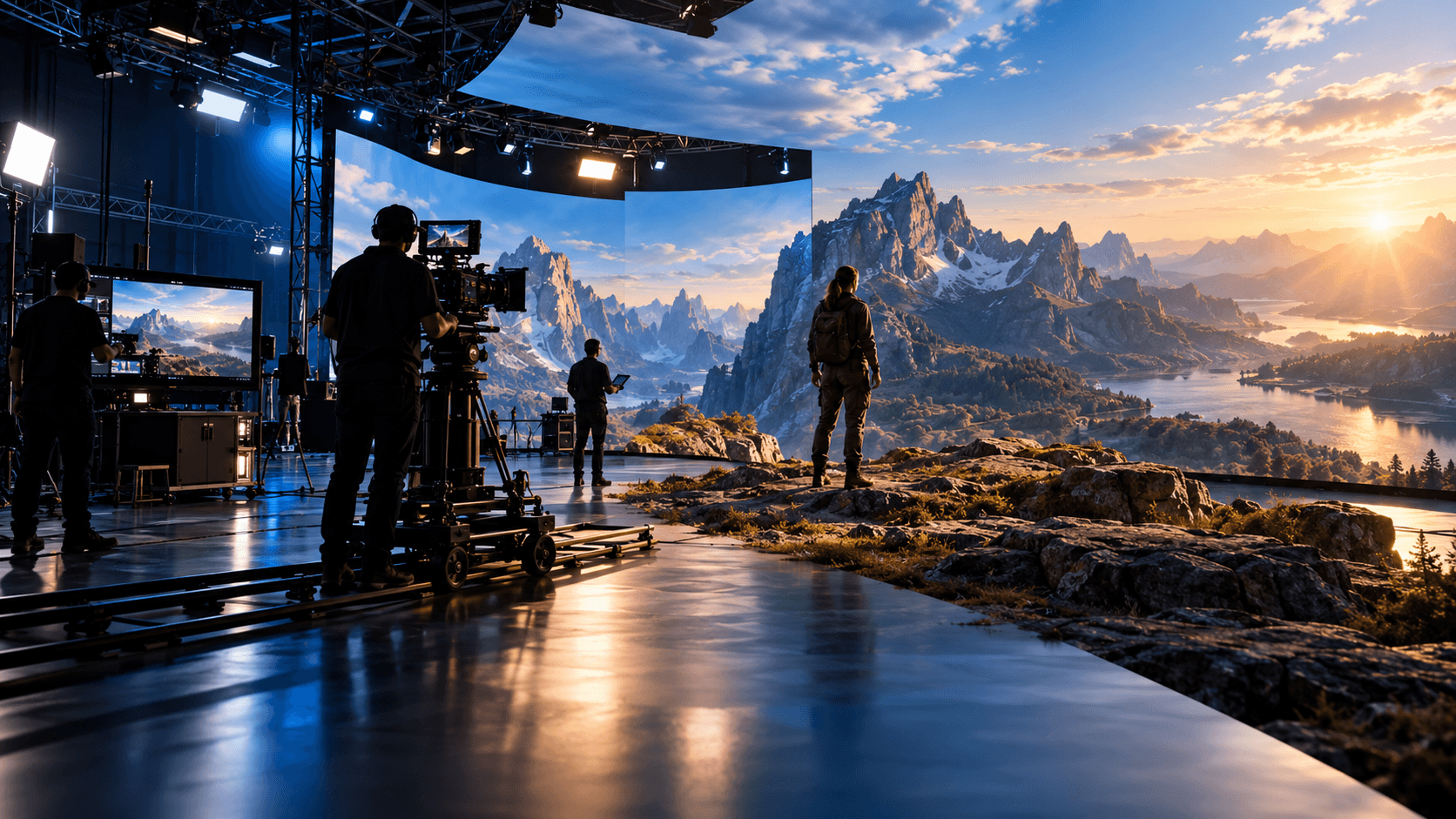
LED walls and real-time engines are normalizing. The durable edge is moving to orchestrated pipelines, remote supervision, and learning systems.
Three LED stages became more than three hundred in three years. Now that the hardware is ordinary, the advantage moves to whatever makes all of it behave as one system under live constraints.
Market shift: the components crossed over, the coordination did not
What started as experimental LED volumes and real-time engines is becoming normal studio infrastructure. As the parts commoditize, the differentiated advantage moves up the stack into synchronized pipelines, calibration methods, remote oversight, adaptive lighting and capture, and the education-linked workflows that let a studio scale talent alongside throughput.
The most valuable IP in this next phase will not look like a better panel or a faster renderer. It will look like systems and methods that coordinate many good-enough components into predictable cinematic outcomes while the clock is running.
Evidence: a category that scaled fast
Two pairs of endpoints rather than measured series. The 2030 number is a projection and the figure is stated as a floor, so treat the direction as the signal rather than the slope.
The growth is not in dispute. What matters strategically is how little of it has been claimed.
Even the largest named holding is under three percent of the field. Platforms, streaming majors, and imaging incumbents are placing bets, but no one has consolidated.
The field is busy but fragmented. Hundreds of filings, and the biggest single position among named players is still a rounding error against the total.
The filings cluster on components. Camera tracking and LED display integration are where the named holders sit, which is the part that is commoditizing fastest.
The service layer is unprotected. Many end-to-end providers, the ones who actually run the full stack every day, operate with minimal filings or none at all.
That last point is the opening. The teams with the most operational knowledge of how these systems behave under pressure are the teams with the least protection around it.
Opportunity: protect the glue, not the parts
Most competitors pick a side, hardware or services. The edge belongs to teams that run the full stack across creative, technical, and operational work, and then write down those practices as protectable systems and methods. Three zones are worth looking at now.
1. Remote collaboration during live production
Live supervision across the set and off-site experts is still fragmented, which is expensive when on-set time is the scarce resource.
Build: low-latency telemetry over the stage, synchronized camera and scene state, notes that translate into actions, and a rollback that is safe to trigger mid-shot.
Protect: methods for multi-stream sync across tracking, lighting, and assets, adaptive bitrate tied to camera motion, supervisory state machines, and exception handling.
2. Education and training integration
Curricula rarely mirror live studio conditions, so the skills gap becomes a production risk at exactly the moment the stage count is multiplying.
Build: teaching rigs for LED volumes, sandboxed pipelines, competency checkpoints, and scenario libraries drawn from real productions.
Protect: evaluation-driven pipelines, simulated signal paths for training, graded calibration tasks, multi-user virtual set labs, and credentialing data models.
3. End-to-end pipeline optimization
Assets, previs, tracking, lighting, and final capture still depend on manual glue, and as the market scales, predictable throughput becomes the thing clients actually buy.
Build: an orchestration layer that holds the scene of record, validates compatibility automatically, predicts contention, and enforces latency and quality targets in real time.
Protect: constraint solvers for this domain, continuous calibration methods, scene and lighting co-optimization, and provenance linking creative intent to capture parameters.
Product implications: build the control plane
A single source of truth across assets, tracking, lens and distortion, color, lighting, and network quality of service.
Remote oversight as a service: telemetry, state snapshots, and playbooks an off-site supervisor can trigger without breaking the take.
Calibration as a service: continual health checks on tracking, panel uniformity, color pipelines, and camera and lens profiles.
An education mode that mirrors the production pipeline in a sandbox, with evaluation and credentialing hooks built in.
IP implications: claim the choreography
System claims covering end-to-end coordination of panels, camera tracking, real-time rendering, and lighting under latency constraints.
Method claims for dynamic calibration, predictive drift detection, and auto-tuning scene complexity against available bandwidth and camera motion.
Data model claims for scene state and supervisory annotations that deterministically change what happens on set.
Training workflow claims mapping curriculum tasks to production-grade validations and performance thresholds.
File forward. The disclosures worth writing describe where the orchestration is heading, not only the rig that exists today.
The bigger trend: orchestration is where the hidden innovation lives
The same pattern shows up anywhere many good components have to perform as one system under time pressure. Robotics cells, digital twins in manufacturing, live sports broadcast, experiential retail, automotive hardware-in-the-loop rigs, immersive learning labs. In each one the moat is built from the same four things.
A shared state model that every subsystem respects.
Predictive calibration and recovery for when reality drifts from the plan.
Remote supervision that can change the outcome safely while it is still happening.
Training pathways that turn scarce expertise into workforce leverage.
Leaders who name these patterns inside their own roadmaps convert everyday know-how into strategic positions, usually before the market has a label for the product.
CEO take: the next ninety days
Map the live workflow as a state machine covering assets, tracking, color, lighting, network, and decision rights.
Instrument for truth with per-shot health metrics, drift detection, rollback, and provenance.
Design a remote command link that is low-latency, safe, and auditable.
Split the pipeline into a production mode and an education mode with evaluation gates between them.
Write forward-looking disclosures that capture where the orchestration is going rather than what shipped last season.
Where is the hidden white space in your pipeline?
If you run the full stack, you already own operational knowledge that competitors cannot buy. The question is whether any of it is written down in a form that holds.
Which roadmap concepts already contain protectable inventions?
Which strategic positions could competitors occupy first?
What should be captured before the market crowds in?
How can product strategy and IP strategy reinforce one another?
Nobody patents the LED wall any more. The choreography is still unclaimed.Talk with ipCapital Group about invention harvesting and strategic filing around the orchestration layer.
Share
Work with ipCapital Group
Turn insight into IP strategy
From invention to monetization, our team has guided 2,000+ engagements across the full IP lifecycle. Start with a free 30-minute discovery call.