
Gaming’s durable value is shifting from hit titles to the infrastructure under play. Patent data shows the between-worlds layer is still open.
Gaming has always had a content problem: hits are rare, expensive, and hard to repeat.
That is why the infrastructure around play deserves more attention than another hunt for the next title.
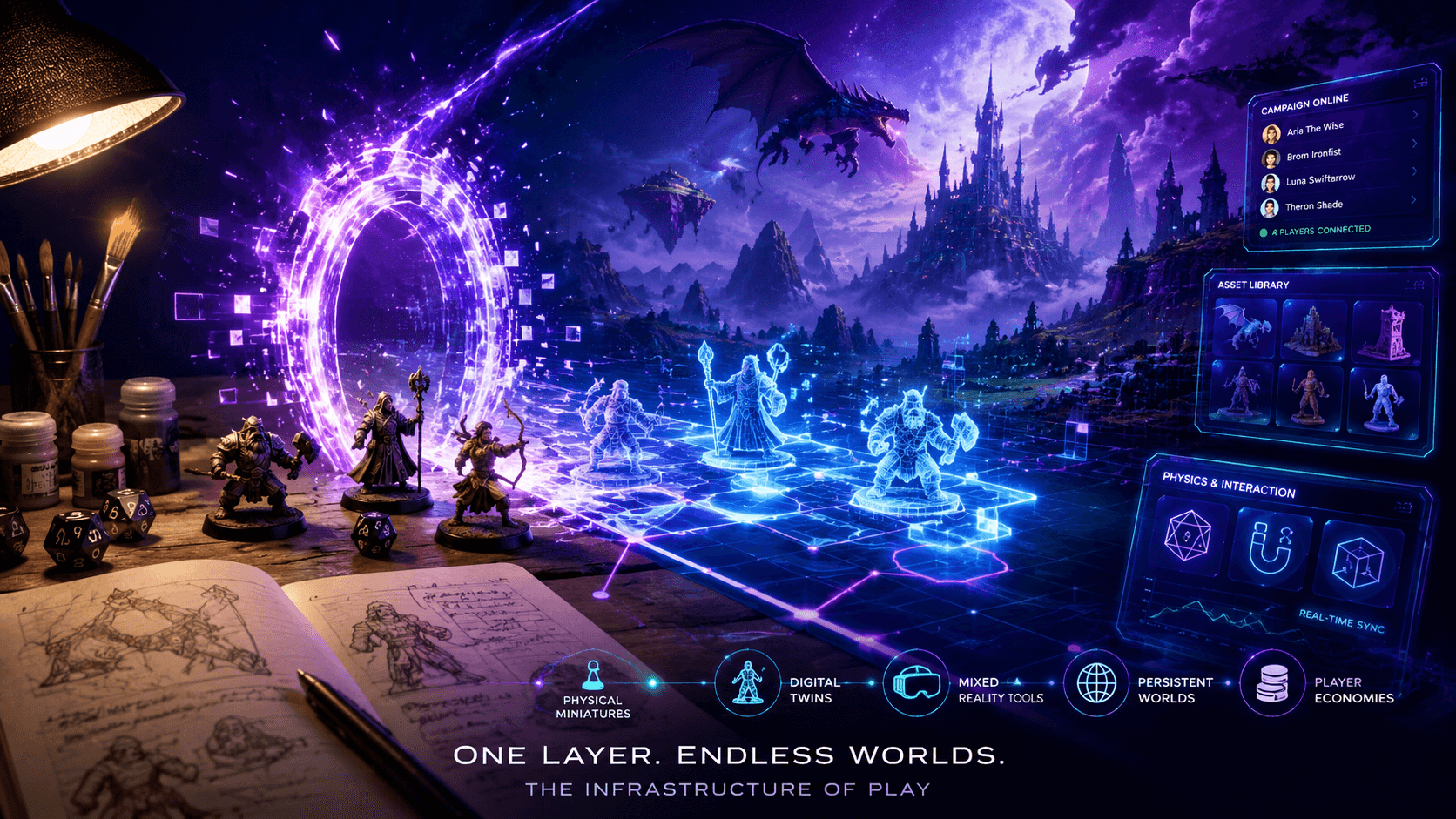
A connective layer is forming between physical experiences, digital worlds, virtual communities, collectible assets, mixed reality tools, and persistent multiplayer environments.
Companies that define that layer may not own the biggest game of the year. They may own the rails underneath many of them.
That is a very different kind of gaming company.
A decade ago, gaming innovation centered around rendering engines and platform distribution. Five years ago, it shifted toward live-service operations, digital economies, and player retention systems.
Today, a new category is quietly emerging: infrastructure that connects physical hobbies, digital ownership, immersive creation, tactical simulation, and multiplayer communities.
The market is no longer only asking, “What game are you playing?” It is increasingly asking, “What ecosystem are you participating in?”
Patent activity in digital collectibles, mixed reality, gaming platforms, and creator tools shows that large players are already protecting key parts of the market. Yet the intersection of physical miniature aesthetics, immersive creative tools, physics-based interaction, and multiplayer tabletop infrastructure remains surprisingly open.
This creates an unusual opportunity for emerging studios, tooling companies, simulation startups, and mixed-reality teams to establish defensible positions before the category becomes crowded.

The strongest opportunities appear where digital systems do more than reproduce a game. They translate the rituals, emotion, craft, ownership, and social dynamics of physical play into immersive technology.
Building the rails under play? An ipScan invention session can surface the platform inventions hiding in your toolchain, or talk to an ipCG strategist.

The first generation of gaming companies built titles. The second generation built platforms. The durable companies will build the connective systems between physical play, digital worlds, user-generated content, collectible assets, AI tools, and persistent communities.
This same pattern is appearing across healthcare, education, sports, retail, media, industrial training, and manufacturing.
Physical experiences are becoming digital. Digital experiences are becoming immersive. Immersive experiences are becoming persistent. Persistent experiences require infrastructure. Infrastructure creates defensible technology. Defensible technology creates enterprise value.
Gaming may simply be one of the clearest places to see the pattern early.
Many teams believe their value is in the product customers see. Increasingly, value is migrating into the infrastructure beneath the product.
That infrastructure may include simulation systems, asset pipelines, physics engines, creator tools, multiplayer architectures, customization workflows, AI-assisted content systems, data models, or proprietary user experience methods.
These capabilities often begin as internal tools. Over time, they can become product lines, licensing opportunities, strategic partnerships, acquisition value, and intellectual property positions.
The most valuable gaming companies of the coming decade may not be defined only by the games they launch. They may be defined by the infrastructure they create beneath those games.
The opportunity is not merely to build content. The opportunity is to own the technology layer that lets future content, creators, collectors, communities, and virtual worlds operate at scale.
If your organization is building software, AI systems, simulation tools, immersive platforms, digital asset workflows, or market-specific infrastructure, there may be hidden innovation assets already inside the business. Reach out if you want to discuss where deeper white-space opportunities may be forming in your market.
Work with ipCapital Group
From invention to monetization, our team has guided 2,000+ engagements across the full IP lifecycle. Start with a free 30-minute discovery call.

Written by
John Cronin