The Next Guard: Turning Hybrid AI and Human Security into Defensible Advantage
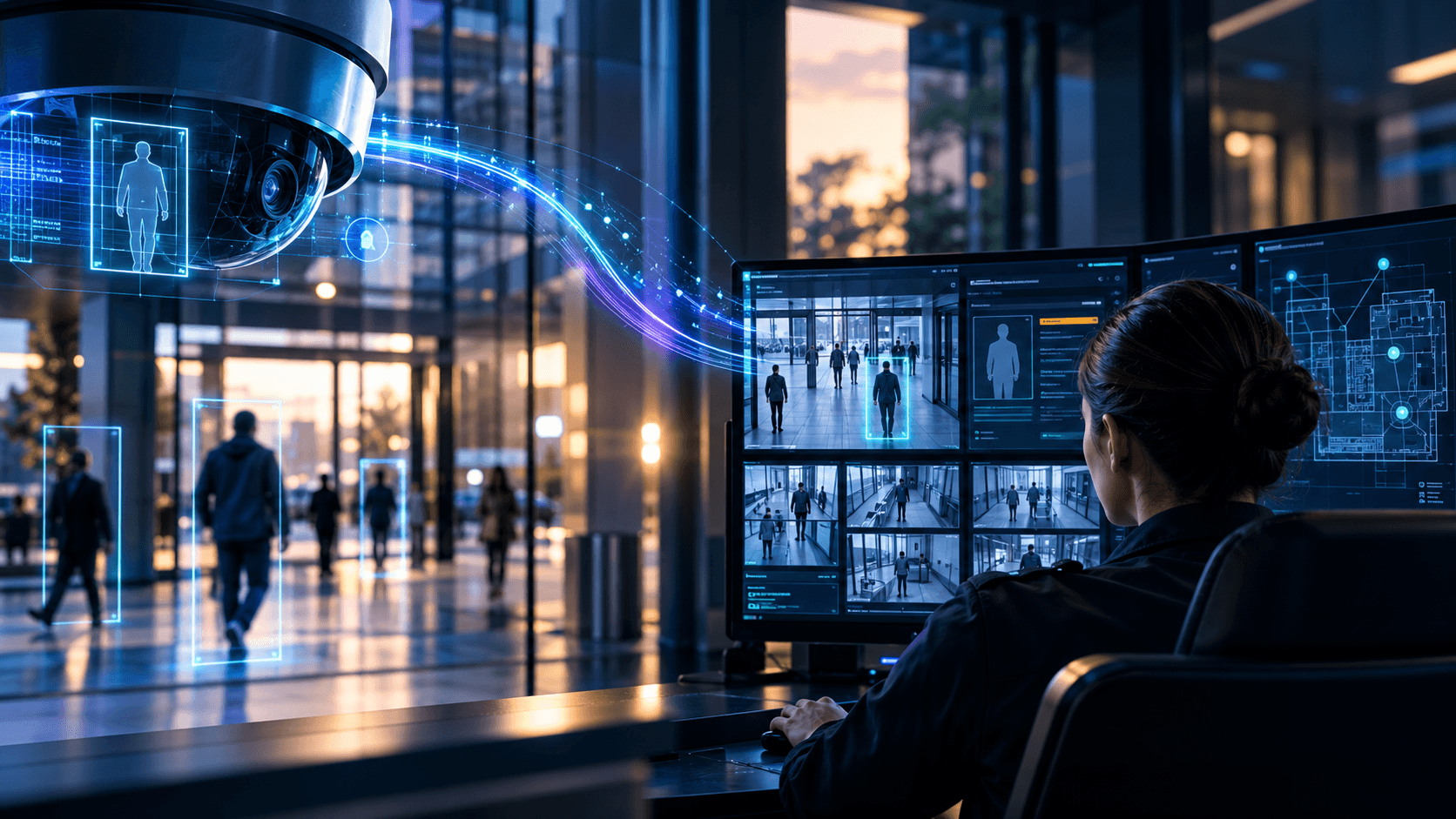
Security is shifting to orchestrated systems where AI detection and human judgment co-pilot outcomes. The prize goes to teams that productize the handoff.
Security is shifting from more cameras or more guards to orchestrated systems where AI detection and human judgment co-pilot outcomes. The prize goes to teams that productize the handoff, and protect it.
Market shift: detection, decision, and dispatch as one workflow
Security has outgrown point solutions. Adding more cameras or more guards on their own no longer moves risk meaningfully. The shift is toward hybrid systems that synchronize machine perception with human action: AI flags, humans adjudicate, and the system learns. This is not merely operational efficiency. It is a new product category, an orchestration layer that treats detection, decision, and dispatch as one continuous workflow.
The competitive advantage is shifting to those who productize and protect the handoff between AI and operators.
Evidence: an expanding market and concentrating filings
AI video surveillance is projected to grow from $4.7B to $12.5B by 2030. Timing favors teams that lock in defensible positions now.US patent activity is concentrating among a handful of AI-first entrants. Many hybrid providers remain under-protected, leaving their operating methods open to replication.
The most important finding
Hybrid security is not simply a staffing model with smarter alerts. It is an emerging system architecture, where detection models, operator tooling, escalation logic, and post-incident learning are designed as one product. That system boundary is the moat. Teams that define, instrument, and protect this end-to-end loop will set the terms of competition.
157 US patents in AI camera monitoring between 2020 and 2026.
$12.5B projected AI video surveillance market by 2030.
Zero to one: the most valuable move for regional leaders is going from no protection to a focused IP position.
Where the white space is forming
The crowd is racing to file around detection algorithms and camera hardware. The white space lives in the operational intelligence between AI and people, in the hard-to-copy mechanisms that deliver outcomes at scale.
1. Human-in-the-loop orchestration engine
Why it matters: Response quality hinges on how AI alerts are triaged, enriched, assigned, verified, and escalated across operators and sites.
Build: A rules-and-learning driven mission control that scores alerts, routes them to the right operator, blends multi-camera context, enforces SLAs, and captures feedback to retrain models.
Protect: Novel alert scoring features, operator and AI co-decision policies, escalation protocols, and feedback loop instrumentation that measurably reduce false positives and time to resolve.
2. Real-time training, simulation, and QA telemetry
Why it matters: Hybrid performance compounds when operators train the system and the system trains operators.
Build: Scenario simulators that inject synthetic incidents, evaluate operator decisions against policy, auto-generate training snippets, and tune model thresholds per site risk.
Protect: Methods for synthetic event generation, operator proficiency scoring tied to model calibration, and continuous QA pipelines that close the loop on incident outcomes.
Why it matters: Scaling remote guarding across enterprises demands privacy, compliance, and verifiable audit, without neutering responsiveness.
Build: Edge-to-cloud redaction, incident-only video retrieval, policy-aware retention, and cryptographic audit of who saw what, when, and why.
Protect: Selective redaction tied to alert semantics, multi-tenant access controls with time-bound keys, and compliance engines that adapt policies by jurisdiction and site type.
Product and IP implications
Hybrid providers can convert operational know-how into durable product features, and protect them before the market crowds.
Define the system boundary: Treat detection, decision, dispatch, and learning as one product with clear interfaces and telemetry.
Instrument the handoff: Capture operator context, decision reasons, and outcomes, and make them first-class data for model and workflow tuning.
Codify escalation: Formalize policies that blend risk score, site constraints, and incident history, and enforce them in software rather than in procedure binders.
Operationalize QA: Build closed-loop feedback that proves reductions in false alarms and response times, which becomes the evidence base for both patents and sales.
File forward-looking: Protect where your orchestration, QA, and privacy layers are headed, not just today’s implementation.
Defensibility lives upstream of features, in the methods that turn alerts into action.
The bigger trend
The same pattern is unfolding across many categories where AI perception meets human judgment. The white space often sits between model output and operational outcome.
Healthcare triage: Model confidence, nurse workflows, and escalation policy as one orchestrated decision loop.
Industrial inspection: Vision detections routed to technicians with context from maintenance logs and sensor history.
Insurance claims: Auto-estimate scores blended with adjuster inputs and fraud signals under audit-ready policies.
Logistics and retail: Loss prevention detections fused with staffing rosters, store layouts, and incident playbooks.
In each case, invention opportunities hide in the connective tissue: routing logic, policy engines, QA telemetry, privacy enforcement, and learning feedback. These are not generic. They are domain-specific and defensible when thoughtfully documented and protected.
What this means for leadership
For founders, CEOs, and boards, the strategic move is clear. Elevate the hybrid operating model into a product, and lock in the elements competitors cannot see from the outside. The market is expanding, patent activity is concentrating, and the window for defining the orchestration layer is open but narrowing.
Decide your hybrid thesis: Where will human judgment uniquely compound model performance in your footprint?
Prioritize telemetry: If it is not measured, it cannot be improved, or protected.
Sequence filings: Start with the orchestration kernel, then QA and privacy frameworks, and protect forward paths.
Commercialize the moat: Turn measurable response quality into enterprise-grade SLAs and premium tiers.
Let’s explore your defensible edge
Executives are asking the right questions:
Where is the hidden white space in our hybrid AI and human workflows?
Which roadmap concepts quietly contain protectable inventions?
Which strategic positions could competitors occupy first if we do not move?
What should we capture now, before filings and features converge?
How can product strategy and IP strategy reinforce each other quarter by quarter?
If you are building the next guard of security, it is time to architect the orchestration layer and claim it.Talk with ipCapital Group.
Share
Work with ipCapital Group
Turn insight into IP strategy
From invention to monetization, our team has guided 2,000+ engagements across the full IP lifecycle. Start with a free 30-minute discovery call.