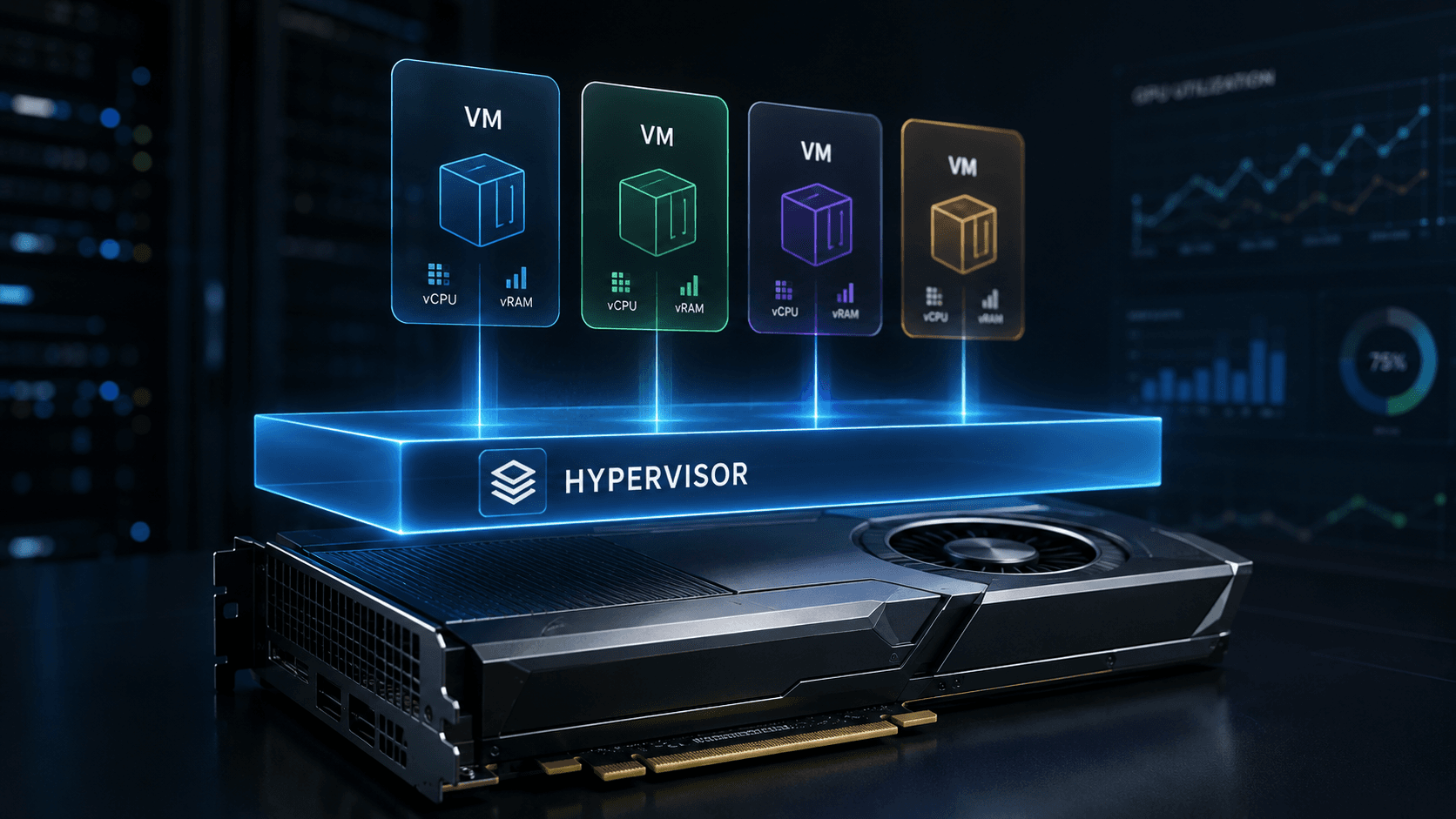
Hypervisors Are the New Silicon: The GPU Efficiency Play Hiding in Plain Sight
Patent signals reveal a surprising white space in GPU scheduling and virtualization, opening room to build, differentiate, and protect the next compute layer.
Patent signals reveal a surprising white space in GPU scheduling and virtualization, opening room to build, differentiate, and protect the next compute layer.
Market Shift: From Buying More GPUs to Extracting More From Each GPU
AI workloads are outpacing hardware supply. The next wave of performance will not come only from larger clusters. It will come from smarter scheduling, memory-level parallelism, and virtualization at the hypervisor boundary. That layer is becoming the new silicon.
When GPU utilization in many enterprise environments still hovers around 30% to 50%, unlocking higher effective throughput is a direct growth lever. Emerging hypervisor-level approaches show 90% to 100% utilization by capturing kernels earlier, multiplexing resources differently, and reducing memory and cache bottlenecks. The strategic question is no longer how many GPUs you own. It is how efficiently every streaming multiprocessor can be kept busy.
Why It Matters Now
Patent activity reveals both intensity and omission. The market is investing heavily in GPU resource management, but several high-leverage mechanisms remain largely unclaimed, especially at the hypervisor and kernel interface.
Published filings cluster in a few players, yet critical scheduling topics remain thinly covered.
Emerging hypervisor-level stacks reach 90% to 100% GPU utilization, against the 30% to 50% that is common in enterprise workloads.
Several core mechanisms show zero or near-zero filings, which is rare in a market this competitive.
Opportunity: Build the Optimization Layer That Turns Scarcity Into Throughput
The market is primed for a product that treats hypervisor scheduling, SM utilization, and memory behavior as first-class surfaces. If you can consistently lift utilization from the 30% to 50% range toward the upper bound demonstrated by emerging approaches, you create ROI that customers can measure in days.
Emerging Product Positions
Hypervisor-level GPU scheduler: captures kernels before cluster job schedulers, reshapes work to reduce stalls, and coordinates across vGPU slices.
Multi-vGPU to single-VM multiplexing: removes artificial slice boundaries and feeds larger models without replatforming.
Memory-aware and cache-aware dispatch: L2 crossbar-conscious placement, warp-aware rescheduling, and memory-level parallelism that keeps SMs continuously engaged.
Reserved GPU cloud tiers: guarantee bare-metal-class throughput using these optimizations under the hood.
Product and IP Implications
Timing matters. White space at the hypervisor boundary creates an unusual opening to build and protect a throughput operating system for GPUs, before the category crowds.
Strategic IP Angles
Kernel capture and rescheduling: hypervisor-level mechanisms that optimize warp behavior and reduce stall propagation.
Virtual GPU fusion: techniques to multiplex multiple virtual GPUs into a single VM while coordinating cache, memory, and SM dispatch.
Topology-aware placement: crossbar and memory-topology strategies that minimize traversal latency and maximize parallelism.
Telemetry-driven feedback: loops that learn workload patterns and adapt scheduling in real time.
These angles can underpin licensing, deter copycats, strengthen enterprise procurement, and elevate fundraising or M&A positioning.
Three White-Space Moves Worth Building Now
1. Hypervisor-Level Kernel Scheduling
Why it matters: zero filings identified in 2020 to 2026 US data, despite direct impact on utilization and latency.
Build: a kernel interception and reshaping layer that batches, reorders, and co-schedules work across vGPU slices.
Differentiate: warp-aware policies that minimize stall chains and synchronize memory access windows.
Protect: claims around pre-scheduler kernel capture, warp-state inference, and dispatch policies that exploit SM-level signals.
2. Multi-vGPU to Single-VM Multiplexing
Why it matters: only two filings, an unusually sparse field given the demand for bigger models and contiguous memory views.
Build: a virtualization path that fuses multiple vGPUs into one logical device for a VM, without vendor-specific slicing limits.
Differentiate: cache-coherent coordination and crossbar-aware mapping to avoid hot spots.
Protect: mechanisms for device enumeration, memory unification, and cross-slice synchronization primitives.
3. Memory-Level Parallelism and L2 Crossbar Awareness
Why it matters: zero identifiable filings, but significant headroom to keep SMs continuously engaged.
Build: a placement engine that co-optimizes memory, cache, and SM dispatch to maximize parallel transactions.
Differentiate: live telemetry that closes the loop between observed stalls and subsequent kernel reshaping.
Protect: scheduling policies and data structures that prioritize crossbar locality and exploit parallel memory lanes.
The Bigger Trend: Hidden Innovation Lives in the Invisible Layers
The most defensible performance breakthroughs often occur where systems meet, below popular frameworks and above raw silicon. The same pattern now appearing in GPU virtualization will echo across:
Storage and IO schedulers that re-time DMA for AI batch locality.
CPU and GPU co-scheduling that allocates host-side prep to eliminate device underutilization.
Data pipeline compilers that fuse operations for cache warmth and shared memory reuse.
Network and RDMA offload paths that collapse inference tail latency.
Memory disaggregation that presents pooled, low-fragmentation capacity to accelerators.
AI runtimes that learn workload signatures and continuously re-optimize execution plans.
In each case, small, well-placed inventions compound into step-function throughput gains, and form IP that scales across products and customers.
What Leaders Should Do Next
Interrogate your utilization gap: where are stalls, cache thrash, and underfed SMs hiding?
Elevate the hypervisor boundary to a product surface: scheduling, multiplexing, and memory policy belong in your roadmap.
File forward, not backward: protect where your optimization engine is heading, before the market converges.
Operationalize ROI: sell guaranteed throughput tiers backed by your optimization stack.
Bottom Line for CEOs and Boards
Compute scarcity has turned efficiency into strategy. The next leaders will not simply buy more accelerators. They will manufacture performance out of the infrastructure they already have. Today’s white space at the hypervisor and kernel boundary is a rare chance to take product and IP leadership in a market that rewards measurable throughput.
Let’s Pressure-Test Your Hidden Performance Levers
Executives, founders, and investors are asking the right questions:
Where is the hidden white space in our GPU stack, especially at the hypervisor boundary?
Which roadmap concepts quietly contain protectable inventions?
Which strategic positions could competitors occupy first if we wait?
What should we capture now, before filings crowd the category?
How should product strategy and IP strategy reinforce one another?
If you are exploring hypervisor-level scheduling, multi-vGPU multiplexing, warp stall optimization, or memory-parallel execution, it is the right moment to map white space, shape invention disclosures, and operationalize throughput as a product.
Share
Work with ipCapital Group
Turn insight into IP strategy
From invention to monetization, our team has guided 2,000+ engagements across the full IP lifecycle. Start with a free 30-minute discovery call.