
A short window has opened to secure strategic positions in edge-run motion planning, measured in months, not years. The advantage will accrue to teams that turn runtime architecture into product and IP.
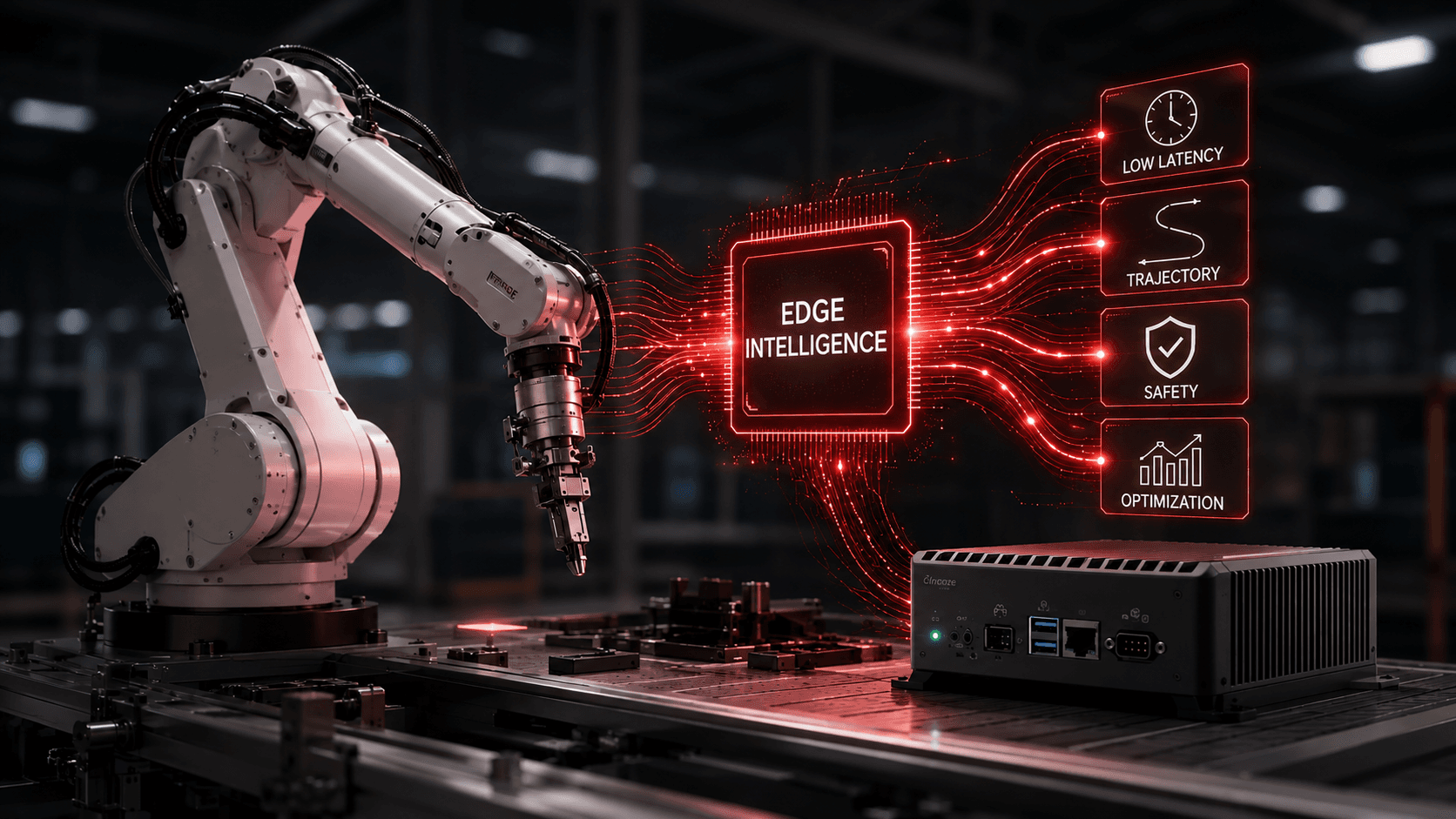
A short window has opened to secure strategic positions in edge-run motion planning, measured in months, not years. The advantage will accrue to teams that turn runtime architecture into product and IP.
Industrial robots are leaving the world of pre-programmed paths and brittle cloud round-trips. In high-throughput environments, even a 50 millisecond delay can cascade into positioning errors, collisions, or line stoppages. The market is rewarding motion intelligence that lives at the edge, co-located with sensors and actuators, so decisions happen in milliseconds, not hundreds of milliseconds.
As robots increasingly work alongside people, handle variable parts, and reconfigure tasks on the fly, on-device autonomy becomes the moat. The next defensible layer is not just a better model. It is a better runtime: asynchronous, multi-priority, resource-aware inference that keeps a factory moving under real-world constraints.
While capital is consolidating into robotics foundation models, the deployment bottleneck is the edge runtime: how perception, planning, and control co-execute on constrained hardware with asynchronous clocks and strict safety envelopes.
That layer is remarkably under-patented relative to its commercial importance. Timing matters. The window to establish product and IP positions at the edge is open, and it will not stay open long.


What it is: An edge runtime that decouples sensor clocks (vision, force, depth) from control loops so perception and motion planning run as independent, prioritized threads on the same constrained hardware.
Why it matters: Eliminates the 50 ms latency trap in dynamic cells. Keeps arms moving safely at line speed when inputs jitter, drop, or spike.
What to build: A schedulable micro-orchestrator and API that binds sensor streams, model inference, and real-time planners with QoS, back-pressure, and deadline awareness.
IP angles: Claims around temporal decoupling of heterogeneous sensor clocks and control loops, priority-aware inference scheduling, and deadline-driven motion updates on edge compute.
What it is: A confidence-weighted fusion layer that continuously adjusts joint-space or task-space trajectories using live certainty scores from visual, force and torque, acoustic, and environmental sensors.
Why it matters: Removes human-tuned guardrails. Robots adapt motion on the fly when cameras glare, grippers slip, or fixtures drift.
What to build: A fusion kernel and planning adapter that injects confidence weights directly into trajectory replanning without pausing the control loop.
IP angles: Methods for confidence assignment across modalities and direct incorporation into replanning cost functions and collision buffers.
What it is: A local protocol for robots to share motion optimizations peer to peer inside a facility, with no cloud round-trip and no central coordinator.
Why it matters: Fleet-wide improvement without security, latency, or IT headaches. Critical for automotive and aerospace plants with strict data boundaries.
What to build: A mesh-native update format for micro-policies, plus convergence and rollback logic validated within cycle-time constraints.
IP angles: Edge-only knowledge sharing for motion policies, local convergence criteria, and safety-aware update acceptance on industrial networks.
The winning wedge is pragmatic: reduce cycle time and stoppages on existing hardware this quarter, then expand into fleet learning and cross-cell optimization next.
Patents serve more than defense. They signal technical depth to enterprise buyers, create licensing paths with robot OEMs and integrators, and constrain fast followers.
Industrial-grade edge compute has arrived, and large robotics models are maturing fast. The unsolved piece is orchestration: how to run perception, planning, and control concurrently on the edge without missing deadlines or compromising safety. That is the layer where new category leaders, and their IP, are being formed.
When AI moves from the cloud to physical systems, the constraint shifts from model accuracy to runtime architecture. Similar white space shows up in:
The takeaway: valuable inventions often hide in practical decisions, such as scheduler design, QoS, safety overrides, and data paths, rather than in the neural network itself. Executives who surface and protect those decisions create asymmetric leverage.
Foundation-model platforms will keep advancing, but they still need to run inside real factories with hard deadlines, safety constraints, and legacy hardware. That is your opening. Own the edge runtime where performance, safety, and uptime are decided.
ipCapital Group helps robotics leaders map hidden inventions, explore edge white-space opportunities, and stress-test strategic IP positions before the platform layer closes the gap. Talk with our team about a working session.
Work with ipCapital Group
From invention to monetization, our team has guided 2,000+ engagements across the full IP lifecycle. Start with a free 30-minute discovery call.

Written by
John Cronin