
Nobody pays $115 billion for 1,900 patents on their own; Lumentum’s patents are one layer of an IP strategy that was built on purpose over more than a decade.
This is the main story from This Week in IP for November 10, 2026, written out from what I said on the episode. Lightly edited, so it reads like I talk.
On November 2nd, Marvell agreed to acquire Lumentum in a deal valued at 115 billion, with a B, dollars. I read the press release. I read the transcript of the call with analysts. The word patent doesn’t appear once. So what exactly are they buying? And if you run an IP portfolio, or you’re building a company you might sell one day, what can you learn from how Lumentum got here? I think this is one of the best executed IP strategies I’ve seen in a long time, top to bottom.
If you haven’t heard, Lumentum makes light. Specifically, the lasers and optical parts that move data through fiber, between servers, between racks, across data centers. Its CEO, Michael Hurlston, put it this way on the call. Lumentum owns the world’s largest indium phosphide manufacturing footprint. Indium phosphide is a compound used in semiconductor manufacturing that can emit and absorb light efficiently. Silicon can’t do that well on its own. So, if you want a laser on a chip, somebody has to grow it in a fab, a fabrication facility like Lumentum’s.
And business is very good. Lumentum just reported $1.26 billion, with a B again, in revenue for the September quarter, up 136% from a year earlier. Its current guidance is around $1.6 billion next quarter. For its last full fiscal year, it did about $3 billion. So if we’re being honest about what Marvell is buying, it’s buying well over a billion dollars a quarter in revenue, at the very least. And it’s buying a revenue generating business that’s growing very fast from a company that says demand is outpacing its supply. That alone explains a lot of the price.
Now Marvell designs chips, but they don’t own fab. They’re called a fabless semiconductor company. It was founded in 1995, and Matt Murphy has run it since 2016. Better part of a decade. Last fiscal year it did about $8.2 billion in revenue, and 74% of that came from data centers. Marvell makes much of the electronics inside an optical link. Optical links communicate with light between a lot of different parts of a data center rack. These could be the signal processors, the drivers, the custom AI chips. On the call, one analyst put Marvell’s share of optical DSPs, digital signal processors, at 70%. But what Marvell doesn’t make is its own light source.
Here’s where it gets interesting. Both of these companies were assembled through acquisitions, deliberately, over the years. They weren’t just grown out of one initial seed. It’s actually a patchwork of a bunch of different companies coming together. Under Murphy, Marvell bought Cavium in 2018 for about $6 billion. It also bought Inphi, an electro-optics company, in 2021. Then it bought Celestial AI, a photonic interconnect startup, this February. It also sold businesses that didn’t fit, like its automotive Ethernet unit, which went to Infineon for $2.5 billion last year. On the call, Murphy said that when Marvell bought Inphi, “it looked like we were paying a very high multiple.” He says that business is on track to grow more than tenfold since then, and he called Lumentum about ten times the size that Inphi was back then. So, Marvell is making the same bet again, at ten times the scale.
Lumentum’s story runs way deeper. It traces back to a company called Uniphase, founded in 1979, which merged with JDS Fitel in 1999 to form JDSU. In 2015, JDSU split in two, and Lumentum was spun off on its own. Then, Lumentum went shopping. It bought Oclaro in 2018 for about $1.8 billion, which brought indium phosphide laser and photonic chip technology. Then it bought NeoPhotonics and a product line from IPG Photonics, not to be confused with ipCG or ipCapital Group, in 2022. Then Cloud Light in 2023, which brought data center transceivers. And it also lost one. In 2021, Lumentum bid for Coherent and was outbid by II-VI. It walked away from that deal with a $217.6 million breakup fee. So notice the pattern here. Every one of those deals added a piece of the same stack. The laser chip, the components around it, then the finished module a data center actually buys.
So what’s Marvell trying to achieve, and why now? Murphy’s answer: “the next decade of networking will be defined by optics, just as electrical SerDes defined the previous era.” Here’s a simpler version for those not inside of these industries. Inside AI data centers, copper wiring is running out of room to go faster and farther. If you’ve ever seen a data center rack, the wiring harness is absolutely wild, mind-boggling. Hundreds, if not thousands, if not millions of different interconnects, and they take up physical space and they are very hard to assemble and connect. Hurlston called it the copper wall. The industry’s answer is to move the optics closer and closer to the chips themselves, eventually right into the chip package. That’s called co-packaged optics, and every one of those optical connections needs a laser. Murphy was blunt: “Every one of those needs a light source, and the best light source company in the world is Lumentum.” He also said, to be a leader in this market, “you have to invest and control your own destiny.”
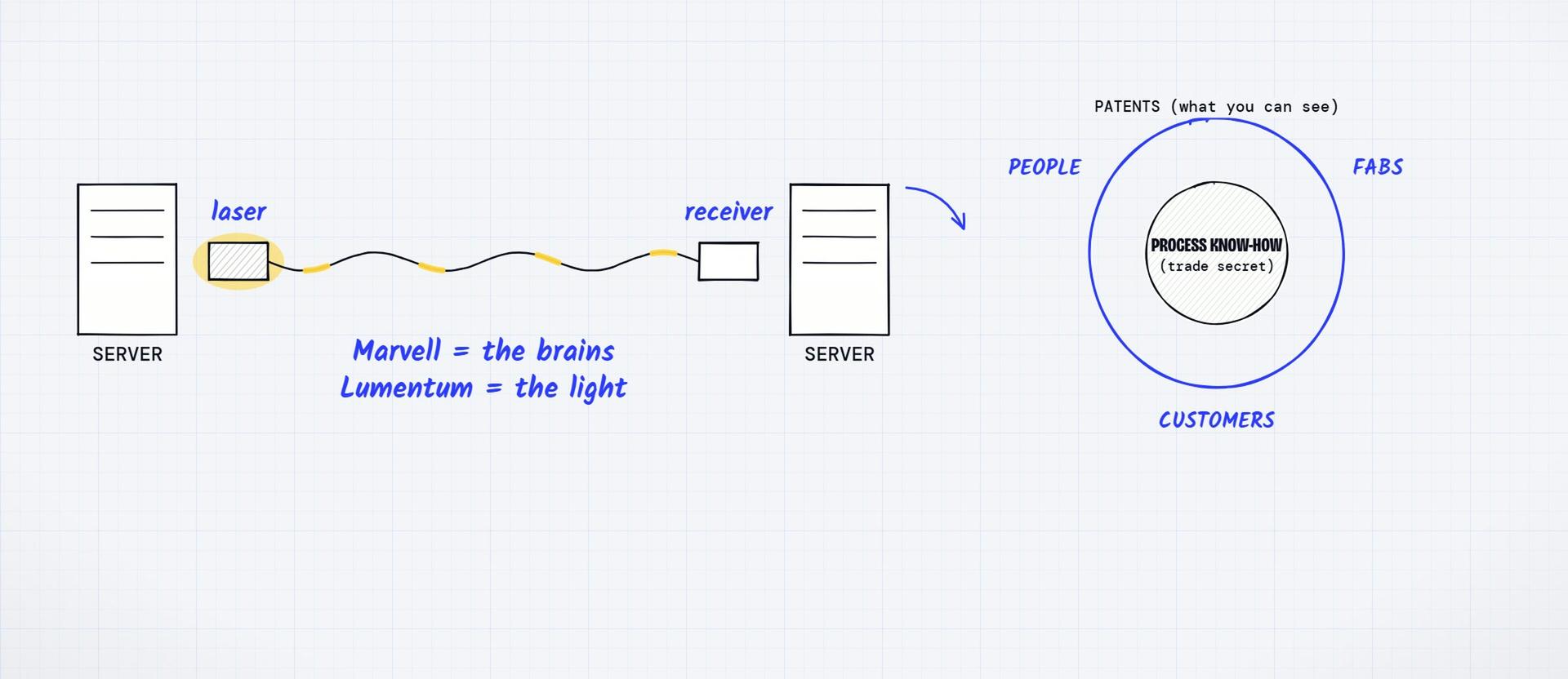
Hurlston’s version is the one I’d underline. Now, about the fabs, he said, “It is not practical to replicate this capability as a fabless company.” He called them “a crown jewel.” That’s the deal in one sentence. Marvell designs the brains of the optical link. Lumentum makes light, and you can’t build what Lumentum has in a hurry. Anyone who’s been following the AI infrastructure build-out knows that the fabs are one of the major bottlenecks. If you’re Elon Musk, you are building your own fab because you simply can’t buy chips from TSMC. You need to build it yourself, and that takes years and years and years. If you want chips soon, you need to already own the fabs today.
Let’s review the terms of the deal. It’s all stock, 4.5 Marvell shares for every Lumentum share. At prices before the news leaked on October 28th, that worked out to about $1,132 per share, a 23.9% premium, and an implied enterprise value of $115 billion. So that’s the headline you’ll get tossed around a lot. Because it’s all stock, that number moves with Marvell’s share price. Marvell’s stock, interestingly, fell sharply when the talks were first reported. But when it closes, Marvell shareholders will own about two-thirds of the combined company and Lumentum about a third. The companies are targeting more than a billion dollars a year in cost savings. They expect to close in the first half of 2028 after shareholder votes and regulatory approvals. If the regulators block it, Marvell owes Lumentum a $3.2 billion fee. So this isn’t done, but it is an agreement.
What’s the IP worth in all this? And since no one’s saying, I guess I won’t guess. The company didn’t split that $115 billion into patents, fabs, products, customers, and people. There’s no numbers for that. Here’s what we do know. In its annual report, Lumentum says it owns about 1,000 U.S. patents, about 900 foreign patents, and roughly 670 more applications pending. It also says, in its own words, that the IP rights covering its products “include patents, trade secrets and trademarks.” And it says it doesn’t intend to broadly license them unless the price is right. That’s a solid portfolio. Marvell, for their part, already owns more than 10,000 issued and pending patents. Nobody pays $115 billion for 1,900 patents on their own.
So what’s the IP consideration? At ipCapital Group, we’d call this a cross-wrapped portfolio. You patent what a competitor could reverse engineer from the product, like a laser structure you can see under a microscope. You keep secret what they can’t see, like the process recipe that makes a fab have high yield. Each protects the other. And you don’t need to disclose your trade secrets. You can hold them forever, as long as they are still giving you competitive advantage. Lumentum’s version of that is decades of indium phosphide process know-how, plus the patents around the device it ships. Hurlston described it as “proprietary fabrication techniques and deep packaging know-how that has been developed and refined over decades.” That’s not something you can just read in a patent and copy.
And that connects to the first question we ask in any acquisition diligence. Can the buyer invent around this? You certainly can’t invent around owning the fabs. You can’t invent around a billion in revenue a quarter. But if the answer is yes, you can build around the patents, the buyer can negotiate harder. When the answer is no, they pay top dollar. Here, Lumentum’s own CEO told you the answer. As a fabless company, it can’t practically replicate this. That’s why the premium makes sense.
One more IP detail I think is worth watching. In its latest quarterly filing, Lumentum notes that regulators could make approval conditional on things like divesting assets or licensing intellectual property. Lumentum says it sells lasers to “almost all of our competitors.” If regulators worry about Marvell controlling that supply, IP licensing is one remedy they could ask for.
So here’s why I think Lumentum’s strategy was so well executed. It didn’t grow its IP one way, it grew it four ways in parallel. It invented, and it kept filing. It acquired, picking up Oclaro’s laser chip, NeoPhotonics components, and Cloud Light’s modules. It built know-how that’s hard to copy in a fab, and it kept expanding it, including a former Qorvo fab in North Carolina it’s converting to make lasers. And it tied that capacity to customers. NVIDIA invested $2 billion in Lumentum this March, with a multi-billion dollar purchase commitment attached. Patents, process, capacity and customers, all pointed at the same bottleneck: the light source for AI. AI chips need to move at light speed, and in order to do that, you need them communicating with light.
This pattern isn’t limited to mega deals. There are smaller ones that show a similar pattern. In September 2024, Radiant Opto-Electronics, a Taiwanese display backlight company, agreed to buy NIL Technology, also called NILT, a Danish nanoimprint and meta-optics company. The deal closed in January 2025, reportedly for around 285 to 300 million euros. Radiant was making a big bet on where optics is going, and it didn’t have time to build that capability from scratch. Buying NILT got it the patents, and just as important, the know-how, so it could enter the market without waiting years. In a market you need to enter fast, hard-won know-how is worth a lot.
So what does $115 billion in Marvell stock buy? A fast-growing business. Fabs nobody can replicate quickly. People with decades of know-how. And, dare I say, a patent portfolio that wraps around all of it. The patents matter, but they’re one layer of a strategy that was built on purpose over more than a decade.
If you’re building a company, three questions to ask. What bottlenecks does your IP sit on? Is your know-how documented and protected, or does it just live in your engineers’ heads? And if a buyer asked whether they could invent around you, what would the honest answer be?
Watch the full episode on YouTube, or listen on Spotify. The episode also covers our Patent of the Week, Lumentum’s electroabsorption modulator patent, US 12,261,412.
Strategy education from ipCapital Group, an IP strategy consulting firm (not a law firm). Nothing here is legal advice.
Work with ipCapital Group
From invention to monetization, our team has guided 2,000+ engagements across the full IP lifecycle. Start with a free 30-minute discovery call.

Written by
Seth Cronin