
Neuromorphic computing promises a lower-energy path for AI. The patent landscape shows why the opportunity is real, crowded, and strategically urgent.
$475 million for a 2-month-old company with no product.
Last week, Naveen Rao raised the largest seed round in history for Unconventional AI. His pitch: build computers “as efficient as biology.”
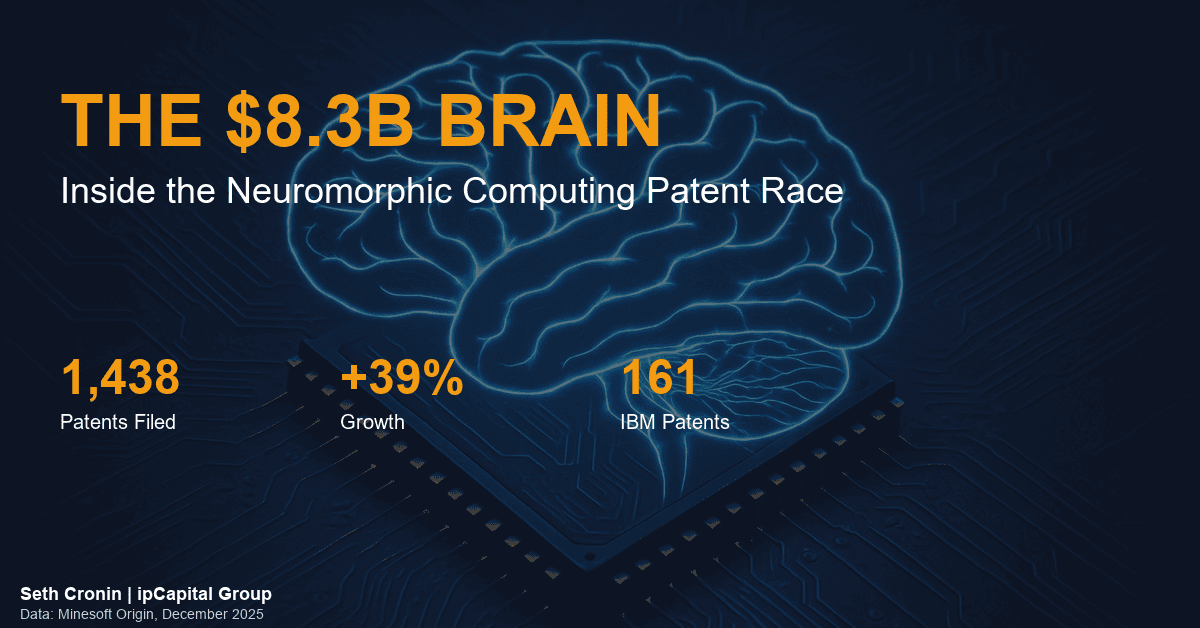
Meanwhile, 1,438 patents have already been filed in neuromorphic computing since 2020.
Is Rao too late? Or is he seeing something the patent data confirms?
I analyzed every neuromorphic computing patent filed in the last five years. Here’s what I found.
Let’s start with why neuromorphic computing matters.
Training GPT-4 consumed approximately 50 GWh of energy. That’s enough to power 5,000 homes for a year.
Running inference at scale? Even worse. Every ChatGPT query costs 10x the energy of a Google search.
The AI industry has an energy problem. And it’s getting worse.

Neuromorphic chips—processors designed to mimic the human brain’s neural architecture—promise a different path.
According to IEEE Spectrum, neuromorphic chips consume 80% less energy than conventional AI systems. A single BrainChip Akida chip runs on milliwatts—enough for years of battery life in IoT sensors.
UT Dallas researchers, working with Texas Instruments, are targeting 100-1000x more energy efficiency compared to Nvidia GPUs.
This isn’t incremental improvement. It’s a paradigm shift.
Since 2020, neuromorphic computing has generated significant patent activity:
| Year | Patents Filed | YoY Growth |
|---|---|---|
| 2020 | 200 | – |
| 2021 | 234 | +17% |
| 2022 | 249 | +6% |
| 2023 | 244 | -2% |
| 2024 | 234 | -4% |
| 2025 | 277 | +18% |
Total: 1,438 patents
After a plateau in 2023-2024, filings accelerated 18% in 2025. The Unconventional AI announcement may drive this even higher in 2026.

The top patent holders aren’t startups. They’re the usual suspects—with some surprises.
Top 10 Neuromorphic Computing Patent Holders (2020-2025):
| Rank | Company | Patents |
|---|---|---|
| 1 | IBM | 161 |
| 2 | Samsung Electronics | 141 |
| 3 | Umnai Ltd | 54 |
| 4 | HRL Laboratories | 52 |
| 5 | Intel | 47 |
| 6 | Tata Consultancy | 26 |
| 7 | Micron Technology | 23 |
| 8 | Syntiant | 21 |
| 9 | ETRI (Korea) | 20 |
| 10 | Polyn Technology | 19 |
The IBM Dominance:
IBM’s 161 patents—11% of all filings—reflect their TrueNorth legacy and ongoing neuromorphic research. They’ve been in this space since 2014.
The Samsung Bet:
Samsung’s 141 patents signal serious investment. They’re not just making memory chips—they’re preparing for what comes next.
The Intel Gap:
Intel, despite building the Hala Point system (1.15 billion neurons), has only 47 patents. They acquired Habana Labs for AI accelerators, but their neuromorphic portfolio is smaller than expected.
The Startup Players:
The Missing Name:
Unconventional AI: 0 patents.
Naveen Rao is betting $475 million that he can out-innovate IBM and Samsung. His track record says maybe he can.
Neuromorphic computing isn’t monolithic. The patent data reveals distinct technology clusters:

Spiking Neural Networks (SNNs):
1,242 patents filed for spiking neural networks and event-driven computing since 2020.
SNNs process information using discrete “spikes” rather than continuous values—mimicking how biological neurons communicate. This enables massive energy savings.
2025 saw 284 SNN patents alone—the highest year on record.
Analog Compute:
A smaller but growing cluster focuses on analog processing rather than digital. Unconventional AI is reportedly exploring this approach.
Memory-Compute Integration:
Patents combining memory and compute elements (avoiding the “von Neumann bottleneck”) are accelerating. Micron’s 23 patents focus heavily here.

| Region | Patents | Share |
|---|---|---|
| United States | 730 | 51% |
| WIPO (International) | 173 | 12% |
| European Patent Office | 170 | 12% |
| South Korea | 127 | 9% |
| India | 126 | 9% |
| Others | 112 | 8% |
The US dominates with 51% of filings—driven by IBM, Intel, and defense contractors like HRL Laboratories.
Korea punches above its weight with Samsung and ETRI contributing 127 patents.
China is notably absent from the top filers—only 5 patents. This is unusual for an emerging technology space and may reflect strategic filing patterns or different technology bets.
India’s emergence (126 patents) is surprising. Tata Consultancy’s 26 patents and several universities are driving activity.
So why would investors put $475 million into a company with zero patents in a space where IBM has 161?
Three possible answers:
1. The Architecture Bet
Rao isn’t building incrementally better neuromorphic chips. He’s pursuing “brain-inspired” computing that may leapfrog existing approaches.
If his architecture is fundamentally different, IBM’s patents in traditional neuromorphic designs become less relevant.
It’s like having the best patents for film cameras when digital arrives.
2. The Talent Premium
Rao’s team includes:
The $475M may be less about technology and more about locking up the talent who can figure it out.
3. The Timing Window
Intel built Hala Point. IBM has TrueNorth. But neither has achieved commercial scale for AI workloads.
There’s a window—maybe 2-3 years—before the market consolidates. Rao is racing to fill it.
The patent data reveals several gaps where focused teams can still build meaningful positions:
1. Application-Specific Neuromorphic:
Most patents focus on general-purpose neuromorphic architectures. Specific applications (medical devices, autonomous vehicles, robotics) are undercovered.
2. Software Stack:
The hardware is being patented heavily. The software to program neuromorphic chips? Much less so.
3. Hybrid Architectures:
Combining traditional GPUs with neuromorphic accelerators for specific workloads is nascent.
4. Edge Deployment:
While Syntiant focuses here, the IoT/edge neuromorphic space remains fragmented.
Neuromorphic computing is no longer a research curiosity.
The energy crisis in AI is real. Neuromorphic computing offers a path forward.
IBM and Samsung have the patent portfolios. Intel has the systems. Startups like Syntiant have the edge focus.
But the market remains early. The winning architecture isn’t determined.
The white space exists, but it is narrowing. Teams building at the edge should map their IP strategy before the dominant architectures harden.
Investors should watch the Unconventional AI experiment. If Rao succeeds, the valuation math changes for the entire category.
Acquirers should treat this as an acqui-hire space today and a strategic acquisition category tomorrow.
The brain-inspired future is being patented right now.
Data: Minesoft Origin, December 2025. Market projections from industry analysts.
Need to understand what this means for your portfolio? ipCapital Group helps leadership teams turn patent landscapes into practical decisions about filing strategy, competitive diligence, M&A readiness, and monetization.
Start a conversation with ipCapital Group or download the IP Strategy Playbook.
Work with ipCapital Group
From invention to monetization, our team has guided 2,000+ engagements across the full IP lifecycle. Start with a free 30-minute discovery call.

Written by
Seth Cronin