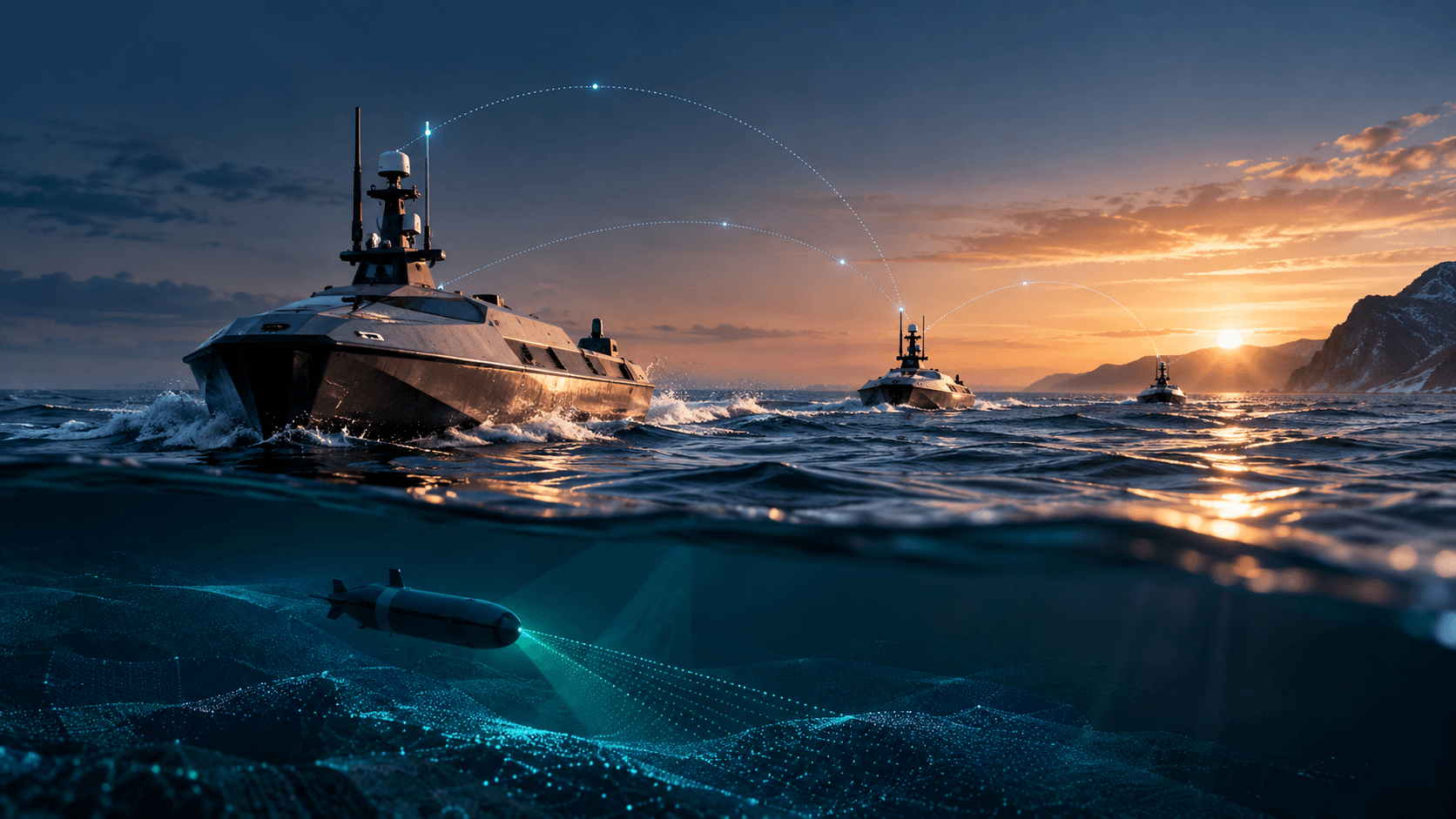
Patent-heavy hulls will not win the next decade. The moat is shifting to the software, fleet coordination, and data-service layers of ocean autonomy.
Patent-heavy hulls will not win the next decade. The durable moat is shifting to the software, fleet coordination, and data-service layers that turn uncrewed surface vessels into persistent ocean infrastructure.
Market shift: from hull design to the autonomy stack
Uncrewed, solar-powered surface vessels have crossed a threshold. Self-righting hulls, robust edge compute, and low-drift power budgets now enable multi-month deployments. As ocean sensing, security, and infrastructure inspection move from expeditions to continuous presence, the strategic control point is migrating from hull design to the autonomy stack that commands fleets and monetizes data.
The industry’s patent gravity remains hardware-centric, while the next decade’s differentiation will be written in software: mission control, AI analytics, fleet coordination, and the economics of marine data services.
Evidence: filings concentrate in hardware
US filings in autonomous surface vessels are concentrated among a few well-funded incumbents, chiefly in mechanical systems and platform hardware. One leading incumbent holds 74 US patents and the next holds 21. A mid-tier player appears with 3. Meanwhile the cloud, AI, and data-service layers remain comparatively under-patented.
Filings cluster in hulls and platform hardware, leaving the cloud, AI, and data-service layers comparatively open.
Hardware patents dominate the visible portfolios.
Cloud command platforms, AI-driven ocean analytics, multi-vessel fleet coordination, and marine data-as-a-service all show visible white space.
That asymmetry creates timing leverage for teams building the autonomy and data layers now.
A conceptual map of the stack. Filing gravity sits at the base while differentiation moves to the upper three layers.
Why now
Deployment duration and mission complexity are growing faster than legacy control stacks. Endurance targets are measured in months, demand is dual-use across environmental monitoring and maritime security, and the software and data layer remains under-patented.
Self-righting hull designs de-risk long missions, but value concentrates when autonomy, energy, and sensing converge into fleet-wide software that scales from one vessel to hundreds.
Opportunity: three build zones
Three strategically meaningful build zones stand out where product and IP strategy can reinforce each other.
1. Autonomy control plane
Cloud-to-edge command, assurance, and mission compilation.
Why it matters: Mission complexity and regulatory assurance are rising, and operators need repeatable safety envelopes rather than bespoke scripts.
Build: A cloud-native control plane that compiles intent into edge-executable behaviors, with policy, geofencing, risk scoring, and over-the-air updates across variable connectivity.
Protect: Methods for intent-to-mission compilation, energy-aware policy transforms, degraded-comms fallbacks, and self-righting state integration with autonomy decision loops.
2. Fleet OS
Multi-vessel coordination and task economics.
Why it matters: Value scales when dozens of vessels coordinate sensing, handoffs, and coverage, especially under power, weather, and bandwidth constraints.
Build: A fleet scheduler that allocates tasks by energy budget, ocean state, and sensor mix, with mesh communications, rendezvous logic, and cross-domain handoff across surface, air, and satellite.
Protect: Protocols for energy-aware and risk-aware tasking, inter-vessel consensus under intermittent links, handoff verification, and mission SLA enforcement at fleet scale.
3. Ocean data service layer
Provenance, analytics, and monetization primitives.
Why it matters: The defensible asset is trusted, queryable ocean data with quality guarantees and lineage, not raw packets.
Build: A data pipeline with sensor fingerprinting, on-edge event detection, adaptive sampling, encryption at sea, and marketplace-ready pricing, watermarking, and SLAs.
Protect: Data provenance models for marine sensors, event-driven compression, streaming quality scores, and watermarking and rights tracking tied to mission context.
Product implications: from vessel-first to autonomy-first
Ship a mission compiler and policy engine before adding niche sensors.
Design every feature for fleet scale: provisioning, updates, observability, and rollback.
Treat data lineage and quality as a customer-facing contract with SLAs.
Bundle autonomy, analytics, and service guarantees into outcome-based pricing.
Dual-use by design. Build for environmental monitoring and maritime security with the same primitives: assurance, auditability, remote updates, and zero-trust communications. This unlocks government procurement while making commercial deployments safer.
IP implications
Portfolios dominated by hull mechanics risk getting boxed in by incumbents with large legacy filings. The leverage now sits in method and system claims that bind hardware to autonomy and data economics.
File method claims on mission compilation, energy-aware routing, degraded-link behaviors, and fleet scheduling.
Protect data-service primitives: provenance, watermarking, pricing, and SLA verification for marine telemetry.
Use continuations to extend core mechanical claims into systems-level integrations, such as self-righting states feeding autonomy policies.
Prioritize jurisdictions aligned to growth and procurement, across the UK, EU, and North America, where partnerships and defense buyers value IP assurance.
IP is not just defense. It is eligibility. It enables government contracts, partner confidence, premium valuation, and cross-licensing options with patent-heavy incumbents.
Meaningful white space
Not all white space is equal. The following layers remain under-patented yet central to autonomous ocean operations.
A. Assurance by design
What: Certifiable autonomy behaviors for contested waters, where operators need predictable, inspectable autonomy under NATO and IMO-aligned rules of the road.
Build: Safety envelopes, explainable decision logs, and automated post-mission audit trails linked to mission policies.
Protect: Policy compilation, explainability artifacts, and automated compliance proofs across edge and cloud.
B. Energy intelligence
What: Solar, sea state, and payload-aware mission planning. Power is the hard currency of ocean autonomy and planning must treat it as a first-class constraint.
Build: Forecasting models that balance charge cycles, payload duty, and weather windows, with opportunistic loitering and sprinting behaviors.
Protect: Methods for energy-state prediction tied to mission goals, action selection under uncertain generation, and multi-vessel recharge coordination.
C. Edge AI for the ocean
What: Onboard detection that saves bandwidth and time. Bandwidth is scarce, and catching events at the edge turns months of drift into minutes of insight.
Build: Acoustic and visual event detectors, adaptive sampling, and change-point alerts fused with satellite tasking for rapid response.
Protect: Event-triggered compression, confidence-weighted transmission, and sensor fusion methods resilient to marine noise.
The bigger trend
The autonomy-stack gap is not unique to ocean systems. Across ground robots, drones, logistics, mining, agriculture, and industrial inspection, filings overweight hardware while orchestration, assurance, and data rights lag. That is where durable moats are emerging.
Workflow layers: A fleet OS coordinates heterogeneous assets under constraints.
Data architectures: Provenance, watermarking, and SLAs become the product.
Automation systems: Edge AI pushes decisions to the field with policy guardrails.
AI applications: Model choice matters less than the mission-context pipeline around it.
Executives who treat autonomy and data services as IP-bearing products, not just features, consistently unlock new revenue, procurement eligibility, and acquisition optionality.
CEO-level takeaways
The moat is moving up the stack, to the control plane, the fleet OS, and data-service economics.
Patent concentration among incumbents creates asymmetry, and an opening, if you protect software and data primitives now.
Dual-use buyers increasingly require IP assurance across autonomy and data layers.
Let’s discuss where this meets your roadmap
Where is the hidden white space in our autonomy and data layers?
Which roadmap concepts contain protectable inventions today?
What strategic positions could competitors occupy first, and how do we preempt them?
How can product strategy and IP strategy reinforce each other in the next two quarters?
The hull is the commodity. The autonomy stack is the moat.Talk with ipCapital Group about aligning product direction with strategically meaningful intellectual property.
Share
Work with ipCapital Group
Turn insight into IP strategy
From invention to monetization, our team has guided 2,000+ engagements across the full IP lifecycle. Start with a free 30-minute discovery call.