
The orbital service layer spans space awareness, rendezvous, servicing, and in-space assembly. A patent landscape shows where the technical and IP positions are forming.
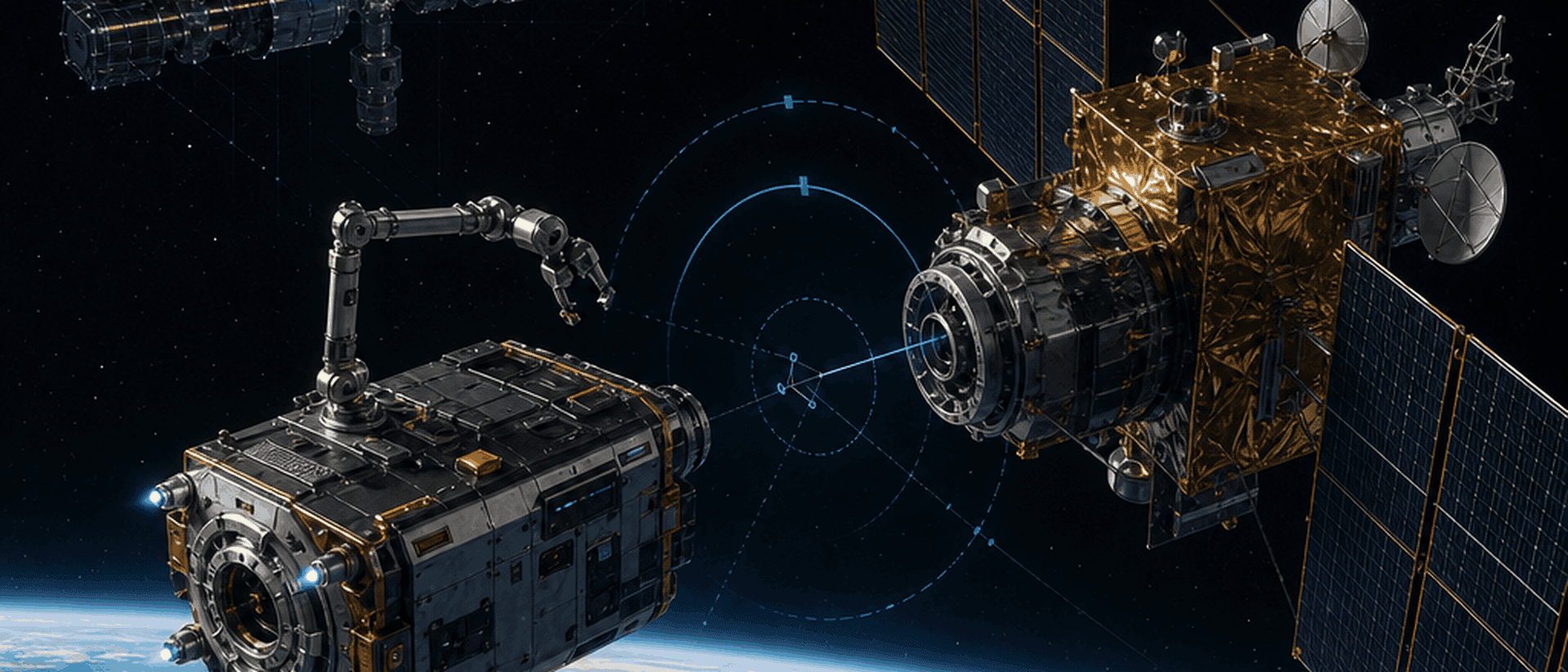
Launch puts hardware in orbit. The next valuable layer keeps that hardware working.
That means finding an object, predicting where it will be, approaching it safely, inspecting it, docking with it, servicing it, or building something nearby. Each capability has its own hardware and software. The more interesting IP position sits in the connections among them.
The UK government gave that stack a fresh business signal on July 20. It announced more than £62 million for satellite communications and space innovation. The package includes £42 million for the C-LEO program and £20 million for the National Space Innovation Programme. Up to 40% of the latter is focused on space domain awareness and in-space assembly and manufacturing.
Funding does not prove where the best IP sits. It tells us which operating problems governments and industry expect someone to solve.
So I mapped the patent layer.
I built four Boolean search sets in Minesoft Origin. Each used title, abstract, and claims text, limited the results with relevant CPC classifications, and grouped the results by extended family.
ATAC=(space_domain_awareness OR space_situational_awareness OR ((space_object* OR orbital_object* OR resident_space_object*) W8 (detect* OR track* OR monitor* OR surveill*)) OR (satellite* W8 conjunction_assess*) OR (satellite* W8 collision_avoid*)) AND CPC=(B64G* OR G01S*) AND PD>2010ATAC=((spacecraft* OR satellite* OR orbital_vehicle*) W10 (rendezvous OR dock* OR proximity_operation* OR relative_navigation)) AND CPC=(B64G*) AND PD>2010ATAC=((spacecraft* OR satellite* OR orbital_vehicle*) W10 (servic* OR inspect* OR repair* OR refuel* OR deorbit* OR life_extension)) AND CPC=(B64G*) AND PD>2010ATAC=(in_space_assembly OR in_space_manufactur* OR on_orbit_assembly OR on_orbit_manufactur* OR orbital_manufactur* OR ((in_space OR on_orbit) W5 (additive_manufactur* OR 3D_print* OR construct* OR assembl* OR fabricat*))) AND CPC=(B64G*) AND PD>2010The searches returned:
Those sets overlap. A servicing patent can also discuss rendezvous, docking, inspection, and relative navigation. Adding the four numbers would double-count that overlap. The union returned 1,656 extended families.
This work is a bibliographic landscape. I reviewed records, abstracts, and first-claim previews for representative results. I did not review complete claim sets, so the analysis does not establish infringement, validity, product coverage, freedom to operate, or the legal scope of any patent.

The combined query produced 44 indexed application records for 2010. That bucket reached 437 in 2020. The statistics stayed above 300 in every year from 2021 through 2024:
The 2025 bucket contains 235 records and 2026 contains 23 as of July 27. Those years are incomplete because patent applications often publish after an 18-month delay. I would not read the lower recent buckets as a market slowdown.
The chart uses application-record statistics under the same query. It should not be compared directly with the 1,656 extended-family search total because one family can produce multiple application records.

The useful signal is the shape before the lag. Activity stepped up sharply in the late 2010s and established a higher operating range from 2020 onward. The field was already moving from isolated demonstrations toward a broader infrastructure layer.
The ultimate-owner statistics under the combined query returned a mixed group of aerospace primes, public research organizations, universities, and focused orbital-service companies.
The largest named record buckets included:
These are indexed-record counts from the statistics endpoint, not extended-family portfolio totals. The labels also reflect Minesoft’s ultimate-owner normalization. I did not merge similarly named entities beyond what the endpoint returned.

The mix explains why the opportunity is difficult to reduce to a normal competitor grid.
An aerospace prime can connect spacecraft design, mission planning, ground systems, and government programs. A focused company can build deeper operating data around one mission type. A university or research institute can establish an early technical position before the commercial market is ready.
Owner counts are only a starting point. The strategic question is which owner can connect protected technology to repeatable missions, operating data, integration know-how, and customer trust.
The bibliographic results describe four different jobs.
Space domain awareness starts with sensing, but sensing alone does not create an operating picture.
Representative results include US-20260140250-A1, assigned to InTrack Radar Technologies, on searching for space objects; EP-4016504-A1, assigned to OKAPI:Orbits, on determining collision probability; and EP-4571358-A2, assigned to the Korea Astronomy and Space Science Institute, on space-surveillance and tracking radar.
The titles, abstracts, and first-claim previews move from observation into search scheduling, risk analysis, and decision support. That is the first transition in the service stack: raw measurements become a basis for action.
Rendezvous requires relative navigation, guidance, control, sensing, and a physical capture or docking interface. Those elements have to work together under limited communications, limited fuel, and tight safety margins.
Representative records include EP-4554863-A1, assigned to ClearSpace, on a spacecraft docking system and method; and US-12600498-B1, assigned to IMETALX, on a multi-agent spacecraft system for rendezvous and proximity operations.
The service provider has to know where the target is, understand how it is moving, plan the approach, control the servicing vehicle, and handle the physical interaction. An error in one layer can invalidate the rest of the mission.
The servicing set is the largest of the four at 734 extended families.
Representative records include US-20190023420-A1, assigned to Northrop Grumman Innovation Systems, on spacecraft servicing devices and related assemblies; US-12097979-B1, assigned to Astroscale Israel, on rendezvous and docking using electric propulsion thrusters; and US-20220332443-A1, on servicing systems for on-orbit spacecraft.
The returned records span capture, station keeping, modular servicing equipment, inspection, repair, refueling, life extension, and deorbiting. The commercial value rests on completing the mission reliably across those layers.
In-space assembly and manufacturing is the smallest search set at 198 extended families. It may also demand the largest change in system design.
Representative records include US-20220219839-A1, assigned to Opterus Research and Development, on in-space assembly using a composite boom, robotic arm, and printhead; US-20240013939-A1, assigned to Atomos Nuclear and Space, on modular space reactor systems; and US-12595080-B1, assigned to Nanjing University of Aeronautics and Astronautics, on an auxiliary device for assembling space structures in orbit.
The common idea is architectural freedom. Hardware no longer has to reach orbit as one finished object constrained entirely by a launch vehicle’s volume and loads. Assembly, deployment, repair, and manufacturing can become part of the operating plan.
The CPC statistics confirm the cross-disciplinary character of the field.
The largest bucket is B64G for cosmonautics and spacecraft. The same results also include:
Those CPC buckets overlap. They are tags on records, not pieces of a pie.

This is why a narrow patent list will miss the business story. A working service can depend on protected hardware, proprietary software, mission data, simulation, operator procedures, supplier relationships, and physical interfaces. Some of that belongs in patents. Some should stay secret. Some depends on contracts or standards. The architecture has to show the whole system.
I would start with the transitions:
A competitor can sometimes replace a component. Replacing a tested loop is harder because the parts have learned to work together.
That does not mean every integration should be patented. It means the company should identify what is technically distinctive, what can be observed or reverse engineered, what depends on confidential know-how, and where standards or partner interfaces constrain the design. Patent counsel can then assess the legal questions against a business and engineering map that reflects the real system.
The visible space race still centers on launch, constellations, and payloads. The quieter race is about what happens after deployment.
Who can see clearly, move safely, touch reliably, perform useful work, and learn from every mission?
That is the orbital service layer. It is becoming infrastructure.
Work with ipCapital Group
From invention to monetization, our team has guided 2,000+ engagements across the full IP lifecycle. Start with a free 30-minute discovery call.

Written by
Seth Cronin