
Patent activity is dense in digital twins and policy tooling but light in privacy-preserving governance. That asymmetry is where the IP window sits.
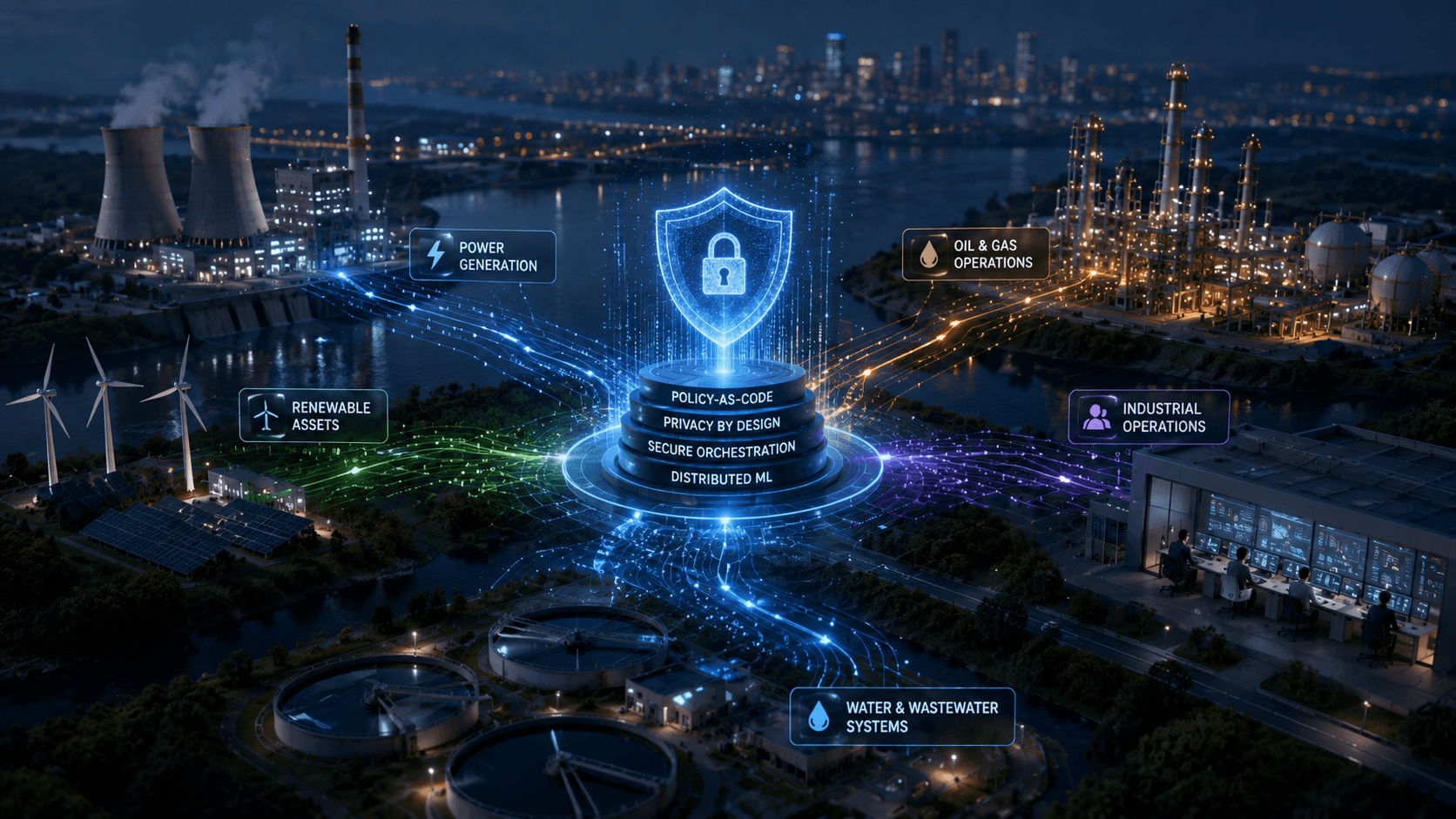
The patent-light zones are not where you think. They are around data governance fused with distributed ML and policy-as-code. That is where durable advantage is compounding.
Critical infrastructure operators are converging three forces: digital twins for real-time context, distributed ML to respect data boundaries, and policy-as-code to make compliance executable. The strategic insight is that privacy-preserving orchestration, not raw AI horsepower, will decide who wins procurement, trust, and long-run margins.
As AI touches regulated workloads, the architecture that bakes in privacy, residency, and auditability by design becomes the differentiator. This is creating a new class of defensible products: governance-aware AI platforms that operate across clouds, edges, and jurisdictions without violating policy or performance constraints.
Patent activity is dense in twins and policy tooling, but remarkably light in privacy-preserving governance. In the areas that decide trust and deployability, the field is materially more open than in infrastructure-heavy categories. That asymmetry creates a near-term window to establish durable positions around data governance fused with federated ML.


Why it matters: AI needs to act on live systems without crossing policy or safety boundaries. Operators want orchestration that is provably compliant.
Strategic IP angles: Policy-carrying graph formats, validation compilers for governance-aware execution, and twin-linked safety constraints for ML actuations.
Why it matters: Residency and sector regulations now dictate architecture. Automation that proves compliance, rather than claiming it, will win RFPs.
Strategic IP angles: Verifiable residency proofs, policy-aware schedulers, and compliance drift monitors with remediation logic.
Why it matters: Executives need a straight line from regulation text to enforceable controls in data prep, training, serving, and feedback.
Strategic IP angles: Multi-target policy compilers, privacy-budget allocators across federated nodes, and lineage binding between regulatory clauses and pipeline steps.
The defensible layer is shifting to how systems coordinate data, twins, models, and policy under real-world constraints. Focus product roadmaps and IP capture on:
These are the primitives customers will pay for, and the surfaces where strong patent positions can amplify sales velocity, partnership leverage, and valuation.
With digital twin and policy tooling already crowded, the opening sits in the glue code that makes AI deployable in regulated environments. The counts above indicate a rare window: privacy-preserving governance and federated ML controls remain comparatively under-protected, and central to buyer decisions.
What is emerging in critical infrastructure is rhyming across healthcare, education, public sector, financial services, and industrial IoT. As AI scales, the advantage accrues to platforms that convert governance into code, then bake that code into orchestration. The repeatable invention patterns include:
Executives who systematize this pattern discover that hidden inventions already sit inside their architecture decisions, and that coordinated product and IP strategy can turn those decisions into durable market positions.
Across your roadmap and customer deployments, there are likely invention-grade mechanisms that can be captured now, before the category ossifies and the white space closes.
Questions worth a working session:
If you are building AI for regulated, distributed, or safety-critical environments, now is the time to turn governance into code, and code into advantage. Talk with ipCapital Group about mapping the protectable seams in your orchestration layer.
Work with ipCapital Group
From invention to monetization, our team has guided 2,000+ engagements across the full IP lifecycle. Start with a free 30-minute discovery call.

Written by
John Cronin