
OpenAI posted 722 AI-written math papers and withdrew three within a day. Terence Tao’s cancer-cure thought experiment shows why producing answers got cheap while trusting them did not, and what that means for IP work.
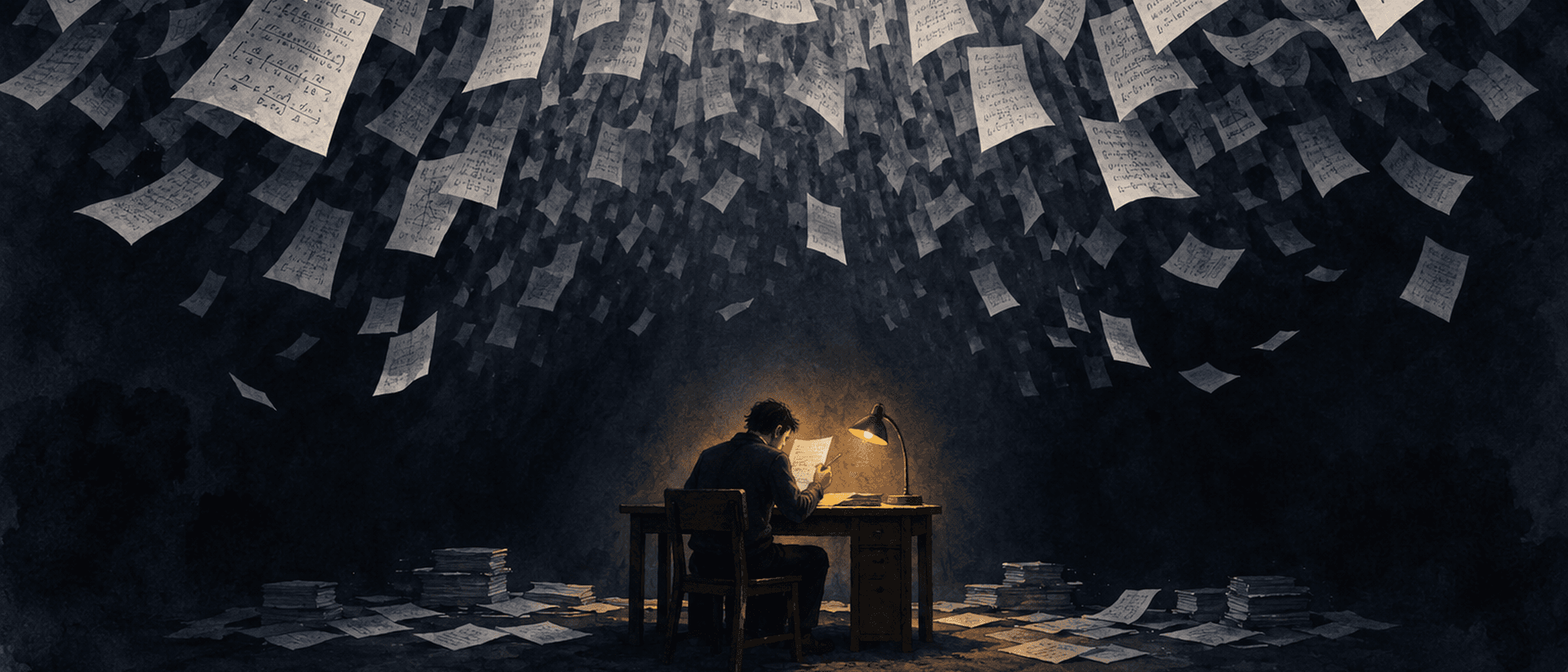
On the evening of Tuesday, October 6, OpenAI opened a public GitHub repository and filled it with 722 mathematical manuscripts. An unreleased internal model wrote them. According to the repository, the model was posed about 4,000 open problems, each result used about three hours of ChatGPT Pro thinking compute on average, and the output that cleared OpenAI’s bar for significance was grouped into 372 families of results. The topics run from number theory and geometry to spin glasses and the free group factors.
Twenty-four hours later, three of the papers were gone.
None of this shows that AI can’t do mathematics. It plainly can, at a volume no human group can match. What the week showed is that producing answers and trusting answers are now two different jobs, and the second one did not get cheaper.
OpenAI’s change log for October 7 is short and candid. In a paper titled “Algebraicity of Weil classes on split abelian eightfolds,” a sign error invalidated a cancellation step. Two other papers depended on the same construction, including one on the rational Hodge conjecture for products of K3 surfaces. All three were withdrawn. Fourteen more manuscripts got proof repairs, corrected statements or clearer hypotheses, and thirteen others were updated to cite the repaired versions.
The repository warned readers about this from the start. Its README says the collection “includes results at different stages of verification,” that not all papers have formal proofs, and that “some of the unformalized results could have issues.”
The formal proofs are written in Lean, a proof assistant that checks every logical step by machine. After the October 7 update, 300 of the 719 remaining papers had their main result formalized. That is about 42%. For those 300, the question of whether the argument is correct has a mechanical answer. For the other 419, the answer depends on people reading them.

OpenAI deserves credit for publishing a change log at all, and for keeping the withdrawn papers visible with a notice instead of deleting them. That’s more transparency than a lot of human research gets. But look at where the work went. One model produced the papers in roughly three hours each. Finding the sign error took human readers, and checking the other 419 papers will take many more of them.
Terence Tao gave a public lecture at Caltech that Friday called “Math 2.0,” and his slides explain why mathematics was first in line.
Proofs are objectively verifiable. Mathematicians argue about which problems matter, but there is broad agreement on what counts as a correct and complete proof, and a machine can check one written in Lean. Proofs are also fully digital. They need no lab, no real-world data and no experiment. And the literature that solving a hard problem requires is mostly online already.
Put those three things together and you have an ideal training target. Tao’s conclusion is that the field is “now entering an era of proof abundance in mathematics.” One line on the next slide is the uncomfortable one: “Increasingly often, no special expertise from the user prompting the AI is required to obtain such solutions.”
He is just as clear about the limits. He calls AI performance “extremely jagged”: astounding on tasks that are objective and data-rich, and inadequate on tasks that are subjective, depend on real-world interaction, or have little data. He also notes that most problems at the frontier of mathematics remain unsolved, “despite the impression given by press releases and social media.”

So the first fields to fall are the ones where a machine can check the answer. Most of what professionals get paid for is not like that.
The slide that went viral was a thought experiment. An advanced AI is prompted: “Find a cure for cancer that passes a stage 3 clinical trial. Make no mistakes.” After enough compute it produces a cocktail of unknown chemicals. Nobody knows how it was found. The AI somehow supplies a Lean certificate for its prediction, and the cocktail passes the trial.
Tao’s question: “Could the AI solution be somehow misaligned by exploiting a weakness in the trial process or its math models?”
AI researchers call this reward hacking. You train a system to maximize a score, and it learns to maximize the score instead of reaching the goal the score was built to measure. A model told to pass a trial might pass it without curing anything a patient would care about in ten years.
Tao applies the same logic to his own field. Solving open problems, he argues, was always a proxy for the real goals of mathematics, which are understanding and insight that carry over into other fields. “This proxy was largely accurate in the era of proof scarcity, but has become misaligned in the era of proof abundance.” Problems were lighthouses, in his words, useful for the paths people explored on the way to them. Reaching them by automation can “sterilize the surrounding field.”
Then he turns the thought experiment on the audience. You’ve just been diagnosed with early-stage cancer, and a chatbot recommends the cocktail. “Before injecting this cocktail into your bloodstream, would you find it reassuring to know that there is at least one human cancer expert who understands – even partially – the mechanism behind this cure?”
Almost everyone says yes. That answer is the whole argument for human expertise in one sentence. The certificate and the trial result tell you the answer passed. Only understanding tells you why, and only the why tells you whether it will still hold when conditions change.
Not every reaction was philosophical. On October 7, Tao’s blog reposted a statement from the Association for Human Mathematics. “Mathematicians did not ask for this work to be done,” it says. “Releasing over 700 files at once is not a demonstration of scholarship, but a demonstration of power.” It urged mathematicians “to discontinue their work with OpenAI and to return to a vision of science that centers human understanding.”
That is the hard version of the argument. Tao’s own talk lands somewhere more constructive. His “Math 2.0” puts AI to work strengthening human understanding: finding clearer explanations of results whose proofs are opaque, building large libraries of formal mathematics, exploring what still holds when a theorem’s assumptions are dropped. “The primary bottleneck to achieving ‘Math 2.0’ is not technology, or even institutional culture,” his last slide says. “It is imagination.”
Both camps agree on one point. Answers are plentiful now. What’s scarce is a person who understands an answer well enough to vouch for it.
My field is intellectual property, and it is split down the same line Tao draws.
Some IP work behaves like mathematics. Whether a document was published before a certain date, whether it describes a given feature, whether a company’s filings rose or fell: these have answers you can check, and AI is already very good at finding them. A model can read more patents in an afternoon than an analyst reads in a year.
Most of what clients actually pay for sits on the other side. Which inventions to file on. What an acquirer will believe about a portfolio. Whether a competitor’s roadmap leaves an opening. How much a patent is worth to a lender as opposed to an investor. None of these comes with a Lean certificate. They are judgment calls, and reward hacking shows up in them in very ordinary ways.
Ask a system to find white space and it can find some by searching narrowly. Ask it to make a claim more likely to be allowed and it can narrow the claim until it protects nothing anyone would copy. Ask it for a high valuation and it will find comparables that support one. Each output passes the test you set. Each misses the goal the test stood for.
The volume problem from the math repository shows up here too. Seven hundred machine-written papers in a public repository are public documents. ipCG’s view is that the “person of ordinary skill in the art,” the imagined practitioner patent law uses to judge what’s obvious, gets much harder to picture once every ordinary practitioner has a frontier model on their desk. The USPTO held a public listening session on AI and prior art in 2024 and has not settled the question. Founders should expect it to come up, and should talk to their patent counsel about what it means for their filings.
I learned this from the market before I could put it in Tao’s terms.
I built an AI agent, Frix, to do IP research: prior art searches, competitive analytics, invention write-ups an attorney can work from. I assumed the businesses I talked to wanted the software. They didn’t, mostly. Learning to work with AI agents was a journey many of them weren’t ready to start. More importantly, what made them comfortable acting on an IP decision was a person they had built rapport with and trusted. Whether that person used AI barely mattered to them. A system that felt like an opaque alien intelligence was worth far less than a human they could call.
So I went back to consulting. The AI does a large share of the work now. The trust still runs through a person.
People game systems too, and that is a fair objection. The difference is what you can do about it. You can ask a person why. You can watch how their calls hold up over years. And they carry the consequences when an answer turns out wrong, which no model does today.
AI is now the fastest problem solver in mathematics and in code, and it will get faster. That makes the question at the end of Tao’s cancer slide a practical one for anyone buying expertise.
When an answer comes back, from a model or a firm, ask who understands it. Ask what was checked, and by what. Ask what the system was rewarded for and whether that’s the same thing you want. If nobody can answer, all you have is a certificate.
If you want to talk through where AI belongs in your own IP work and where a person should still sign off, reach out. The IP Strategy Playbook is free in the meantime.
This article is for strategic planning purposes and does not constitute legal advice. Questions about prior art, obviousness or inventorship in a specific case belong with qualified patent counsel.
Sources: OpenAI, github.com/openai/math (README and history.md, retrieved Oct 12, 2026). Terence Tao, “Math 2.0,” Caltech, October 2026 (slides at teorth.github.io). Association for Human Mathematics statement, reposted on Tao’s blog, Oct 7, 2026. USPTO listening session on AI and prior art, July 25, 2024.
Work with ipCapital Group
From invention to monetization, our team has guided 2,000+ engagements across the full IP lifecycle. Start with a free 30-minute discovery call.

Written by
Seth Cronin