
PLD Space raised $209M, but reusable launch vehicle patents show ArianeGroup, Blue Origin, and Stoke Space already own the technical ground.
Europe’s private rocket race is accelerating, and the IP landscape behind it deserves the same attention as the funding headlines.
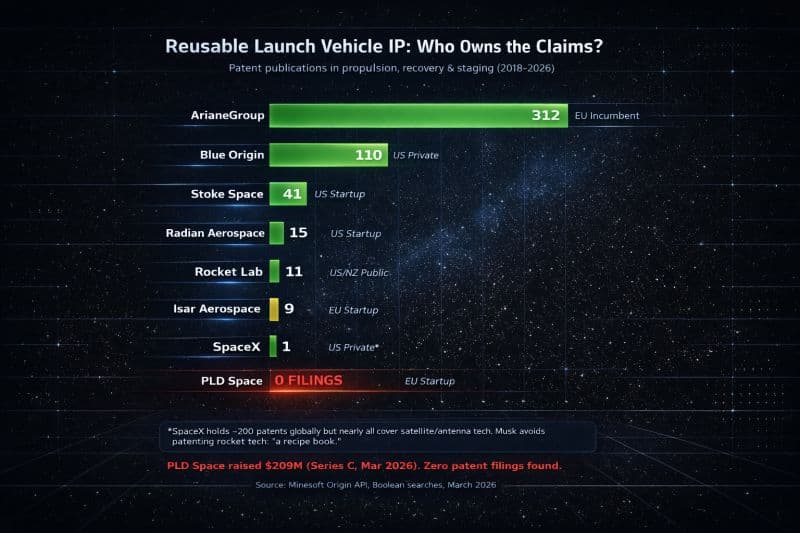
PLD Space just closed a $209 million Series C to move into serial production of its Miura 5 launch vehicle, one of the largest private space rounds in European history. A Minesoft search across reusable launch propulsion and recovery patents since 2018 reveals a clear hierarchy: ArianeGroup has published 312 patent documents, Blue Origin 110, and Stoke Space 41. These filings cover engine cycles, vertical landing methods, and stage separation mechanisms.
Funding shows who is building, but patent filings show who already owns the technical ground.
SpaceX is the outlier, holding virtually no rocket propulsion patents. Musk called patents “a recipe book” for competitors and bet on trade secrets instead, a strategy that works when you are a decade ahead operationally and valued at $800 billion. For earlier-stage companies competing for the same ESA and commercial contracts, the calculus is different. Granted claims on propulsion and recovery systems create real freedom-to-operate questions that every founder and investor in this space should answer early.
Propulsion patent filings grew 75% between 2018 and 2025, and the land grab is still underway. For anyone backing European launch startups, the IP map matters as much as the flight manifest.

Backing or building a launch company and need to know where the granted claims already sit? Talk to ipCapital Group about a freedom-to-operate and IP landscape analysis before your next round.
Work with ipCapital Group
From invention to monetization, our team has guided 2,000+ engagements across the full IP lifecycle. Start with a free 30-minute discovery call.

Written by
John Cronin