
Robotaxi patent data shows automakers own the depth while Tesla barely files. Durable leverage sits in teleoperation and fleet orchestration.
In February, Waymo raised $16 billion at a $126 billion valuation, the largest round the robotaxi category has ever seen (TechCrunch, Feb 2, 2026). Last week, Tesla expanded its robotaxi service to all of Austin with a fleet reported around 20 vehicles (Electrek, Jun 3, 2026). The press covers this as a race of fleet size and city count. That is the visible game. The durable game is over who owns the inventions, and the filing data tells a different story than the headlines.

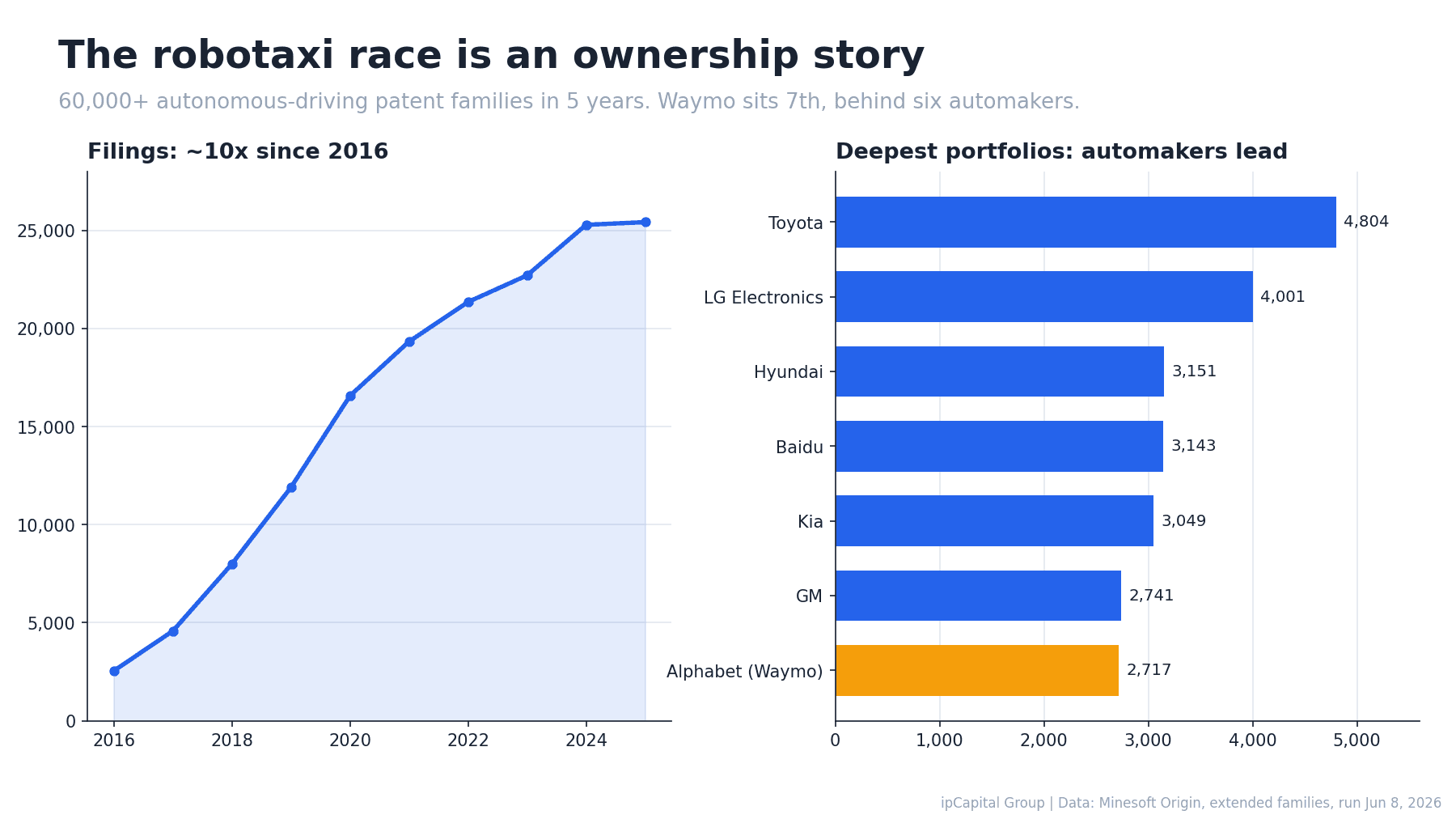
More than 62,000 patent families touch autonomous driving in the last five years. The curve is up roughly 10x from 2016, with a steep climb through 2020 and a high plateau from 2023 to 2025. This is not a green field. It is a mature, crowded space where the easy ground is already claimed and the open questions sit in the hard sub-problems.

By family count, the deepest owners are Toyota (4,804), LG Electronics (4,001), Hyundai (3,151), Baidu (3,143), Kia (3,049), and GM (2,741), then Alphabet/Waymo at about 2,717. Aurora, Bosch, and Amazon (with Zoox) follow. The takeaway is blunt: automakers and a few suppliers hold the strongest filing positions, and the robotaxi brands that dominate headlines do not automatically own the deepest IP. The most striking absence is the name running robotaxis in Austin right now.

So where is Tesla? It barely registers. Tesla Inc holds about 196 patent families in the autonomous-driving net over the last five years, roughly 6% of its ~3,150-family portfolio and a full order of magnitude below the tenth-ranked owner. What it does file clusters in on-vehicle perception (179 families) and motion control (296), the driver-assist layer it already ships. In the service-layer categories a commercial robotaxi depends on, teleoperation and fleet orchestration, no Tesla filings surface in this search at all. These are keyword-net, extended-family counts from Minesoft run June 11, 2026, so read the zeros as “nothing surfaces in this net,” not proof of none.
The weight of Tesla’s IP sits in energy, not autonomy. Battery and energy-storage families outnumber its AV motion-control families by about three to one (940 vs 296).
Is your moat operational or owned? Run a quick screen with our patent valuation calculator, or scope a formal IP valuation with ipCG.
This tracks Tesla’s public posture on patents. Elon Musk has called patents “for the weak,” a line he delivered about SpaceX on Jay Leno’s Garage in 2022 (CNBC). In 2014 Tesla published “All Our Patent Are Belong To You,” pledging not to sue anyone using its technology in good faith (Tesla). That pledge is conditional, not a giveaway. The protection drops if you assert a patent against Tesla or challenge a Tesla patent, which makes it as much a defensive shield as an act of openness. The clearest case of Tesla wielding patents offensively came in 2023, when it sued Cap-XX over supercapacitor patents it had inherited from its 2019 Maxwell acquisition (Bloomberg Law).
Put it together and a deliberate strategy shows. Tesla is betting on being a product and data leader, not an IP leader. It is scaling its own robotaxi fleet instead of licensing the stack, and by late 2025 Musk conceded that no automaker wants to license Tesla’s full self-driving (Electrek). For a competitor or acquirer, that means Tesla’s robotaxi moat is operational and data-driven, not a wall of service-layer patents others must design around. Whether the bet pays depends on execution, not on the portfolio.

Where do the inventions cluster? Motion control and planning is the biggest engineering bucket at roughly 23,000 families. Perception and sensing follows near 17,000. Lidar and radar sit around 5,000, fleet management and orchestration around 5,100, and teleoperation, the remote human fallback every driverless service quietly depends on, is the smallest at under 3,000. These buckets overlap, so they do not sum to the total. The pattern that matters: the core stack is densely filed, and the operational glue, teleoperation and orchestration, is comparatively thin.
The open white space for founders is not “build a better self-driving stack.” That ground is contested by companies with thousands of families. The opportunity is in the adjacent, under-filed problems, especially teleoperation and fleet orchestration, where the filing density is a fraction of the core.
Investors should treat fleet size as a vanity metric for IP value. Durable advantage is better measured by what a company owns in perception, fallback, and orchestration, and whether a competitor can engineer around it.
Acquirers should look beyond the headline robotaxi brands. Suppliers and automakers hold leverage that never shows up in a ride count, and that leverage is what survives diligence.
The robotaxi race looks like an operations story, measured in cities and cars. Underneath, it is an ownership story, measured in claims. The companies raising the biggest rounds are not always the ones with the deepest defensible IP, and the thinnest, fastest-growing niches are often where the next leverage hides. If you are building, investing, or buying in this space, read the portfolio, not just the press release.
Want this kind of read on your own space? At ipCapital Group we map where the defensible IP actually sits, the white space others have missed, and how a portfolio stacks up against the landscape. Start with our IP Strategy Playbook, or if you are weighing what a portfolio is worth, run the numbers with our patent monetization calculator.
Patent counts are extended-family, landscape-level figures from live Minesoft Origin searches. They size the field, not claim scope. For claim scope, clearance, or infringement-risk questions, work with qualified patent counsel. This is strategic analysis, not legal advice.
Work with ipCapital Group
From invention to monetization, our team has guided 2,000+ engagements across the full IP lifecycle. Start with a free 30-minute discovery call.

Written by
Seth Cronin