
On August 26, a jury in North Carolina put a $96.4 million price on wire management.
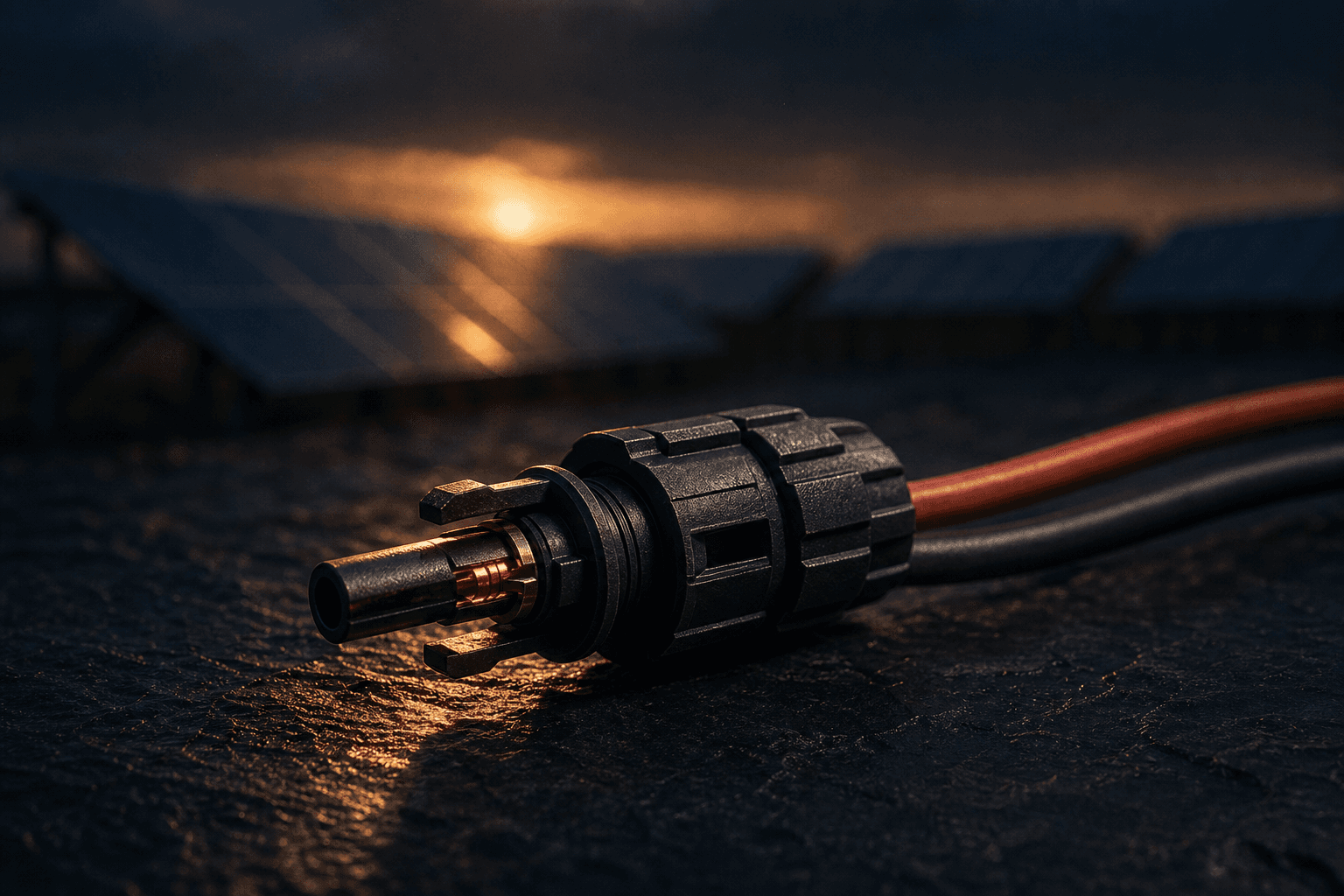
On August 26, a jury in North Carolina put a $96.4 million price on wire management.
Shoals Technologies, a company that makes the cabling and connection hardware for utility-scale solar sites, won a willful infringement verdict against Voltage, LLC and its Chinese manufacturing affiliate, and the court has indicated it will enjoin the infringing product line. The patents at issue were not panels. Not cells. Not inverters. Cabling.
The most interesting IP story in solar right now is not happening in the glamorous part of the field. It is happening in the balance of system: the mounts, trackers, wiring harnesses, combiner boxes, and connectors that turn a pallet of panels into a power plant. Here is what the patent record says about it.

Solar balance-of-system patenting has climbed from 5,404 extended families published in 2011 to a peak of 16,021 in 2024, with 2025 close behind at 14,594 (Minesoft Origin, CPC-anchored query across H02S mounting, interconnection, and monitoring classes plus solar-specific connector filings; retrieved August 31, 2026).
That curve tells you where the engineering effort went. Over the same fifteen years, panel prices collapsed and module manufacturing consolidated into a brutal commodity business. When the core component becomes a commodity, the differentiation, and the margin, migrates to everything around it: how fast you can install, how much labor you can pull out of a site, how much copper you can save, how you monitor and shut down safely. The patent record followed the margin.
Here is the structural fact that makes the Shoals verdict so instructive: this landscape has no dominant owner.

The single largest holder in the balance-of-system set is not a company at all. It is the individual-inventor bucket, at 19,956 families, roughly one family in eight. The largest corporate holders, TotalEnergies (1,558) and Huawei (1,555), each hold about one percent of the field. Panasonic, Sungrow, State Grid, Sharp, Sumitomo, SMA, and SolarEdge all sit in the several-hundreds.
Compare that to the AI fields we have covered this year, where a single company can hold 5, 10, 15 percent of a landscape. Solar BOS is the opposite: a vast, fragmented commons of installers, component makers, and lone engineers, each patenting the specific problem in front of them.
Fragmentation changes the strategy. In a concentrated field, a startup is filing defensively against giants. In a fragmented field, a focused portfolio around one product category can be locally dominant even if it is nationally invisible. Which is exactly what Shoals built.
Break the field into its working parts and the sizes are lopsided (Minesoft, CPC-plus-keyword queries; the sets overlap and do not sum):

Mounting and racking: 56,981 families. Wiring, harnesses, and combiner boxes: 24,446. Monitoring and rapid-shutdown electronics: 23,093. Trackers: 10,720. And solar-specific connectors and junction boxes, the narrow class where cabling hardware claims concentrate: 1,196.
The verdict came out of the thin end. That is not a coincidence. Thin lanes are where claims stay distinctive, where a competitor’s product either uses your approach or visibly does not, and where a jury can be shown the physical thing. The crowded lanes have volume; the thin lanes have teeth.
The geography splits along a line we keep seeing in hardware fields: China accounts for 57,958 of the families, the US 25,003, Korea 19,378, with Europe and Japan behind (Minesoft, country stats on the same query).
But the enforcement economics live in the US. The Shoals damages award came from a North Carolina jury. The parallel exclusion order against the accused imports came from the ITC in June. For a US hardware company facing overseas competition, that combination, district court damages plus an ITC import bar, is the playbook, and it only works if you hold US patents on the things competitors actually have to copy.
Shoals’ own portfolio is the case study inside the case study. It is small: a few dozen extended families. For most of the 2010s the company filed a handful of applications a year. Then, starting in 2021 and peaking with 60 families’ worth of filings in 2022, it ramped hard, right as it went public and as utility-scale solar construction boomed (Minesoft, application-year stats on the Shoals portfolio).

Four years after that filing surge, the company is collecting: a nine-figure verdict, a signaled injunction, and an ITC order, all against a direct competitor in its core product line. Meanwhile the accused competitor’s own recorded portfolio in the space is essentially one published application.
For founders: in a fragmented hardware field, you do not need a thousand patents. You need depth on the product you actually sell, filed while the market is forming. Shoals covered fuse joints, lead assemblies, retention clips, trunk buses, the unphotogenic components its revenue depends on.
For investors: portfolio-to-product fit beats portfolio size. A pitch deck bragging about patent counts in a field where the largest player holds one percent tells you nothing. Ask instead which of the company’s actual SKUs are covered, and who else’s SKUs might be.
For acquirers: the individual-inventor long tail, nearly 20,000 families, is where quiet, cheap acquisitions live in this field. Somebody’s garage tracker mechanism from 2014 may read on half the industry’s roadmap.
Everyone reads the patent landscape of the technology on magazine covers. The margin, increasingly, is in the corners nobody photographs: the clip, the harness, the junction box, the install method that saves two labor-hours a row.
A $96 million jury verdict on cable hardware is the market telling you where solar’s defensible value actually sits. The next field this happens in will also look boring right up until the verdict.
If you build physical products, it is worth an afternoon to find out: who owns the boring corner of your industry?
Data: Minesoft Origin, CPC-anchored Boolean searches retrieved August 31, 2026; query strings and full tables in the underlying data file. Counting note: two Minesoft endpoints size the overall landscape between roughly 76,000 and 168,000 extended families for the identical query; trend, owner, and country figures above come from the statistics endpoint and are internally consistent. Verdict details: Solar Power World and company statements, August 2026; the injunction is preliminary and had not been entered as of this writing. Patent references are bibliographic reads, not claim-scope analysis, and nothing here is a legal opinion on infringement or validity, that is a question for counsel.
Work with ipCapital Group
From invention to monetization, our team has guided 2,000+ engagements across the full IP lifecycle. Start with a free 30-minute discovery call.

Written by
Seth Cronin