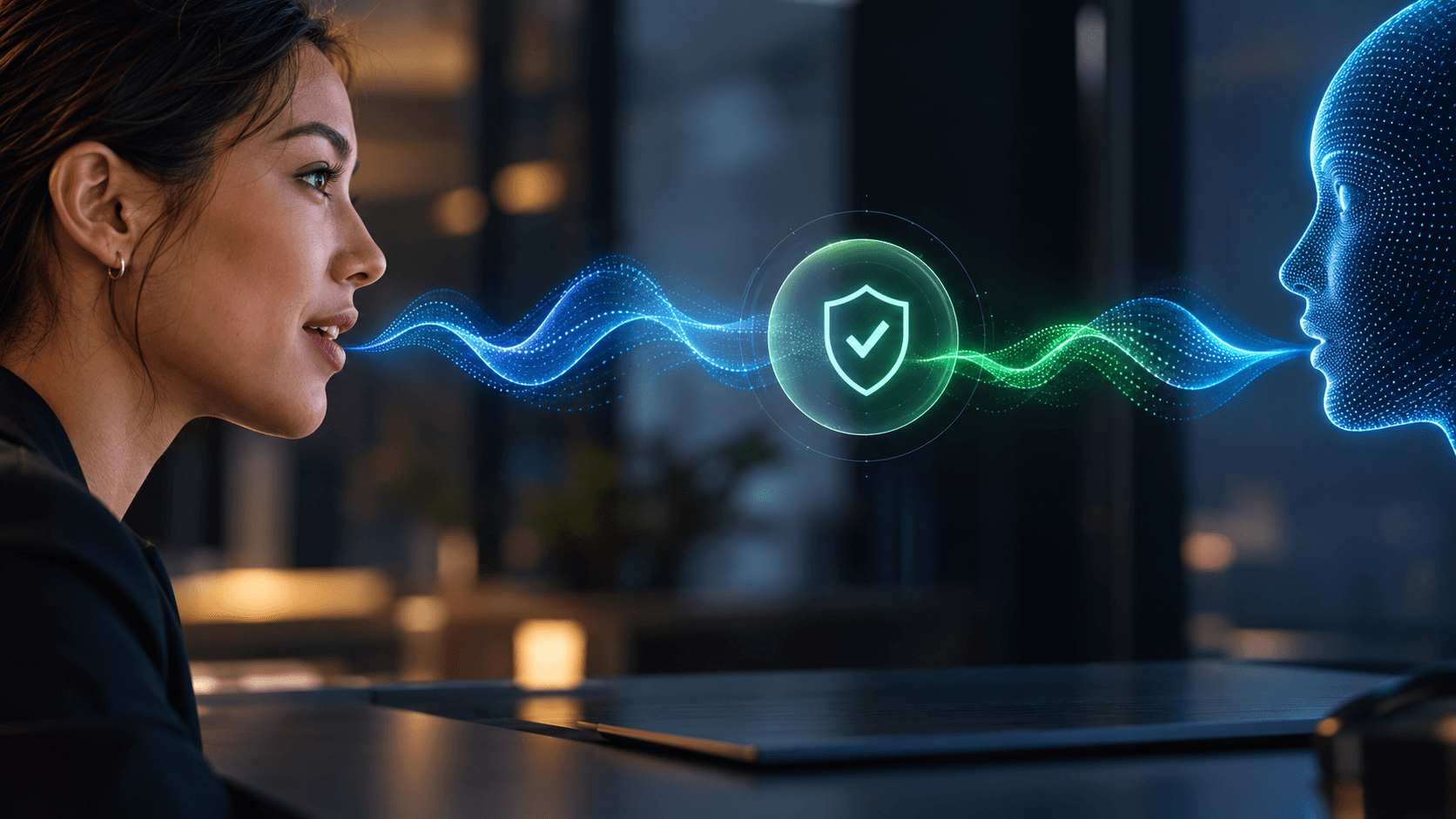
Two patent-scarce layers will decide who captures the enterprise voice stack: real-time consent telemetry and deterministic sub-300ms speech.
Enterprise voice is moving from record and review later to act now. The winners will own the layers that turn live speech into decisions in milliseconds, and prove the whole thing was compliant while doing it.
Market shift: two hard problems decide the stack
Operational voice streams, meaning radio, push-to-talk, and dispatch, are converging with contact center telephony and synthetic speech. As AI moves from text into voice, two problems separate the companies that will capture this market from the ones that will rent it.
Latency: natural speech-to-speech under roughly 300 milliseconds, held consistently, across networks nobody controls.
Consent: real-time telemetry for AI-generated voice, so disclosures, consent state, and audit trails are provable end to end.
Neither is a model problem. Both are systems problems: orchestration, latency control, and compliance telemetry. That distinction matters, because the model layer is the one with the most capital chasing it and the least room left to differentiate.
Evidence: the filings have not followed the deployments
Two business-critical subdomains of voice AI remain close to unclaimed, even as products ship and state regulation tightens.
Six and eight. Both counts reflect public records as of 2026, and they come from two separate searches at different geographic scopes rather than two slices of one total.
Those are not small numbers because the market is small. They are small because the industry has been racing on voice quality while the control layers went unprotected.
The well-funded synthesis companies have filed very little. Read the scope line under each name, because these are not like-for-like counts.
The best-known voice names are the thinnest. A category-leading synthesis company shows no filings found at all, and another shows one.
The deepest portfolio is not in these layers. The largest count here is a company total across everything, not a position in consent or latency.
Incumbents concentrate elsewhere. Legacy contact center players hold filings, but clustered in product areas that leave compliance and latency orchestration open.
Three white-space positions
1. A consent telemetry layer for AI voice
A real-time fabric that tracks disclosure, consent state, and audit proof across every synthetic utterance in a call. State laws increasingly require a disclosure when AI voice is in use, and whoever defines this layer effectively writes the compliance standard everyone else implements.
Build: a consent SDK and call-stack middleware carrying machine-readable consent tokens, audible and visual disclosures, re-disclosure triggers, and cryptographic receipts.
Protect: tokenizing consent at the utterance level, handshake protocols between PBX, session border controller, and the AI, consent-aware buffering and redaction, and call-graph watermarking.
2. Deterministic latency control for speech-to-speech
A quality-of-service orchestrator that holds speech-to-speech under roughly 300 milliseconds using adaptive model selection, streaming synthesis, and jitter-tolerant buffering. Past that threshold, dialogue stops feeling like dialogue.
Build: a latency controller that negotiates codec and bitrate, picks synthesis paths from live network conditions, and degrades without an audible seam.
Protect: token-level streaming policies, frame-aligned vocoder switching, latency-aware turn-taking, and predictive buffering tied to agent and IVR state.
3. Cross-channel operational voice correlation
Unify radio and push-to-talk, dispatch, cameras and drones, and telephony into live multi-source context that triggers guided action. This bridges two stacks that have historically had nothing to do with each other.
Build: a routing layer that maps entities, intents, and incidents across channels, aligns timestamps, and drives tickets, escalations, and safety protocols.
Protect: graph alignment of utterances to sensor events, confidence-weighted action triggers, multi-channel de-duplication, and incident-centric state machines.
Product implications
Consent telemetry SDK: drop-in libraries for carriers and contact center platforms, with real-time consent tracking, proof generation, and a dashboard compliance teams actually use.
Latency orchestrator: a control plane that negotiates models, codecs, and buffering per call, with service level objectives for both response time and naturalness.
Voice intelligence router: one event graph spanning radio and telephony, driving policy-based actions into CRM, ITSM, and incident systems.
Proof-of-action trails: audit artifacts cryptographically binding utterances to decisions and outcomes, which is the price of entry in regulated environments.
In voice AI, defensibility comes from the controller rather than the model. Capture the orchestration layers and you set the rules everyone else has to play by.
IP implications
Telemetry schemas: utterance-level consent tokens, state transitions, cross-system propagation, and revocation and redaction mechanisms.
Latency governance: token streaming policies, adaptive vocoder and codec switching, predictive buffering, and turn-taking arbitration driven by conversational cues.
Correlation logic: alignment of multi-modal events, entity synchronization across channels, de-duplication heuristics, and incident-graph workflows.
Auditable watermarks: binding synthetic segments to traceable receipts, and watermarking that survives compressed voice paths.
These claims protect the system behaviors that make real-time voice both compliant and natural, which is exactly where competitors will converge next.
The bigger trend: control layers repeat across markets
The pattern is wider than voice. As AI moves into real-time systems, durable advantage shifts to the orchestration and governance layers that bind models to business outcomes.
Interfaces: sub-second turn-taking for voice, AR prompts, and autonomous agents.
Workflow layers: policy engines mapping AI events to actions, approvals, and audit trails.
Data architectures: event graphs linking sensor streams, human input, and model output.
Automation systems: latency and quality-of-service control planes for robotics, industrial IoT, and autonomous dispatch.
AI applications: consent and traceability stacks for synthetic media, personalization, and agentic operations.
In each one there is a narrow window where the critical control logic is under-patented relative to how much it matters. Teams that capture those layers early shape standards, build licensing leverage, and compress how much room competitors have left to differentiate.
CEO take
Voice AI is consolidating around two control points, and the patent counts in both are still in single digits precisely where the enterprise value will concentrate. Clear market need, regulatory urgency, and sparse filings rarely coincide for long.
If the roadmap touches live voice, contact centers, or radio and push-to-talk, establish claim priority now rather than next quarter.
Harvest the mechanisms already built into the product, especially around buffering, fallback, and anything that records who consented to what.
Lock product strategy and IP strategy together at the orchestration layer, because that is the only place the two reinforce each other here.
Where is the white space in your voice stack?
If you are building in live voice, the mechanisms worth protecting are probably already in your codebase. The question is whether anyone has written them down as inventions.
Which roadmap concepts contain invention-grade mechanisms for consent telemetry or latency control?
What strategic positions could a competitor claim first if you wait a quarter?
How fast could you credibly occupy the layer you care about most?
How do you bind product execution to a defensible position before the market crowds in?
This is not a model race. It is a race for the controller.Talk with ipCapital Group about invention harvesting and strategic filing around the voice orchestration layer.
Share
Work with ipCapital Group
Turn insight into IP strategy
From invention to monetization, our team has guided 2,000+ engagements across the full IP lifecycle. Start with a free 30-minute discovery call.