
By: Seth Cronin and Michael D’Andrea Companies should consider internal policies or training programs to ensure that inventors know how to maintain their status when using AI. For Patent Attorneys and Agents Patent professionals are increasingly using AI to draft applications, conduct prior art searches, or generate claims. This offers efficiency, and attorneys …
By: Seth Cronin and Michael D’Andrea
This paper outlines practical guidelines to ensure that human inventorship remains clear and defensible when using AI-assisted patent drafting. As AI tools become more common in generating technical content, it is important that human inventors keep a documented, hands-on role in every stage of the process. The key takeaways include:
These practices help create a paper trail that meets current legal requirements and reinforces the role of human creativity in the innovation process.
Artificial intelligence (AI, and particularly generative AI, like large language models) has become a powerful force in patent drafting, rapidly proposing solutions, writing claim language, and even suggesting alternative embodiments. Yet as AI’s role expands, so does controversy around “inventorship.” Can an invention driven or heavily shaped by AI still legitimately name a human inventor?
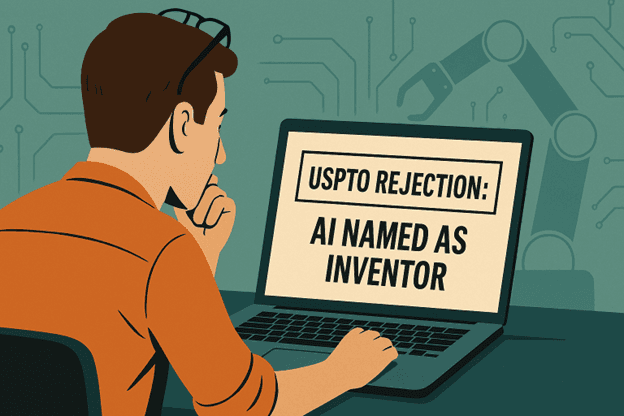
Recent disputes (most notably around Stephen Thaler’s AI system DABUS) highlight that patent offices worldwide generally only recognize humans as inventors. The challenge is making sure the human’s inventorship contributions are clear and unequivocal, even when AI provides extraordinary (or near‑magical) capabilities.
The industry once debated whether AI could outright be named as an inventor. For now, major patent jurisdictions have ruled no: “inventor” remains, by law, a natural person. The stickier question is how to properly maintain human inventorship when relying on AI for ideation, research, and drafting. In practice, if humans are simply pressing “Go,” passively rubber‑stamping AI outputs, and claiming no original insights or discretionary decision‑making, they risk losing inventorship.
Patent offices around the world consistently define inventorship as a role that must be filled by a natural person. This legal principle is based on the understanding that genuine innovation results from human creativity, judgment, and accountability. For example, the U.S. Patent and Trademark Office (USPTO) and the European Patent Office (EPO) maintain that, despite AI’s impressive ability to generate novel ideas or suggest claim language, only human beings can be named as inventors.[1][2]
The landmark DABUS case, where an AI system created by Stephen Thaler was denied inventorship status, highlights these legal standards in practice. Both the USPTO and EPO have reaffirmed that while AI can serve as a helpful tool for research, ideation, and drafting, the decisive inventive contribution must originate from a human. This means that for any AI-assisted patent drafting process, the human inventor must retain control, exercise sound judgment, and document each step of the inventive process. Maintaining a clear paper trail not only satisfies existing legal requirements but also reinforces the foundational role of human ingenuity in the innovation process.
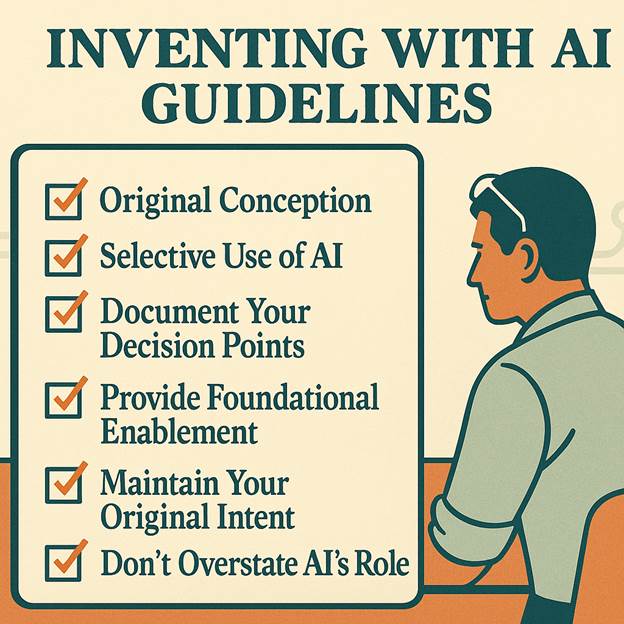
Below are the best practices, drawn from our experience developing hundreds upon hundreds of patent applications, plus our direct experience leveraging AI as a drafting and brainstorming partner. These guidelines help ensure that the human’s unique creative contribution is present and documented.
Patent law requires that an invention be enabled so a person skilled in the art can make and use it. If all of the enabling details come from AI alone, it’s dicey. The human inventor should provide baseline technical insight, working examples, or relevant design details.
AI can then expand, verify, or reorganize, but the seed content and key operational methods must reflect the inventor’s own knowledge. If you are not a domain expert, consider consulting someone who is. Inventors will discuss their problems and propose solutions with other human experts to develop and refine their ideas. You can defend your human inventorship more defensibly by doing primary research than hoping the AI generated content works in practice.
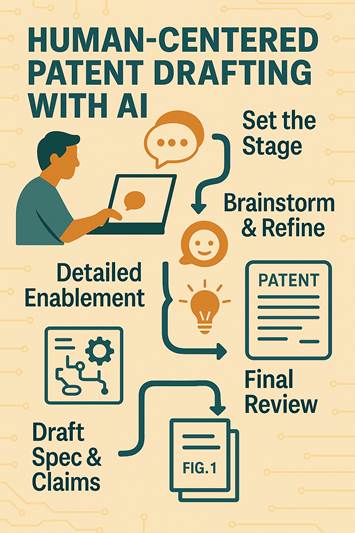
Here’s one practical structure we recommend, which balances AI power with bulletproof human inventorship:
Adhering to these steps isn’t just about passing muster with the patent examiner, though that’s important. It’s about establishing a clear paper trail that cements your status as the true inventor. If you (or your counsel) are ever asked “did you really conceive and enable this invention, or did AI do it?” you’ll have solid evidence in the form of transcripts, selective decisions, and your own documented creative process.
Critics of the human-centered approach to AI-assisted patent drafting might argue that relying on detailed human documentation slows down the process or that AI-generated content is good enough on its own. However, these concerns highlight the importance of keeping a strong human oversight process. Here are some key points to consider:
Challenges of AI-Generated Content:
AI can produce impressive drafts and technical descriptions, but it may also generate errors, include irrelevant data, or lack the nuanced understanding of complex inventions. Relying solely on AI without human review increases the risk of inaccuracies that could jeopardize patent validity or enforceability.
Importance of Human Oversight:
Human inventors provide judgment by evaluating, modifying, or rejecting AI outputs. This oversight ensures technical accuracy and helps keep the inventive concept aligned with the original human idea. Additionally, by documenting decision points through recordings, annotations, and version-controlled documents, the process creates a trail that can be referenced if disputes arise regarding inventorship.
Auditability and Legal Robustness:
A well-documented human oversight process offers transparency and accountability. If questions about the genuineness of the inventive contribution come up, the documented trail of enablement sessions, decision logs, and final revisions provides evidence of human involvement. This not only strengthens the legal standing of the patent but also builds trust among stakeholders and regulatory bodies.
At ipCapital Group, we’ve worked on thousands of invention disclosures over the past two decades and have explored nearly every way to scale the patent application drafting process. Traditional methods include hiring and training in-house writers, building a bench of independent contractors, and outsourcing to partner law firms. While effective to an extent, each approach has limitations such as cost, turnaround time, and quality control among them.
More recently, generative AI tools have allowed us to experiment with a different approach: automating key portions of patent drafting. When given well-structured prompts and source material, these tools can generate dozens of full-length draft applications in minutes, work that might otherwise take weeks. Each draft’s quality still depends on the clarity of the input and oversight by a human inventor or practitioner, but the productivity gains are significant. This has allowed us to create scalable workflows where AI serves as the drafting engine, but humans remain firmly in control of the inventive and strategic aspects.
This mirrors broader industry experimentation with AI. In one of the most prominent examples, Dr. Stephen Thaler submitted patent applications naming his AI system, DABUS, as the sole inventor. The applications were rejected by the USPTO and EPO on the grounds that inventorship must be attributed to a natural person. These cases reaffirm that while AI may assist in ideation or drafting, legal inventorship requires a human’s creative input and judgment.[3] [4]
Interestingly, South Africa became the first country to grant a patent listing DABUS as the inventor. However, this was largely procedural, as South Africa’s IP system does not substantively examine patent applications, which shows the global inconsistency around AI inventorship.
The UK Intellectual Property Office (IPO) further explored this issue in its public consultation and 2022 policy statement. While many respondents noted the growing use of AI in drafting and innovation support, the report concluded that human oversight and intellectual contribution are necessary for maintaining inventorship.[5]
In parallel, WIPO’s 2019 Technology Trends Report documented how AI tools were already transforming patent workflows, including prior art search and specification drafting. But even then, the message was clear: AI’s outputs must be steered and interpreted by humans to meet the legal standards of inventive contribution.[6]
These real-world cases and policy positions emphasize the need for designing human-centered workflows. Whether in internal practice or in broader patent law, AI can scale output but human insight must stay at the center of inventorship.
AI is here to stay, and today is the worst these tools will ever be. The integration of AI into the patent process is not a passing trend; it represents a foundational shift in how intellectual property is conceived, developed, and documented. While current legal frameworks still require a human inventor, the role of that inventor is evolving: no longer the sole author of every sentence, but rather the director of increasingly powerful tools.
Ensuring that inventorship remains valid and defensible in this new era requires action, discipline, and guidance.
AI tools can dramatically accelerate the pace and volume of invention disclosures. But speed must not come at the cost of losing inventorship. Inventors and R&D teams should:
Companies should consider internal policies or training programs to ensure that inventors know how to maintain their status when using AI.
Patent professionals are increasingly using AI to draft applications, conduct prior art searches, or generate claims. This offers efficiency, and attorneys must also:
Attorneys should also consider updating intake processes and invention disclosure forms to prompt clients for specific information about their use of AI.
Patent offices have taken the important first step of rejecting non-human inventors. But more guidance is needed to help inventors and practitioners navigate this evolving terrain. Regulatory bodies like the USPTO and EPO should:
As AI tools become more powerful and accessible, the standards for documenting human inventorship will increase. Companies and law firms should view this not just as a legal requirement but as a strategic advantage: those who adopt disciplined, auditable workflows will not only preserve their patent rights, they’ll move faster and with more confidence in a landscape that rewards both innovation and integrity.
The future of invention isn’t AI versus humans; it’s humans using AI in smart and clear ways. The question of who invents doesn’t go away with AI. If anything, it becomes more important and more worth getting right.
For more information on innovation and the impact of AI, check out our podcast series, Invent Anything.
[1] U.S. Patent and Trademark Office, Manual of Patent Examining Procedure (MPEP) – Inventorship requirements emphasize that inventors must be natural persons.
[2] European Patent Office Guidelines – Official EPO documentation affirms that only human contributions qualify for inventorship.
[3] U.S. Patent and Trademark Office, Decision on Petition in Application No. 16/524,350 (2020). https://www.uspto.gov/sites/default/files/documents/16524350_22apr2020.pdf
[4] IPWatchdog, AI Inventors? European Patent Office Affirms Rejection of DABUS Patent, Sept. 2021. https://ipwatchdog.com/2021/09/02/ai-inventors-european-patent-office-affirms-rejection-dabus-patent/id=136543/
[5] UK Intellectual Property Office, Artificial Intelligence and Intellectual Property: Policy Statement, June 2022. https://www.gov.uk/government/publications/artificial-intelligence-and-intellectual-property-policy-statement
[6] WIPO, Technology Trends 2019 – Artificial Intelligence. https://www.wipo.int/tech_trends/en/artificial_intelligence/
Work with ipCapital Group
From invention to monetization, our team has guided 2,000+ engagements across the full IP lifecycle. Start with a free 30-minute discovery call.
Written by
ipCapital Group