
In the rapidly changing world of technological advancements, ChatGPT-type technologies emerge as a remarkable innovation. Powered by artificial intelligence, these language models have demonstrated their prowess in automating tasks and producing human-like text. However, concerns have arisen among patent counsels and inventors alike with their widespread adoption.
[vc_row][vc_column][vc_column_text]
By: John Cronin
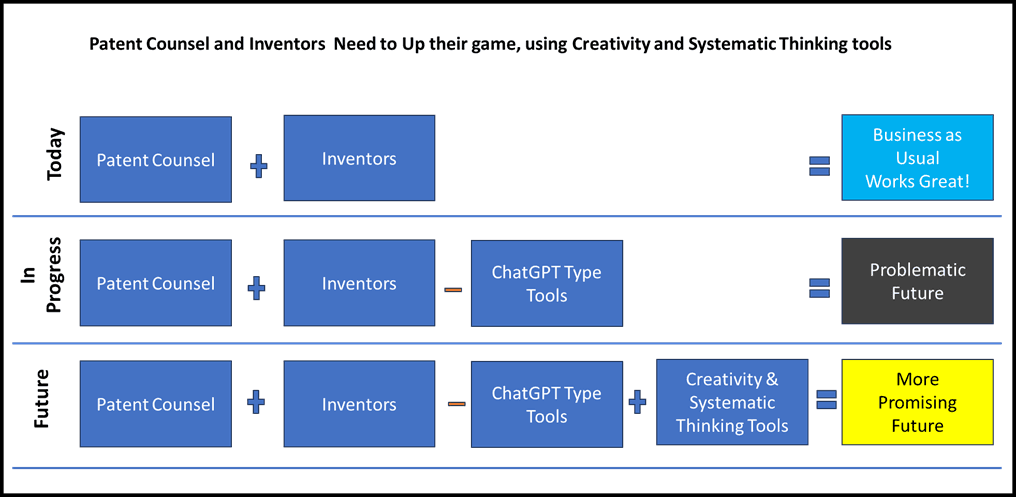
In the rapidly changing world of technological advancements, ChatGPT-type technologies emerge as a remarkable innovation. Powered by artificial intelligence, these language models have demonstrated their prowess in automating tasks and producing human-like text. However, concerns have arisen among patent counsels and inventors alike with their widespread adoption. Patent counsels entrusted with sound thinking practices safeguarding intellectual property now adapt to an era where automation has replaced many traditional duties. Simultaneously, inventors who rely on creativity to conceive groundbreaking ideas navigate a landscape where even idea generation is becoming automated. To navigate this transformative terrain, both patent counsels and inventors must embrace creativity and systematic thinking tools, elevating their skills to remain indispensable in the face of ChatGPT technologies. This is no different that Bank Tellers upper their game. Bank tellers were often retrained to take on more complex tasks, such as assisting customers with more advanced financial services, promoting banking products, or focusing on customer relationship management.
The broader impact of automation on employment in various sectors is a subject of ongoing debate and research. While automation may displace certain jobs, it can also create new roles, increase productivity, and lead to overall economic growth. The extent to which automation affects employment depends on the specific context, the pace of technological advancement, and how society and businesses adapt to these changes.
ChatGPT-type technologies have slowly started to impacted patent counsels by automating and replacing many of the services they previously offered. Tasks like prior art searches, patent drafting, and even legal analysis of patents can now be performed with remarkable speed and accuracy using AI-powered tools. While this early automation starts to streamline processes and enhances efficiency, it also means that patent counsels must redefine their roles to remain valuable to their clients, so as Chat-GPT like technologies do no make patent counsels less relevant. Patent counsel may start to focus on higher-level tasks that require human judgment, such as , patent prosecution, more creative thinking for invention development and more systematic thinking to patent more strategically. By harnessing both creative thinking tools and systematic thinking tools, patent counsels can identify new areas for IP protection, identify new ways to overcome legal challenges, and offer tailor-made solutions that set them apart from Chat-GPT like automated services.
ChatGPT-type technologies have opened new avenues of automated idea development and enablement for inventors. These AI systems can assist inventors in brainstorming, providing valuable insights and information to support their creative processes. However, this also means inventors must up their game and leverage these tools effectively to stay competitive. Rather than seeing AI as a threat, inventors can embrace it as a powerful ally in their inventive journey. By combining their inventive thinking with AI-generated insights, inventors can refine their ideas, identify unique selling points, and create more robust patent applications. Additionally, inventors can use systematic thinking approaches to analyze market trends, anticipate consumer needs, and align their inventions with commercial opportunities, ultimately increasing the chances of success in an increasingly competitive landscape.
In this paper we will provide many areas that both patent counsel and inventors can up their game, using creative thinking and systematic thinking tools. Each of these areas has much more detail in the specific tools and examples to use (if you follow the links). These areas are (1) harnessing these tools in training and in real life applications, (2) supercharging patent prosecution with inventors, (3) overcoming prior art, (4) filing the IP white space, (5) forward patenting, (6) patent continuations, and Master Disclosure techniques.
“Creativity tools” refers to strategies and procedures that encourage innovative thinking. These tools act as catalysts, allowing patent counsels and inventors to develop unique ideas and inventions. They make it possible to explore uncharted territories in a structured manner, which increases the likelihood of producing valuable intellectual property.
One example of a creativity tool is associative thinking, where patent counsels and inventors gather to generate a wide range of ideas. Encouraging open and accessible associations allows participants to explore different angles and perspectives, leading to innovative solutions and inventions. During these sessions, they can use techniques like “lions-den” or “visually identifying relationships” to structure their thoughts and uncover new possibilities.
Systematic thinking tools provide a structured approach to problem-solving by organizing information, exploring alternatives, and facilitating informed decision-making. These tools guide inventors in analyzing complex problems and identifying potential solutions. One example of a systematic thinking tool is the morphological matrix, which breaks down a problem into its constituent elements and explores various combinations to generate novel ideas.
[1]Despite working closely with inventive individuals, patent counsel often lacks formal training in creative thinking. However, by embracing tools for creative thinking, they can better understand the “voice of the inventor” and strengthen patent claims by uncovering arguments for non-obviousness. Understanding the inventive thought process enables patent counsel to gain valuable insights, identify creativity tools used by inventors, and facilitate productive brainstorming sessions, resulting in more robust patent applications. Equipped with creative thinking tools, patent counsel can propose inventive workarounds, craft compelling responses to patent examiners, and demonstrate the innovation of inventions beyond existing knowledge. Incorporating creative thinking empowers inventors and the patent process, fostering a culture of innovation within companies and positioning patent counsel as valuable partners and advisors for inventors and businesses. By bridging the gap between legal expertise and inventors’ creative minds, creative thinking revolutionizes the patenting process, navigating complexities, advocating for innovative ideas, and ensuring the adequate protection of intellectual property.
[1] https://www.ipcg.com/unleashing-inventive-potential-how-patent-counsel-can-harness-creative-thinking-and-tools-to-empower-inventors-and-strengthen-the-patent-process/
[2]The concept of “Quality through Quantity” emphasizes how patent counsels can leverage the power of “Structured Creativity Tools Based Brainstorming” to improve the quality of inventions they file. By exploring many ideas, patent counsels stimulate creativity and uncover groundbreaking concepts that may have been missed during more limited inventor interviews. Expanding patent specifications with new ideas bolsters the coverage and protection of inventive concepts while drafting multiple dependent claims strengthens the patent portfolio by offering alternative embodiments. Additionally, this approach enables multi-dimensional enablement, ensuring that patent specifications adequately support the core concepts. Moreover, the method facilitates broader prior art searches, helping patent counsels identify existing technologies that may impact novelty and non-obviousness. It also aids in determining inventorship, resolving potential disputes, and ensuring proper recognition. Patent counsels can preserve valuable trade secrets by strategically excluding certain aspects, maintaining a competitive advantage. Embracing “Structured Creativity Tools Based Brainstorming” allows patent counsels to prioritize their patenting efforts strategically, group ideas, and differentiate between patentable and publishable concepts. Moreover, it creates a long-term docket enhancement, serving as a valuable resource for future invention evaluation and facilitating ongoing organizational innovation.
[2] https://www.ipcg.com/unleashing-the-power-of-structured-creativity-tools-based-brainstorming-10-ways-to-supercharge-patent-counsels-patenting-results/
[3]Prior art poses a challenge to inventors seeking patent protection for their inventions. Creativity and systematic inventing tools can help overcome barriers presented by prior art.
Prior art is existing knowledge or public disclosure predating the patented invention. Overcoming prior art involves differentiating the new invention from existing knowledge.
[3] https://www.ipcg.com/how-to-overcome-prior-art-with-creativity-tools/
[4] https://www.ipcg.com/patent-counsels-and-inventors-can-use-creativity-tools-to-direct-invention-for-filling-the-ip-white-space/
[5]Patent counsels and inventors are essential members of the team that assists companies and individuals in navigating the process of obtaining patents. Throughout history, their primary concern has been ascertaining whether proposed inventions satisfy the prerequisites for receiving a patent. However, patent counsels and inventors can go beyond obtaining a patent by incorporating creativity tools to obtain more “Forward patents” as well.
[5] https://www.ipcg.com/patent-counsels-and-inventors-could-use-creativity-tools-to-direct-invention-for-forward-patents/
[6] Patent counsels play an essential part in the ever-evolving world of intellectual property by ensuring the inventive process is protected and directing it in the right direction. Their expertise extends beyond legal matters in shaping and refining patent specifications in collaboration with inventors. This article investigates the potential advantages of using “creativity tools” and “master disclosures” to direct invention for patent continuations, aiming to improve the quality and scope of patents.
[6] https://www.ipcg.com/unlocking-inventive-possibilities-how-patent-counsels-leverage-creativity-tools-and-master-disclosure-for-patent-continuations/
ChatGPT-type technologies have undoubtedly revolutionized the landscape of intellectual property and invention. For patent counsels, embracing creativity and systematic thinking tools is vital to remain valuable in this new era where many tasks are automated. By focusing on higher-level tasks that demand human judgment and expertise, patent counsels can set themselves apart from AI-powered tools and offer tailor-made solutions to their clients. On the other hand, inventors can harness the power of AI as an ally in their inventive journey, combining innovative thinking with AI-generated insights to refine ideas and create more robust patent applications. By embracing creativity and systematic thinking, inventors can analyze market trends, anticipate consumer needs, and align their inventions with commercial opportunities, ensuring success in a competitive landscape.
As technology advances, integrating creativity and systematic thinking tools will play an increasingly crucial role in navigating the complexities of intellectual property and fostering a culture of innovation. For patent counsels and inventors alike, mastering these tools will improve the quality and scope of patents and unlock new inventive possibilities and secure their positions in an ever-changing world of invention and intellectual property. By strategically leveraging creativity and systematic thinking tools, patent counsels and inventors can supercharge their patenting results, overcome prior art challenges, fill the IP white space, and direct inventions toward securing valuable forward patents that shape the future of technology. As we move into an era dominated by AI and technological advancements, the collaboration between human ingenuity and AI-powered tools will be the key to staying ahead and thriving in the world of intellectual property.[/vc_column_text][/vc_column][/vc_row]
Work with ipCapital Group
From invention to monetization, our team has guided 2,000+ engagements across the full IP lifecycle. Start with a free 30-minute discovery call.
Written by
ipCapital Group