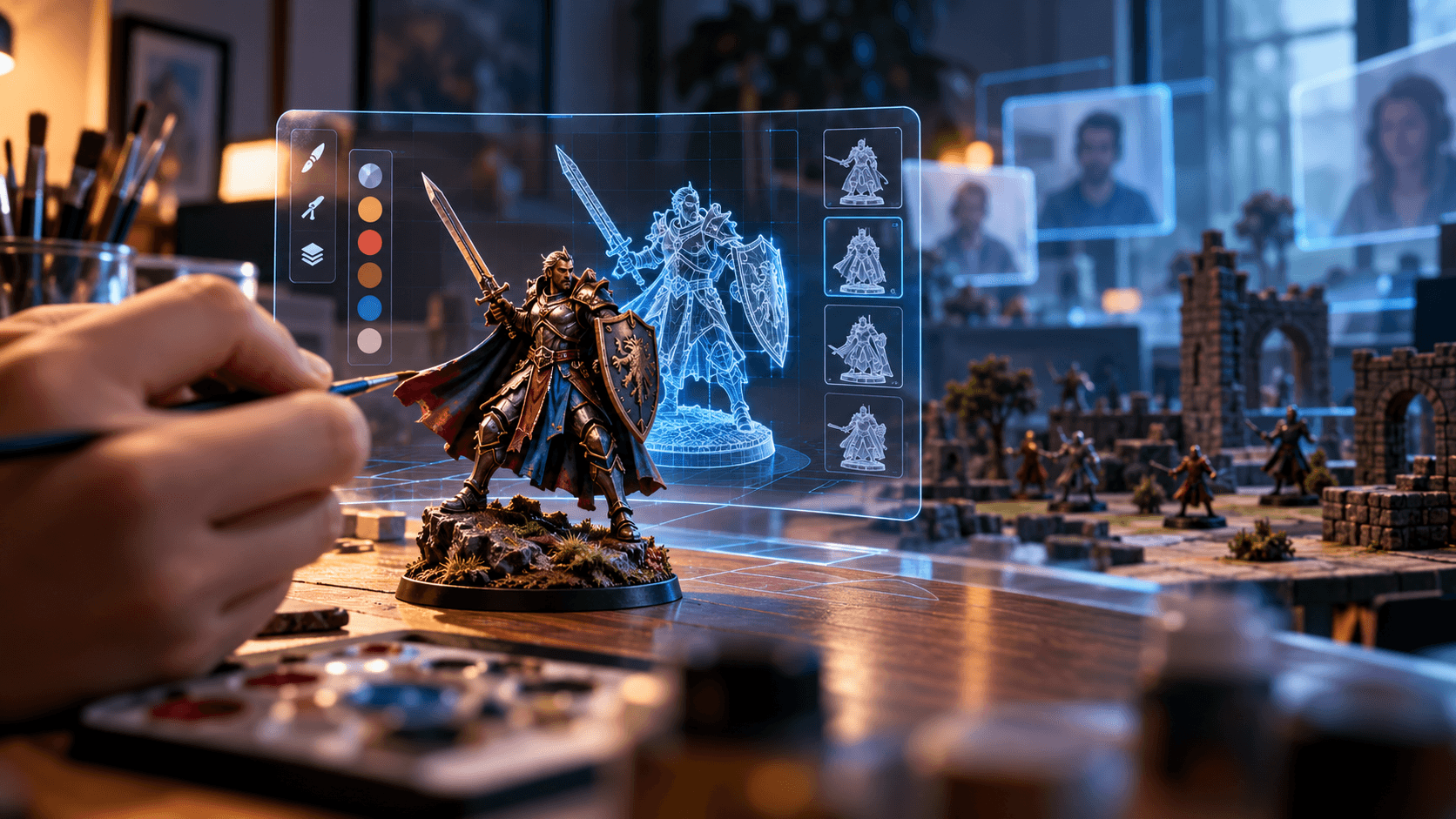
Digital Miniatures: The Moat Is in the Experience Layer
Engines belong to the incumbents. The open ground in digital miniatures is MR painting, tactile physics, and networked tabletop state.
Fortune 500s own the engines. Indies own the experience. The defensible ground is the narrow band between them, and it is still open.
Market shift: the center of gravity is moving up the stack
Core engines and render technology are controlled by platform-scale incumbents. Competing there is a capital contest a new entrant will lose. The open opportunity sits one layer up, in the tactile band where physical miniature aesthetics, material behavior, and networked tabletop workflows meet digital play.
Three forces are converging. Mixed reality is finally usable outside a demo. Digital collectibles have normalized ownership semantics. Miniature gaming keeps expanding as a hobby. Together they create a new premium category: creator-grade digital miniatures and the multiplayer infrastructure that makes them feel real when shared.
Evidence: filings concentrate in collectibles, not in the craft layer
A scan of more than a thousand US patents across VR and MR customization and digital gaming shows the same shape every time. Filing activity is engine-heavy and collectibles-heavy. The digital miniatures intersection is thin.
A digital collectibles leader holds roughly 36 times the filings of the next name in the sample, and three representative studios in tabletop-to-digital show none at all.
The zeros matter more than the leader. Studios shipping real tabletop-to-digital products are building quickly and filing not at all. That gap between what is being invented and what is being protected is the whole opportunity.
Capital signals point the same direction, from both sides of the physical and digital divide.
A platform valuation and a crowdfunding total measure different things, so they are shown separately. Both establish willingness to pay.
The conclusion is an asymmetry, not a prediction. Experience-layer innovation is outpacing experience-layer protection, and that is a timing advantage for whoever moves first.
Opportunity: three defensible experience layers
The prize is not another engine. It is ownable experience and infrastructure, where physics, creation tools, and multiplayer state combine to make a digital miniature feel handmade, persistent, and fair.
1. The tactile digital experience layer
Make digital miniatures behave like painted resin, with weight, wear, chipping, and diorama context.
Build: damage and wear shaders bound to mesh topology, breakpoints for believable destruction, diorama-aware lighting presets.
Why it matters: production value rises without an AAA budget, and the result is a signature feel competitors cannot copy by buying the same engine.
Protect: interaction models linking physics events to material outcomes, mesh and material co-simulation, diorama context mapping.
2. Mixed reality and VR creative tools
Creator-grade miniature painting in headset, with pigment that behaves the way pigment actually behaves.
Build: parametric brush kernels, pigment absorption and bleed on roughness maps, a layered varnish system, handheld and passthrough calibration.
Why it matters: it collapses the gap between crafting and play, which is what drives user-generated content and community retention.
Protect: brush and material solvers, gesture-to-stroke translation, MR anchoring and occlusion on tabletop surfaces.
3. Network-enhanced tabletop
Ruleset-agnostic multiplayer built for turn-based skirmishes, where miniature authenticity and fairness are the product.
Build: deterministic state sync, measurement tools, line-of-sight and fog-of-war kernels, anti-cheat with verifiable move proofs.
Why it matters: it brings the trust of a local table to online play, which is what unlocks competitive modes and leagues.
Product implications: modules that become strategy
Procedural brush engine: physics-informed pigment blending, masks, and edge catching for speed and realism together.
Miniature destruction kit: topology-aware fracture plus wear state that persists across matches.
Tabletop sync stack: turn arbitration, measurement tooling, and impartial line of sight, portable across rulesets.
Device-agnostic MR anchoring: fast calibration on any surface, with passthrough occlusion that respects bases and terrain.
Creator commerce hooks: provenance for painted variants, and matchmaking that respects cosmetic state.
Each of these is a product and a moat at the same time. Shippable now, licensable later.
IP implications: protect the experience, not just the code
Claim chains around cause and effect between player action, material physics, and persisted appearance.
Gesture-to-stroke translation in MR that binds hand motion to pigment deposition through material-aware kernels.
Deterministic multiplayer mechanisms for measurement and line of sight that preserve fairness without over-revealing state.
Data formats that encode wear, paint layers, and variant lineage across platforms.
Calibration and anchoring sequences for mixed-reality tabletops under variable lighting and surfaces.
File forward. Protect where the experience is heading, not only what shipped last sprint.
Timing: the window before convergence
Incumbents are focused on engines, platforms, and advertising technology, not on the rules, physics, and craft of miniatures.
Collectors and hobbyists have already signaled they will pay for authenticity and customization.
Representative studios in this niche show no filings, so first movers can anchor claims that later become the licensing standard.
This is a familiar strategic asymmetry. The most valuable experiences are nascent and the field is clear enough to define them.
The bigger trend: the seam between platforms and workflows
What is happening in digital miniatures echoes across industries. The most defensible layer is usually the workflow-specific experience that platform companies overlook because it is too small for them and too specific to generalize.
Industrial twins: AR work instructions tied to material states and safety envelopes.
3D commerce: configuration tools with photoreal wear, tear, and provenance.
Robotics simulation: physics kernels that reflect domain-specific constraints.
Creative tooling: gesture engines that translate intent into material-aware outcomes.
AI and user-generated content: model-assisted authoring with rules-safe multiplayer integration.
In every one of these there are invention-worthy seams between the core platform and the real-world workflow. Mine them, name them, protect them.
CEO take: turn product into position
Map the experience layer and find where physics, craft, and fairness define how your product feels.
Modularize by packaging brush engines, damage kits, and tabletop sync into components you could license.
File forward by codifying inventions at the roadmap stage rather than after launch.
Anchor standards by defining the protocols for measurement, line of sight, and wear persistence that others will adopt.
Align go-to-market with IP so protection unlocks partnerships, publishing deals, and non-dilutive revenue.
Let us map your hidden ground
If you are building in digital miniatures, MR creation tools, or networked tabletop, this is the moment to lock in the advantage. The best conversations start with questions like these.
Where is the hidden white space in our technology?
Which roadmap concepts already contain protectable inventions?
Which strategic positions could a competitor occupy first?
What should we capture before the category crowds?
Where can product strategy and IP strategy reinforce one another?
The engine is settled. The craft on top of it is not.Talk with ipCapital Group about invention harvesting and strategic filing around the experience layer.
Share
Work with ipCapital Group
Turn insight into IP strategy
From invention to monetization, our team has guided 2,000+ engagements across the full IP lifecycle. Start with a free 30-minute discovery call.