
Calendar and contact data is the richest context layer for personal AI. Patent filings are climbing but the invention white space is still open.
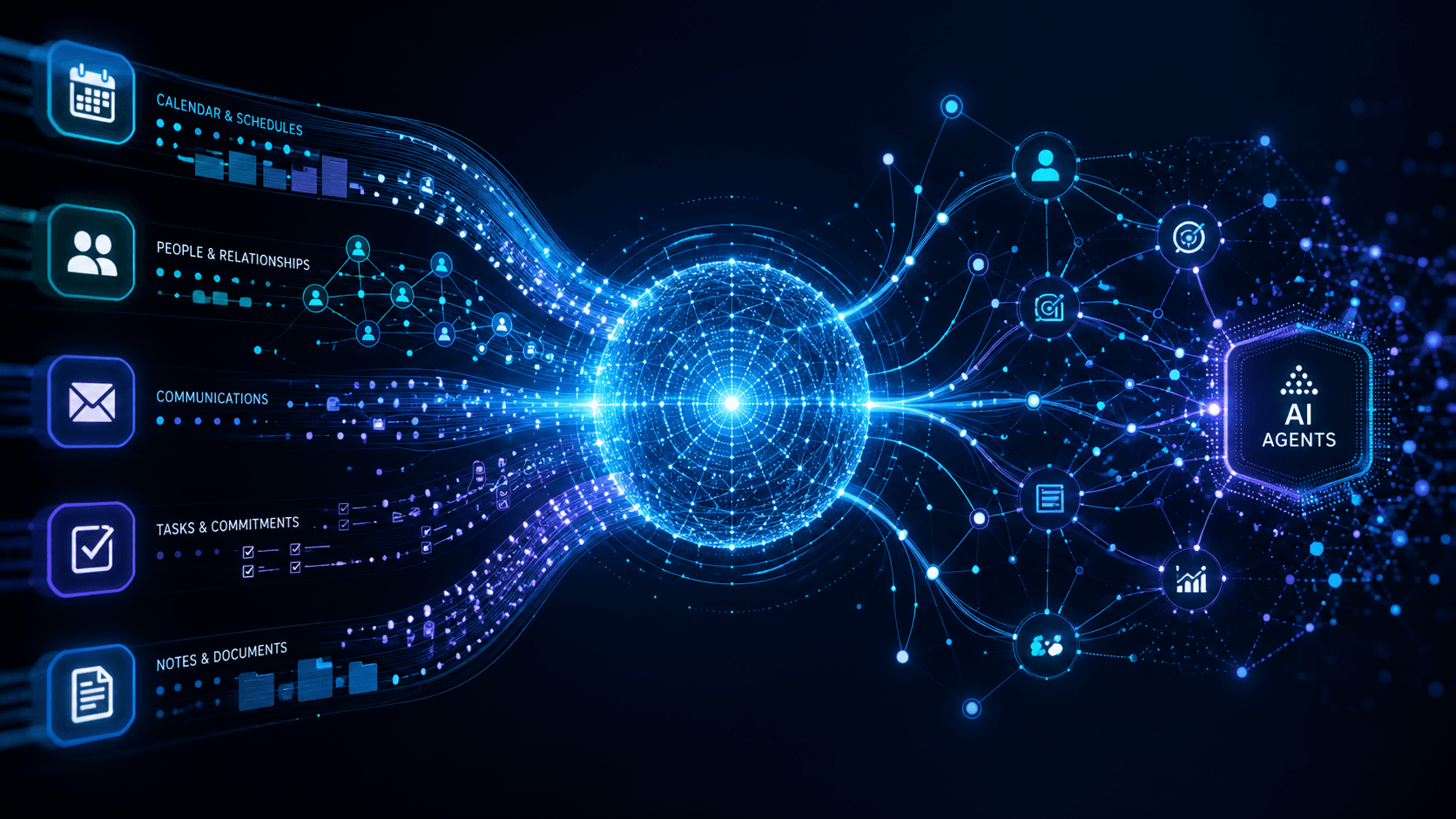
Personal AI keeps being sold as a better chat window. That is too small.
For twenty years, consumer and enterprise software has been sorting the world into searchable piles: pages, people, files, messages, projects, and knowledge bases.
Time never fit neatly into that story. A calendar is not just information. It is a record of priority, obligation, avoidance, trust, urgency, and habit.
That makes calendar and contact intelligence one of the more underrated arenas in AI.
Whoever understands the human context around the work can do more than answer questions; it can decide what should happen next.
Historically, calendars have been passive systems. Users created appointments. The software displayed them. Reminders appeared. The day progressed.
That model is ending. Modern AI systems are beginning to transform calendars from record-keeping tools into decision-support platforms.
The calendar is no longer just documenting what happened. It is increasingly determining what should happen next.
A calendar contains who you meet, when you meet, how frequently you meet, what priorities dominate your time, which relationships matter, which commitments are growing, and which obligations are being ignored. No other productivity application possesses this combination of signals.
The AI calendar and scheduling landscape has already expanded into thousands of patent families, with major platform companies building positions around scheduling, assistants, reminders, natural-language interfaces, and calendar intelligence.
But even with heavy platform-company activity, the space remains fragmented. That fragmentation matters: it means specific, application-level inventions around privacy-first scheduling, relationship intelligence, and cross-calendar conflict arbitration can still become meaningful patent positions.

Large technology companies have already built substantial patent portfolios around calendar and scheduling intelligence. That matters because productivity features are becoming AI-agent features, and AI-agent features are becoming strategic platform territory.
At the same time, portfolio concentration remains low enough that focused innovators can still own narrow but valuable invention zones.

The market is not stabilizing. It is accelerating. Patent filings in this area grew from 244 in 2015 to 388 in 2025, a 59% increase over the decade.
That trend signals a category in transition: calendars are no longer basic productivity utilities. They are becoming AI interfaces, agent endpoints, memory layers, and privacy-sensitive decision systems.
Does your product already read human context? An ipScan invention session with ipCG can turn that scheduling and relationship logic into filed assets.

Most software understands transactions. Very little software understands relationships.
Yet relationships drive almost every important outcome in business: sales, recruiting, partnerships, fundraising, customer retention, and executive leadership.
The better productivity platforms will move beyond task management and into relationship management.
Imagine a system that recognizes important contacts you have not spoken with recently, relationships losing momentum, potential introductions between individuals, strategic connections forming across your network, and communication patterns indicating opportunity or risk.
This is no longer contact management. It is relationship intelligence.
The most interesting opportunity is not simply improving calendar entry. It is building the intelligence layer that connects time, relationships, privacy, and AI agents.

The first wave of AI required sending data to the cloud. The second wave may increasingly happen on-device.
As users become more aware of privacy concerns, organizations are beginning to realize that some of the most valuable AI systems may be those that never transmit sensitive information externally.
Future scheduling systems may predict ideal meeting times, recommend preparation actions, identify scheduling conflicts, surface contextual reminders, and optimize personal productivity without transmitting private data to third-party AI services.
The result is a new category: privacy-first personal intelligence.
Most discussions about AI focus on models. The larger opportunity may be the infrastructure surrounding those models.
Every AI system needs context, memory, prioritization, orchestration, and decision support. Calendars sit at the center of all five.
As AI assistants become more capable, they will require access to schedules, contacts, projects, commitments, and communications. The software platforms controlling those intersections may become foundational infrastructure providers for personal AI.
The same pattern is emerging everywhere: healthcare, financial services, manufacturing, education, legal, insurance, and professional services.
Every industry is moving through the same progression: data becomes context, context becomes intelligence, and intelligence becomes automation.
Calendars happen to sit at one of the richest intersections of context available anywhere in software. That makes them uniquely positioned to become a foundation layer for the AI economy.
Most technology companies believe their value comes from the product users see. Increasingly, the greatest value may come from the intelligence infrastructure hidden beneath the product.
The future winners may not be the companies building larger language models. They may be the companies controlling the contextual layers that make those models useful.
Time. Relationships. Priorities. Intent. These are becoming strategic assets. The platforms capable of understanding them may become some of the most valuable software companies of the coming decade.
Personal AI will need more than answers. It will need understanding.
Understanding requires context. Few systems contain more context than the intersection of time, relationships, commitments, and communication.
The race is no longer about organizing information. The race is about organizing human context.
If your organization is building AI platforms, productivity tools, workflow systems, relationship technologies, or context-aware software, there may be hidden innovation assets already inside your business. The most valuable opportunities are often not the features users see, they are the intelligence layers quietly operating beneath them.
Work with ipCapital Group
From invention to monetization, our team has guided 2,000+ engagements across the full IP lifecycle. Start with a free 30-minute discovery call.

Written by
John Cronin