
Camera-based fitness AI turns the phone into a movement coach. Patent filings grew 84% since 2021 but the application layer is still open.
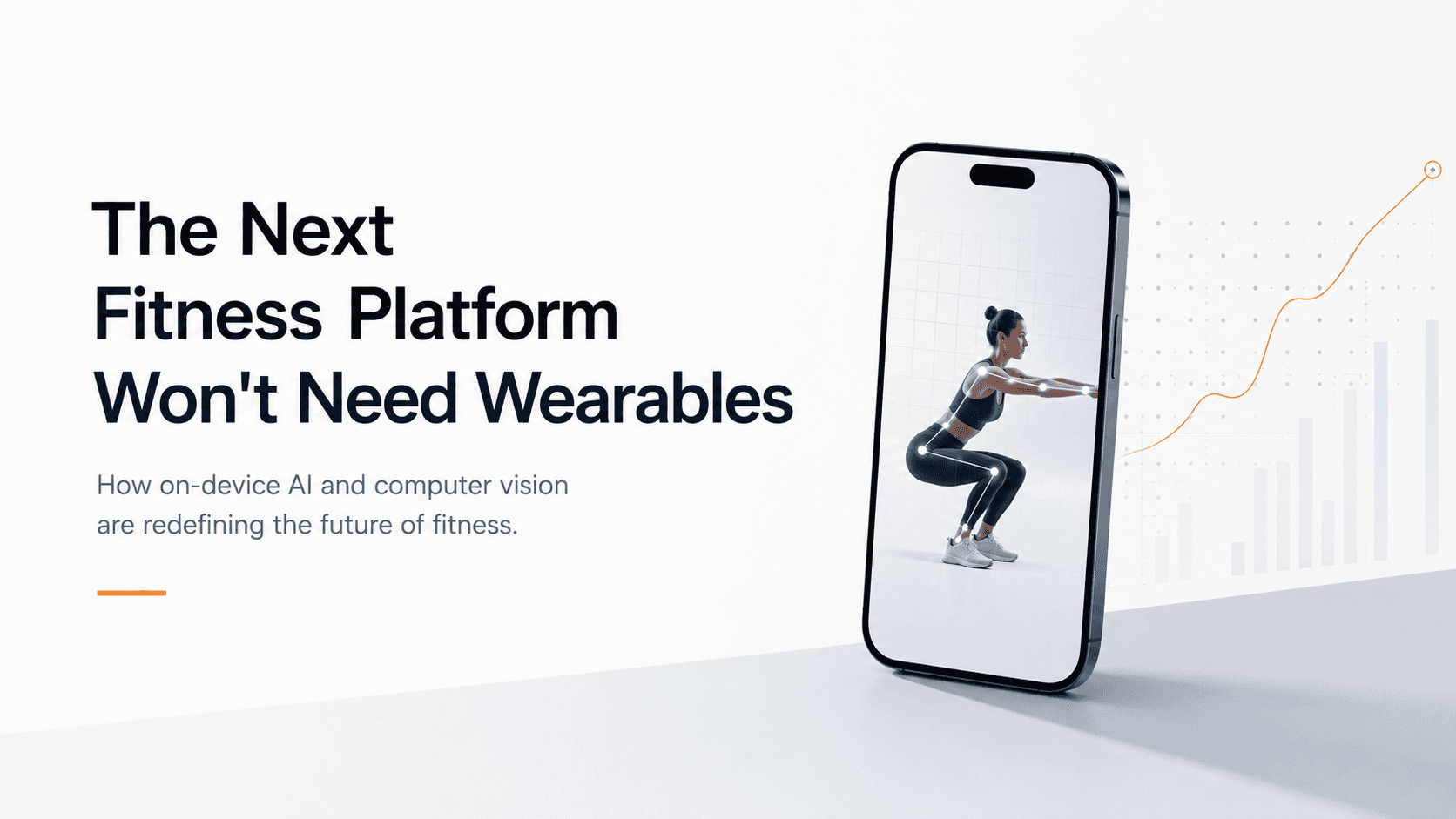
Digital fitness spent years selling straps, screens, bikes, mirrors, and metrics. The least exotic device in the room may now be the most important one.
For years, connected fitness has been defined by hardware: bikes, treadmills, watches, sensors, bands, mirrors, and gym equipment.
That changes the category. A watch can tell you that you worked. A camera, paired with edge AI and pose estimation, can start to judge how you moved.
The camera is becoming the sensor. The phone is becoming the inference engine.
If that works well, the fitness app becomes less like a logbook and more like a coach: counting reps, correcting form, spotting fatigue, and adapting the next exercise without a proprietary machine.
Most fitness products measure activity: steps taken, calories burned, heart rate, distance, pace, and time spent exercising. Those metrics are useful, but they do not answer the more important question: is the person moving well?
Computer vision changes that. Smartphone-based pose estimation can identify body keypoints, track joint angles, count repetitions, score form quality, detect fatigue signals, and guide the next exercise without requiring a wearable or connected machine.
That transition opens a much larger market: consumer fitness, enterprise wellness, remote physiotherapy, senior care, insurance engagement, sports training, and clinical rehabilitation.
Patent activity around pose estimation, exercise analysis, on-device inference, and fitness AI has expanded rapidly. The broader landscape now contains more than 5,000 patent families, and filings grew sharply from 2021 to 2025.
Yet the market remains fragmented. Large technology companies hold defensive positions in pose estimation and mobile AI. Fitness and healthcare companies have filed around adjacent functions such as rep counting and pose model fine-tuning. But the highest-value application layer remains surprisingly open.

Basic pose detection is becoming a commodity layer. Open-source frameworks and large-platform research are making body-keypoint estimation more accessible every year.
The defensible layer sits above the commodity model: personalization, injury-risk scoring, adaptive coaching, clinical workflow integration, and privacy-preserving on-device learning.
That is where new products, new patent families, and new market leaders are likely to emerge.
Coaching movement from an ordinary camera? An ipScan session can map the coaching-loop inventions above the commodity model, or talk to an ipCG strategist first.

The first generation of fitness apps tracked activity. The second generation streamed workouts. The winners will understand movement, personalize guidance, and connect fitness behavior to healthcare outcomes.
This same pattern is appearing across healthcare, sports, elder care, workplace safety, physical therapy, insurance, and education.
Devices are becoming sensors. Sensors are becoming intelligence layers. Intelligence layers are becoming workflows. Workflows are becoming protected platforms.
Fitness may be one of the most visible entry points because the smartphone camera is already everywhere, the behavior is repeated daily, and the economic value of movement data extends far beyond the gym.
Many AI companies believe their value is in the model. Increasingly, the more valuable asset may be the application layer: the workflow, feedback loop, personalization method, data structure, clinical use case, and decision logic that turns a model into a product.
Those assets can support licensing, enterprise sales, health-system partnerships, insurance programs, fundraising, acquisition value, and strategic intellectual property when they are recognized early.
The important fitness and health AI winners may not be defined by who has the best workout library or the most expensive device. They may be defined by who owns the intelligence layer that understands human movement through ordinary cameras.
The opportunity is not merely to count reps. The opportunity is to own the technology layer that turns movement into guidance, risk prevention, personalization, and healthcare-scale value.
If your organization is building AI systems, camera-based tools, health platforms, fitness software, clinical workflows, or market-specific intelligence layers, there may be hidden innovation assets already inside the business. Reach out if you want to discuss where deeper white-space opportunities may be forming in your market.
Work with ipCapital Group
From invention to monetization, our team has guided 2,000+ engagements across the full IP lifecycle. Start with a free 30-minute discovery call.

Written by
John Cronin