
Indoor delivery robots win when the building cooperates. The durable IP sits in fleet orchestration, elevator integration, and compliance logs.
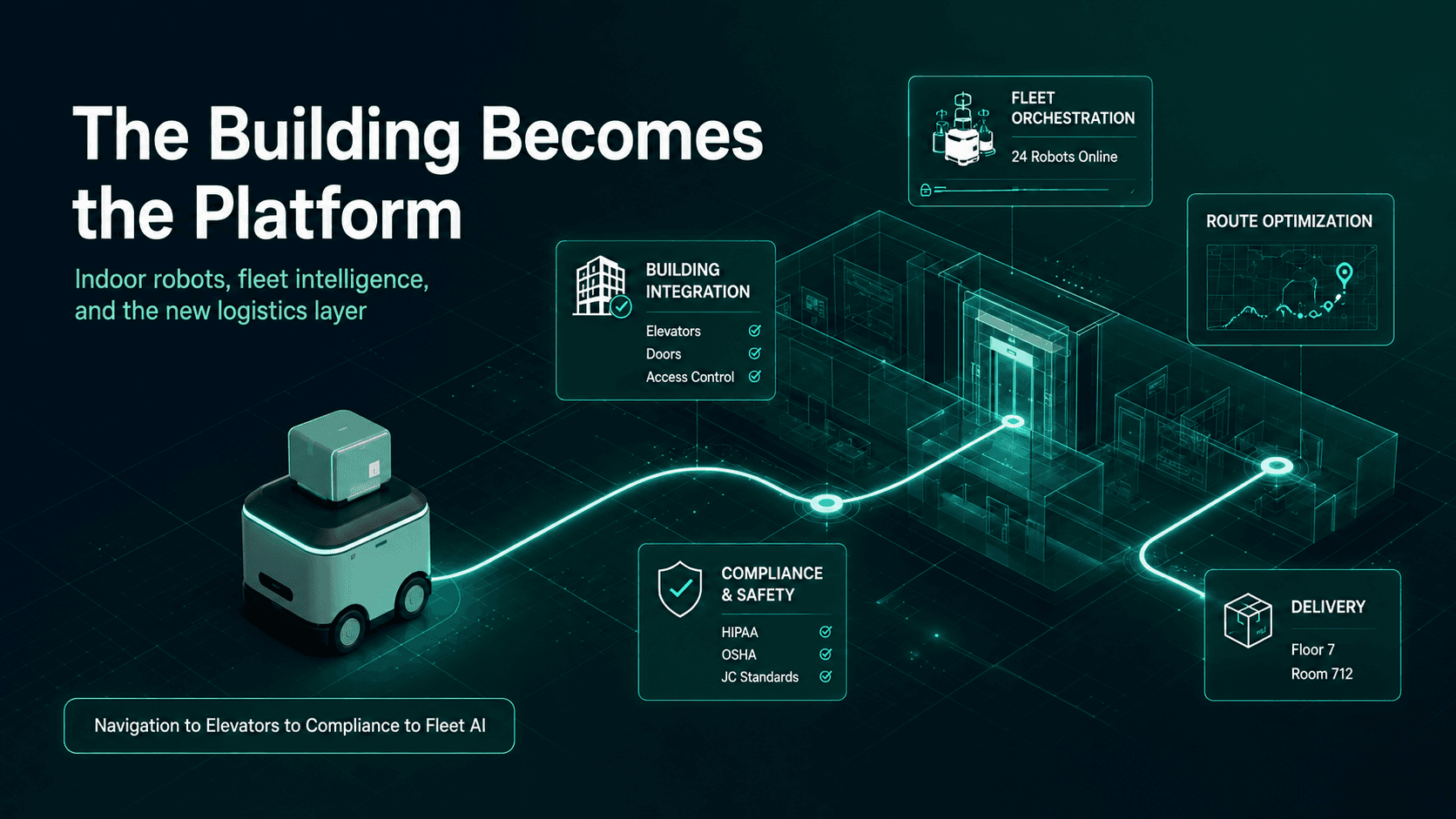
The hard part of indoor delivery is not always the robot.
In hospitals, hotels, airports, campuses, and senior living facilities, the machine has to negotiate with the building: elevators, corridors, locked doors, nursing workflows, service desks, safety rules, and people who did not read the deployment plan.
The visible machine gets the attention. The more durable value may sit in the operating layer that lets fleets work safely and reliably inside complex buildings.
When the building understands the robot, autonomous delivery becomes less of a gadget and more of an enterprise workflow.
That is where the IP opportunity starts to look more interesting.
Early indoor delivery robots proved that autonomous machines could navigate hallways, use elevators, carry supplies, and reduce repetitive labor. That was the first milestone.
The harder milestone is operational: fleet-level intelligence that coordinates multiple robots, understands building conditions, adapts to changing environments, supports healthcare compliance, and integrates with enterprise workflows.
In other words, the future is not simply robots that move. It is buildings that understand, route, authorize, verify, and optimize robotic work.
Indoor robotics is no longer just a hardware problem. In regulated and labor-constrained environments, buyers increasingly care about safety telemetry, chain-of-custody, compliance logs, elevator integration, installation friction, operational uptime, and procurement-grade reliability.
This creates a major white-space opportunity. The companies that own the intelligence layer around indoor autonomous delivery may control a more durable phase of enterprise adoption.

The strongest opportunities sit at the convergence of robotics, building systems, healthcare operations, compliance infrastructure, and AI-native fleet control.

The first generation of companies proved robots could move inside buildings. The serious companies will build the operating systems that coordinate robot work across complex, regulated, multi-floor environments.
Which parts of your robot stack can nobody route around? An ipScan session maps the orchestration and deployment inventions worth protecting, or talk to an ipCG strategist.
This same pattern is appearing in many sectors. Hardware proves the use case. Software scales the system. Data improves the system. Compliance makes the system enterprise-ready. Intellectual property turns the system into a strategic asset.
The visible product may be a robot, a sensor, a device, or a machine. But the long-term value often moves into the invisible layer: orchestration, workflow intelligence, environmental modeling, and operational trust.
Many robotics teams believe their most valuable innovation is the robot. Increasingly, the more valuable assets may be the deployment methods, routing logic, elevator integration, safety telemetry, compliance workflows, fleet orchestration, and building intelligence surrounding the robot.
Those assets can support licensing, enterprise sales, fundraising, defensibility, and acquisition value when they are recognized and protected early.
Robotics winners may not be defined only by the machines they manufacture. They may be defined by the infrastructure they create around those machines.
The opportunity is to own the technology layer that allows autonomous systems to operate safely, intelligently, and compliantly inside real-world buildings.
If your organization is building robotics, AI systems, building automation, logistics workflows, safety telemetry, or market-specific operational software, there may be hidden innovation assets already inside the business. Reach out if you want to discuss where deeper white-space opportunities may be forming in your market.
Work with ipCapital Group
From invention to monetization, our team has guided 2,000+ engagements across the full IP lifecycle. Start with a free 30-minute discovery call.

Written by
John Cronin